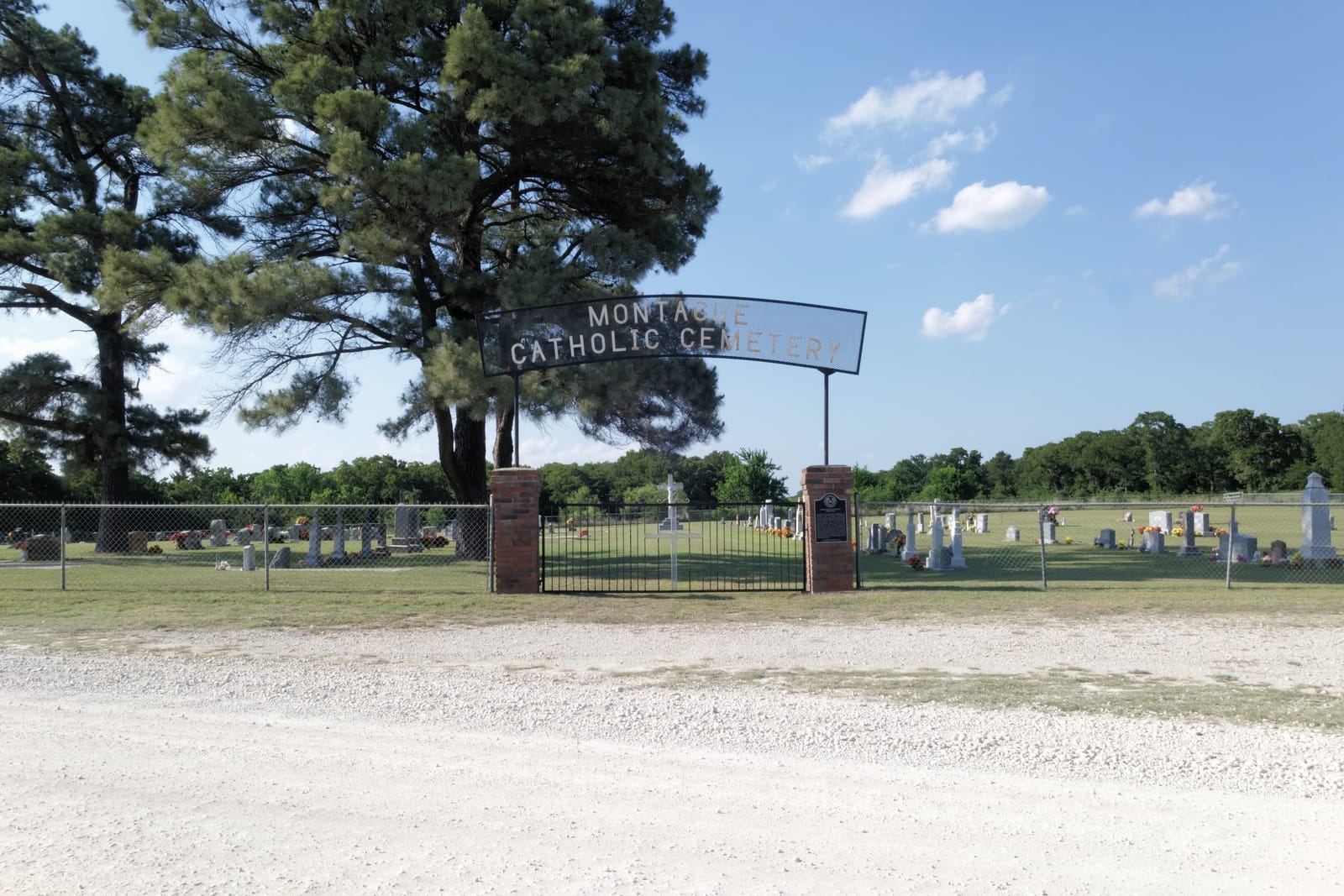
Montague Catholic Cemetery is one of the most historically specific burial grounds in Montague County: a Catholic cemetery established in 1900 for the county’s Italian immigrant community, with a founding story that is unusually well-documented by North Texas rural cemetery standards. The Texas Historical Commission marker erected in 2016 (THC Atlas #montague-03; site id montague-03 in this inventory) provides the documentary foundation for what is known.
The Italian Immigrant Community of Montague
The THC marker inscription records that settlers from mountain provinces of Northern Italy began arriving in Montague in the early 1880s. The earliest documented Italian families named in the marker are the families of Barretto Raimondi, Jack Fenoglio, Antonio Perona, and Charlie Corado. By the early 1900s, as many as fifty Italian families had settled in the Montague area — a concentrated immigrant community in a county whose Anglo Protestant majority had been established for two decades.
Northern Italian immigrants in 19th-century Texas were an uncommon but documented phenomenon. Most clustered near Catholic Church infrastructure, particularly in towns with established diocesan presence. Montague’s Italian community established St. John Catholic Church in 1901, indicating that the community had reached sufficient size and institutional organization to support a parish. The cemetery and the church were co-established: the Most Rev. E.J. Dunne, Bishop of Dallas, purchased three acres for the cemetery on April 28, 1900 — a year before the church was formally organized.
Founding and First Burial
The THC marker is precise: Bishop E.J. Dunne bought the three cemetery acres on April 28, 1900. The first burial was Giroloma Vitali, in 1901. The land purchase preceding the first burial by approximately a year is consistent with institutional cemetery planning — the Diocese of Dallas acquired the ground before the community needed it, anticipating growth and providing infrastructure for the parish then being organized.
The establishment date of 1900 recorded in this spoke refers to the land purchase; the first confirmed burial is 1901. Both dates are drawn directly from the THC marker inscription.
Burial Diversity
The marker inscription notes that “gravestones exhibit Italian heritage as well as families of German, Polish and Hispanic descent.” This diversity within a Catholic-denominated cemetery reflects the composition of Montague County’s Catholic population: Italian immigrants who arrived in the 1880s were joined by Catholics of other backgrounds — German, Polish, and Hispanic — who were also present in the county by the early 20th century, when the railroad and ranching economy attracted workers and settlers from multiple ethnic origins.
The 250+ marked and unmarked graves recorded as of the 2016 marker erection represent a cemetery spanning roughly 115 years of active use (1901–2016) at minimum, with likely ongoing interments.
Relationship to Montague Cemetery
Montague Catholic Cemetery is a distinct burial ground from Montague Cemetery, the county-seat community cemetery approximately a quarter mile away. Montague Cemetery (established 1862, THC marker 1985) served the Anglo Protestant majority of the county seat; Montague Catholic Cemetery served the Catholic community. The master inventory of Montague County cemeteries documents these as separate entries (montague and montague-catholic), noting that the latter “appears to be the same burial ground as Catholic / St. Williams” — an alternate name applied to the same site in some source records.
Researchers should not conflate the two cemeteries. Ancestry lines for Italian Catholic families in Montague County belong in Montague Catholic Cemetery records, not Montague Cemetery.
HTC Designation and 2016 THC Marker
Montague Catholic Cemetery received an Historic Texas Cemetery (HTC) designation from the Texas Historical Commission, with the marker erected in 2016 (THC accession 7337002405 per MCCPC records). The 2016 marker is the most recent cemetery marker erected in the county’s documented inventory — it postdates the Lindale Cemetery marker by 18 years. The marker’s HMDB record (m=118540) contains a photograph and additional context.
What is not yet documented
Despite the THC marker providing more historical detail than most rural Montague County cemeteries, the following remain unconfirmed:
- Complete burial list or indexed burial register
- Current governance or maintenance organization (successor to St. John Catholic Church, if the parish still functions)
- GPS coordinates
- Find A Grave cemetery page ID
- Status of St. John Catholic Church (whether the parish and church structure survive)
The THC Atlas file for #montague-03 and the Diocese of Dallas-Fort Worth archives are the most likely sources for additional founding documentation.
Sources
- Historic Markers of Montague County — Montague Catholic Cemetery (montague-03)
- Montague Cemetery — neighboring county-seat community cemetery
- HMDB — Montague Catholic Cemetery (m=118540)
- Montague County Cemeteries — County Hub
- Montague County Cemetery Preservation Committee
- THC Atlas — Cemetery Search