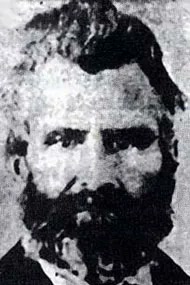
David Crockett Jordan — known as D.C. Jordan throughout his adult life — was the man who made Nocona. Born in the Kentucky hill country in 1842, he came west after the Civil War, drove one of the largest single cattle shipments in north Texas history into Montague County in 1873, accumulated twenty thousand acres of grassland with his partner William Broaddus over the following eight years, and then leveraged every acre into a railroad deal that converted raw pasture into a town. He did not live to see Nocona become the county’s largest city. He died there in 1902 — fifteen years after he built it, and long enough to have known it would last.
Who Was D.C. Jordan?
David Crockett Jordan was born on July 24, 1842, in Carter County, Kentucky, the northeastern corner of the state bordering present-day West Virginia. He bore the name of the famous frontiersman David Crockett — a common naming convention in mid-nineteenth-century Appalachian households — though no known family connection exists.
Jordan came of age as the Civil War fractured Kentucky’s divided loyalties. He served in the 1st Company D, 5th Regiment, Kentucky Mounted Infantry, a Confederate unit raised in the late summer of 1861. The 5th Kentucky Mounted Infantry campaigned at Shiloh, Baton Rouge, and Chickamauga, and participated in the Atlanta Campaign and the defense of Savannah before surrendering on April 26, 1865. Jordan’s specific service record within the regiment — rank, wounds, specific engagements — is not preserved in the sources available.
Like many Confederate veterans who found Kentucky’s postwar economy disrupted, Jordan looked west after 1865. His movements between 1865 and 1873 are not illuminated by available sources — likely Missouri or Kansas in the interim years.
How Did Jordan Build a Ranch Empire in Montague County?
In 1873, Jordan entered Montague County in partnership with William Broaddus (1828–1895), a rancher approximately fourteen years his senior. The two men drove an estimated 15,000 cattle into the region and established a ranch headquarters near what would become the Nocona townsite. It was a massive undertaking: fifteen thousand head on open grassland in a county still on the fringe of Comanche raiding territory and without rail access to markets.
The Broaddus–Jordan partnership was complementary. Broaddus brought experience; Jordan, thirty-one years old at arrival, brought energy and a talent for reading the future shape of north Texas commerce. Over the following eight years the partnership expanded steadily. By 1881, Broaddus and Jordan had accumulated approximately 20,000 acres of Montague County grassland — concentrated near the ridges and creek drainages north of present-day U.S. Highway 82, in the north-central portion of the county.
Both men would die in Nocona and are buried side by side in the Nocona Cemetery, designated Area Pioneers.
How Did Jordan Turn Land into a Town?
The instrument of transformation arrived in 1887 in the form of surveyors for the Gainesville, Henrietta and Western Railway. The GH&W had been chartered on July 23, 1886, to build west from Gainesville in Cooke County toward Baylor County. Before the line’s completion it had already been sold to the Missouri, Kansas and Texas Railroad (MKT) — the “Katy” — which became the operating entity by January 25, 1887. MKT surveyors and agents met with Jordan and Broaddus as the Montague County route was being planned.
Jordan persuaded the railway surveyors to route their line across his land and pledged to donate land for a townsite as an inducement. The arrangement was direct: Jordan and Broaddus deeded 40 acres to the railroad for right-of-way purposes, and Jordan donated one full section of land — 640 acres — for the townsite itself. In exchange, the railroad ran its tracks through his property rather than around it.
Construction of the railroad and the new town commenced simultaneously. The community initially bore the name Jordanville, acknowledging Jordan’s role as donor and driving force. When “Jordanville” was submitted through postal channels it was rejected — another Texas community held a similar name. A Texas Ranger — unnamed in the sources — suggested “Nocona” in memory of Peta Nocona, the Comanche chief who had been the husband of Cynthia Ann Parker and father of Quanah Parker. The name was accepted, postal service began in 1887, and Jordanville became Nocona.
The choice of “Nocona” was historically unusual. Most Texas towns founded in 1887 took the names of Anglo developers or nearby features. Naming a town explicitly for a Comanche chief — in a county raided by Comanche bands as recently as the early 1870s, where Jordan himself had arrived at the tail end of that raiding era — was a culturally specific act of commemoration. Jordan, whatever his personal opinion of the name change, accepted it without apparent protest.
What Was Jordan’s Civic Role in Nocona?
Jordan did not found Nocona and depart. He remained and built an institutional presence that matched his role as a land-and-cattle pioneer.
He served as Justice of the Peace and as a Montague County Commissioner — two of the most practical forms of civic authority available in late-nineteenth-century Texas. The Justice of the Peace role meant adjudicating minor civil disputes and functioning as the community’s first contact with the formal legal order. The County Commissioner role placed him in the body that oversaw roads, public infrastructure, and county finances.
Jordan also became president of the Nocona National Bank, documented in his obituary published in The Alpine Avalanche. A bank presidency in a north Texas railroad town of the 1890s was simultaneously a financial post and a community leadership role — the bank president was the node through which cattle loans, land transactions, and commercial credit flowed.
Nocona itself grew rapidly after its 1887 founding. Postal service began immediately; the first newspaper appeared in 1889; the first bank was chartered at $50,000 capital in 1890; and on July 30, 1891, residents voted to incorporate. Herman J. Justin had already moved his boot-making operation to Nocona in 1887, drawn by the same rail shipping access Jordan had leveraged, and the presence of the boot factory gave the town an industrial identity that would persist for generations.
Jordan died in Nocona on October 21, 1902, at age sixty — fifteen years after the town began and eleven years after it incorporated.
Jordan’s Family
Jordan married Eva Ann Jordan (née unknown; 1860–1940), who survived him by nearly four decades. The couple had five children: William Jordan (1878–1917), Thomas Jordan (1882–1945), Fred Jordan (1886–1893, died in childhood), George Jordan (1889–1899, died in childhood), and David Arthur Jordan (1899–1931).
The loss of two sons in childhood — Fred at age seven and George at ten — shadows the domestic record behind the public career. Eva Ann outlived her husband by thirty-eight years and three of her five sons.
Jordan is buried at Nocona Cemetery, Block 12, Lot 2, Space 3, designated an Area Pioneer. His partner William Broaddus (1828–1895), who predeceased him by seven years, is also interred there.
Jordan’s Legacy in Montague County
D.C. Jordan’s legacy is embedded in the built environment rather than the printed record. The town of Nocona — which he caused to exist by donating land, negotiating right-of-way, and attracting the railroad — became the county’s primary urban center.
The name “Nocona” rather than “Jordanville” is, paradoxically, part of his legacy: the willingness to let the town carry a Comanche name, whether voluntary or simply practical, means that his contribution is embedded in the geography and history of the place rather than in its signage. The Nocona Cemetery’s designation of his grave as an Area Pioneer is the formal expression of what residents who stayed in the town he built already knew.
Jordan represents a recognizable type in the post-Civil War Texas frontier: the Confederate veteran who moved west, accumulated land during the open-range era, recognized the transformative moment when the railroad arrived, and converted his land equity into a town. What distinguishes him from many in that category is the scale of the operation he co-built — 15,000 head arriving, 20,000 acres by 1881 — and his subsequent commitment to the civic and commercial institutions of the community he had founded.