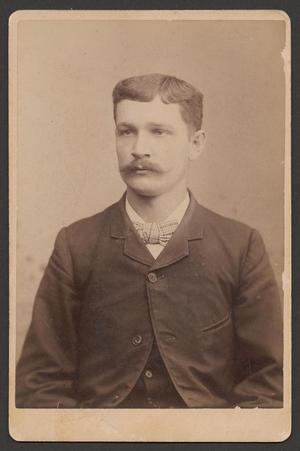
Herman Joseph “H.J.” Justin was born on April 7, 1859, in Lafayette, Indiana. He died on July 14, 1918, in Nocona, Texas. In the 39 years between those dates he built a bootmaking operation from a single shop in a Chisholm Trail crossing town into one of the most recognized boot brands in American history. He never became famous himself. The boots did.
Who Was H.J. Justin?
H.J. Justin — called “Joe” by his family — came to Texas as a young man and apprenticed in cobbling before establishing his own shop. The exact circumstances of his migration and apprenticeship require primary-archival research; available sources do not specify the master bootmaker he trained under or the precise year of his arrival in Texas. What the sources confirm is that by 1879, he was in Spanish Fort, Texas — a Chisholm Trail crossing on the Red River — and he had his own shop.
His German-American family background is reflected in his formal name. His children would carry the business forward; his daughter Enid Justin would become the family’s most celebrated entrepreneur.
What Did H.J. Justin Build at Spanish Fort?
Spanish Fort in 1879 was not a ghost town — not yet. It sat at one of the principal Red River crossings on the Chisholm Trail, and cattle drovers moving longhorns north to Kansas railheads needed boots. Justin made them boots. Custom-fit, durable, built to the demands of men who spent 16-hour days in the saddle.
The shop opened in 1879 with capital of $35 borrowed from the town barber — a detail confirmed by the TSHA Handbook of Texas. That borrowed $35 is the seed of what would become a multimillion-dollar company.
The Mail-Order Innovation
H.J. Justin’s most consequential business contribution was a system that let customers who couldn’t visit his shop still get custom-fit boots:
- Justin mailed customers a paper foot template
- Customers traced their feet at home and mailed the template back
- Justin made boots to those measurements
- Boots were shipped to the customer
This innovation broke the geographic constraint on a custom bootmaker’s customer base. Trail drovers who had passed through Spanish Fort once could order replacement boots from a ranch in Kansas or a town in Oklahoma. By the late 1880s, Justin boots were moving through the mail to customers across Texas and beyond.
See also: Spanish Fort
Why Did He Move to Nocona?
By the late 1880s, Spanish Fort was declining. The cattle-trail era was ending — barbed wire had fenced the open range, the long drives were winding down, and the town’s main economic engine was losing steam. In 1889, the Gulf, Colorado and Santa Fe Railway had created a new town: Nocona.
Justin moved his operation to Nocona in 1889. The decision was straightforward: a new town with railroad access was exactly what a mail-order business needed. You can’t ship boots without a freight depot.
He had married Anna Sophia Allen in 1887 — two years before the move; an earlier account erroneously placed the marriage in 1889, but the TSHA Handbook and Find a Grave memorial #63494502 both confirm 1887. His family came with him to Nocona, and it was in Nocona that his children — including Enid (born 1894), Earl, John Sr., and Avis — grew up working in the business.
The company name became H.J. Justin & Sons in 1908, formalizing what had been a family operation by practice.
What Happened After H.J. Justin’s Death?
H.J. Justin died on July 14, 1918, at age 59, and was buried in Nocona. His sons — John Sr. and Earl — took over operations. In 1925, seven years after his death, those sons made the decision to move the company headquarters to Fort Worth, citing access to a larger labor pool and better infrastructure.
That decision fractured the family. His daughter Enid, who had grown up in the business and knew every aspect of the trade, opposed the move. She stayed in Nocona. She borrowed $5,000 from a local bank and founded the Nocona Boot Company on September 1, 1925 — a direct competitor to her brothers’ operation, run by a 30-year-old woman in an industry dominated entirely by men.
The sibling rift lasted for decades. It was not resolved until 1981, when Justin Industries acquired Nocona Boot Company — reuniting the family business 56 years after the split. By then, Enid was 87 years old. She lived to see it.
See also: Enid Justin
What Is H.J. Justin’s Legacy in Montague County?
H.J. Justin brought boot manufacturing to Montague County. Before his 1879 shop in Spanish Fort, there was no boot industry here. After 1889, Nocona became one of the most important boot-manufacturing towns in the United States — and it was his decision to move there that made it so.
His direct legacy includes:
- The Justin Boot Company, which moved to Fort Worth after his death but carries his name globally
- The Nocona Boot Company, founded by his daughter as a direct consequence of the family’s 1925 decision
- The craft tradition that made Nocona synonymous with quality Western boots through the 20th century
- Decades of employment in leather manufacturing for Montague County workers
H.J. Justin himself was a craftsman and businessman, not a civic promoter. He didn’t build churches or give speeches. He made boots that fit, developed a system that let customers anywhere in the country order them, and trained his children to do the same. The company outlasted him; the town he chose to anchor it in outlasted the era that created him.
Sources: TSHA Handbook of Texas — “Herman Joseph Justin”; Find a Grave memorial #63494502; marriage year corrected from prior “1889” to 1887 per TSHA and Find a Grave confirmation.
See also: Enid Justin | Spanish Fort | Nocona | People of Montague County