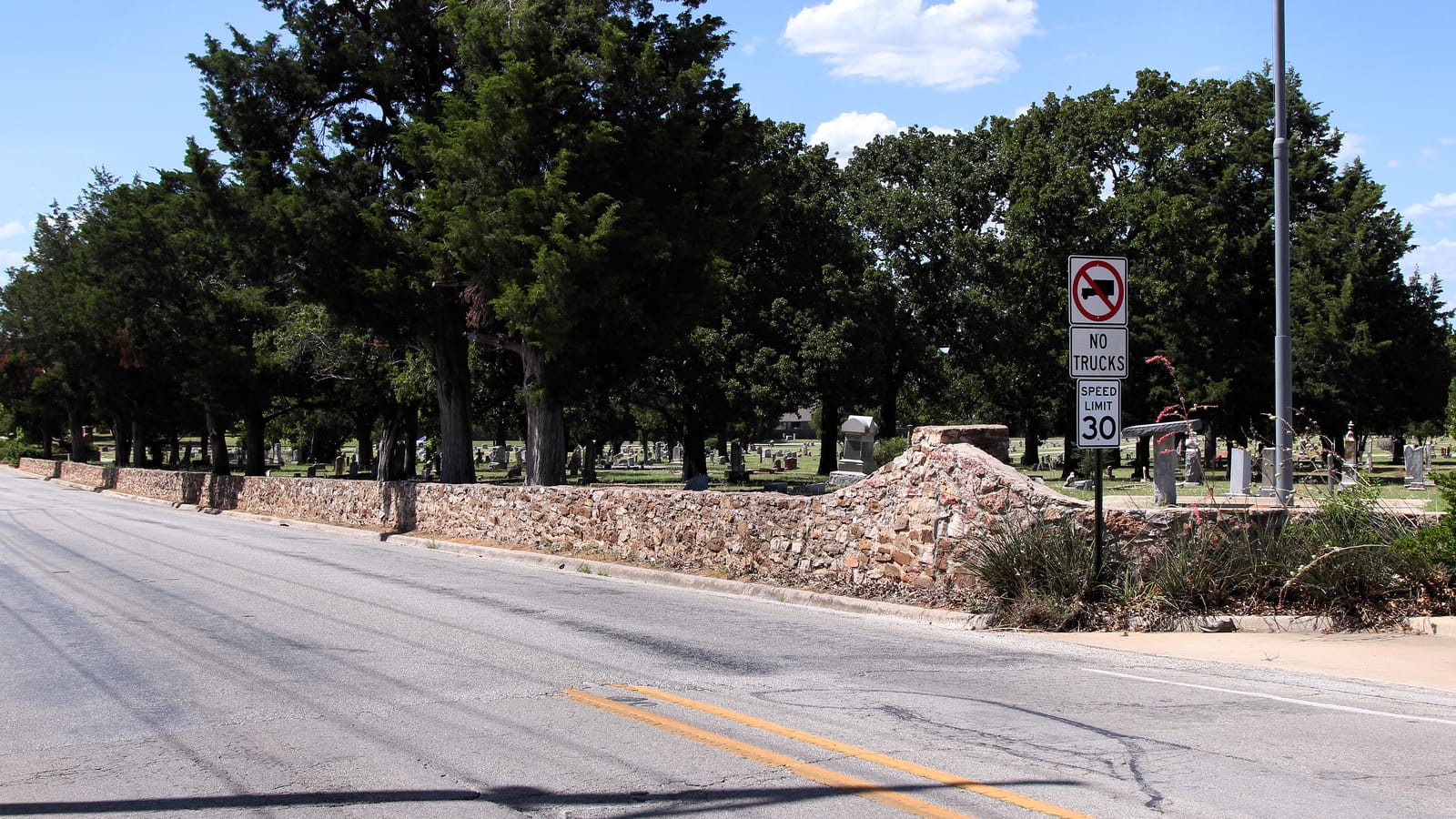
Elmwood Cemetery sits inside the city limits of Bowie, Texas — the county seat of the railroad era, the largest incorporated town in Montague County, and the place where the Fort Worth & Denver City Railway planted its depot in 1882. That arrival remade the county. It pulled settlement toward the rail line, displaced the older Queen’s Peak community four miles north, and built up a town fast enough that it needed a real burial ground almost immediately. Elmwood was that burial ground. James W. Stallings donated the first land in 1880 — two years before the tracks even arrived — and the cemetery has served Bowie continuously ever since.
Today Elmwood is the largest cemetery in Montague County by documented memorial count, with approximately 8,021 records indexed on Find A Grave. It is a working municipal cemetery, maintained by the City of Bowie Parks Department under an agreement that dates to 1938, when the Bowie Cemetery Association formally deeded the grounds to the city.
Founding and Early History
The cemetery’s origin is documented in its 2010 Texas Historical Commission marker (Atlas #5507016324, Marker #16324). James W. Stallings donated the first parcel of land, and the earliest confirmed burial is Willie B. Nelson, who died on June 10, 1880. Stallings’s own wife, Sarah E. (Parker) Stallings, was buried at Elmwood in 1882. The G.W. and Emily Tinkle family added acreage in 1884, 1901, and 1905, extending the cemetery’s capacity as Bowie’s population grew along the rail corridor.
The 1880 founding date places Elmwood in the county’s frontier-to-railroad transition. Bowie’s first settlers were predominantly upland-Southern Anglo families — Tennessee, Kentucky, and Arkansas migrants drawn by cheap land and, later, by the railroad — and Elmwood’s earliest burial cohort reflects that demographic. Railroad-trade workers, German Lutheran immigrants, and smaller numbers of other communities followed through the 1880s and 1890s. The Italian Catholic population of Montague County, concentrated around the town of Montague, largely buried their dead at Montague Catholic Cemetery rather than Elmwood.
The CCC Stonework and Depression-Era Infrastructure
One of Elmwood’s most distinctive physical features has nothing to do with its burials: the native-stone wall along Patterson and Nelson Streets, constructed between 1935 and 1937 by Civilian Conservation Corps crews. That stonework — dry-laid limestone typical of CCC work across Texas — is still intact and remains one of the more unusual features of any Montague County cemetery. Federal Depression-era infrastructure embedded in a community burial ground is not common in Texas county cemeteries, and it places Elmwood in a broader New Deal landscape that touched this part of north Texas in the 1930s.
The PWA-era rock walls and associated buildings visible at Elmwood are artifacts of the same period. Together, the CCC and PWA improvements represent a documented chapter of Elmwood’s physical history separate from its genealogical record.
The Bowie Cemetery Association and the 1938 Transfer
For its first six decades, Elmwood was governed by the Bowie Cemetery Association — a private organization that held the deed and managed day-to-day operations. In 1938, the Association transferred title to the City of Bowie, converting Elmwood into a municipally administered burial ground. That transition brought professional maintenance and municipal funding, and it is the arrangement that remains in place today. The City of Bowie Parks Department currently oversees operations; the Bowie Cemetery Board or City of Bowie Parks Department holds governance authority (formal governance structure not independently verified at time of research).
The 1981 Tarter Cemetery Relocation
In 1981, the expansion of Lake Amon G. Carter — the reservoir that serves as Bowie’s water supply — required the relocation of Tarter Cemetery, a smaller burial ground south of Bowie. Those burials were transferred into Elmwood, not displaced entirely. The 1981 relocation is significant for genealogical researchers: the Tarter surname and associated family corpus — documented in the pre-relocation cemetery record — now form a distinct sub-collection within Elmwood proper. Researchers tracing Tarter family connections in southern Montague County should treat Elmwood as the repository for that relocated burial record.
Bowie’s Role in the Broader County Story
Bowie’s geography shapes Elmwood’s burial history in several directions. The town lies south of the primary Chisholm Trail crossing corridors but served as a regional commercial and supply hub for the cattle-trail era. The KMA Oilfield (Kemp-Moyers area) — developed in northern Montague County in the 1920s and 1930s — drew workers and operators from a regional labor pool that included Bowie. Elmwood’s burial cohort from the 1920s through the 1940s very likely includes oilfield workers and their families, though specific individual records have not been enumerated from the Find A Grave corpus.
The railroad connection is the dominant frame. The Fort Worth & Denver City Railway transformed Bowie from a frontier settlement into a county commercial center, and Elmwood’s growth through the 1880s and 1890s tracks that expansion directly. The cemetery’s marker typology — studied regionally by Lynette Schroeder in a 1974 UNT thesis on upland-Southern burial traditions in Montague County — should show the transition from frontier-era hand-cut stone to commercially produced granite through the 1890s. Elmwood, as the county’s largest cemetery, likely holds the most complete corpus for that material-culture transition.
Notable Burials
The research record for individual notable interments at Elmwood is incomplete. The THC Historical Marker text confirms Willie B. Nelson (d. June 10, 1880) as the earliest burial and Sarah E. (Parker) Stallings (d. 1882) as one of the first documented burials after the founder’s donation. Beyond those two individuals — whose names appear in the primary THC source — the identification of notable burials requires systematic review of the Find A Grave memorial corpus, Bowie News obituary archives (Portal to Texas History, 1907 onward), and county probate records held at the Montague County Clerk’s Office.
High-frequency surnames likely represented at Elmwood, based on Bowie founding-family records, include Beall, Walker, Wyatt, and Nash. The Justin boot-family burials are primarily at Nocona City Cemetery, but descendants who settled in the Bowie area may appear at Elmwood. The absence of confirmed notable burials in this file reflects the limits of remote research, not the limits of the cemetery’s historical significance.
THC Historical Marker
Elmwood Cemetery received a Texas Historical Commission Historical Marker in 2010 (Marker #16324, Atlas record #5507016324, address: 900–1000 East Nelson Street, Bowie, Montague County). The marker confirms the 1880 founding, the Stallings land donation, the earliest burial of Willie B. Nelson, and subsequent land conveyances by the G.W. and Emily Tinkle family. The marker is a Class 1 verified source for Elmwood’s founding history.
Elmwood does not hold a Historic Texas Cemetery (HTC) designation from the THC as of the research date (2026-05-11). The cemetery meets the 50-year threshold easily, and the research file recommends filing for HTC designation, but no designation record exists in the THC Atlas as of this writing.
Segregated Burial Geography
Bowie’s burial geography includes a separate “Colored Cemetery” documented south of Bowie — a racially segregated burial ground from the 19th century. The relationship between that cemetery and Elmwood is unclear from available records. No evidence of racially segregated sections within Elmwood proper has been documented, but no field survey has been conducted. This gap is noted in the research record as an outstanding question requiring field survey to assess.
Genealogical Resources
For researchers, Elmwood’s 8,021-memorial Find A Grave corpus is the primary access point. Texas Death Certificates (1903 onward) are fully indexed on FamilySearch and cover the bulk of the Elmwood record. The 1900, 1910, and 1920 U.S. Census records for Montague County provide household context for the settler families whose members are buried here. Texas Confederate Veteran Pension applications are searchable for any Confederate-era burials.
The vital-records gap before 1903 — when Texas required no statewide death certificates — means pre-1903 Elmwood burials must be reconstructed from Bowie News obituary clippings (Portal to Texas History, digitized from 1907 onward), county probate records, family Bibles, and church burial registers. The Bowie Public Library Local History Collection (301 Decatur St, Bowie TX 76230) holds clippings and family histories; the Montague County Clerk’s Office holds deed books documenting the Elmwood land transfers from 1880 through the 1938 city transfer.
Sources
- Find A Grave — Elmwood Cemetery, Bowie, TX — approximately 8,021 memorials
- THC Historical Marker Atlas — Elmwood Cemetery — 2010 marker, confirms 1880 founding
- Montague County Cemeteries — County Hub
Notable Burials
- Willie B. Nelson d. June 10, 1880
- Earliest confirmed burial at Elmwood Cemetery; death date and name recorded in THC Historical Marker text (Atlas #5507016324, 2010).
- Sarah E. (Parker) Stallings d. 1882
- Wife of James W. Stallings, who donated the original cemetery land in 1880. Her 1882 burial is documented in the THC marker text.