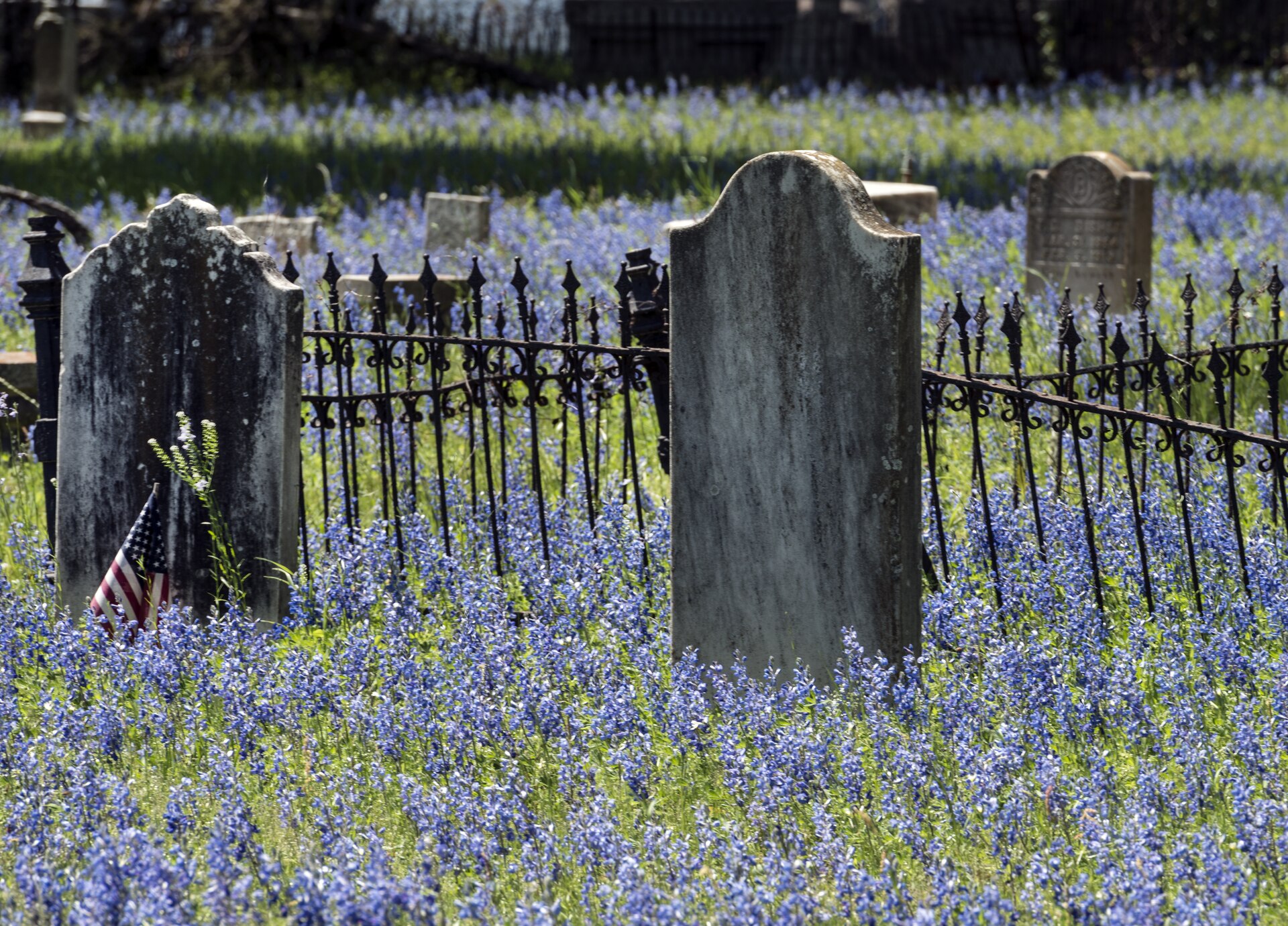
Nocona City Cemetery sits on the west side of Nocona, Texas — the largest city in Montague County, the home of the Justin and Nocona boot industries, and the town that D.C. Jordan platted in 1887 on land he had been accumulating since the early 1880s. The cemetery is older than the town. It predates Montague County’s formal organization in 1857, which means the first people buried here had no county courthouse, no county clerk, and no county road — just a piece of ground that someone decided should receive the dead. That pre-county founding date gives Nocona City Cemetery a singular place in the county’s burial history: it is among the earliest documented burial grounds in the region and one of only a handful that carry the designation of Historic Texas Cemetery.
Today the cemetery is bisected by Airport Road into western and eastern sections, each with a separate entrance. The Nocona Cemetery Association manages operations and maintains a live digital burial database at noconacemetery.com — the most comprehensive public burial database of any cemetery in Montague County. The current count stands at more than 5,987 documented burials, placing it among the two or three largest cemeteries in the county.
Founding and Pre-County Context
The precise founding date of Nocona City Cemetery is not documented in available primary sources. The research record establishes that the cemetery predates 1857 — the year Montague County was formally organized and the county seat established at Montague. This makes the burial ground contemporaneous with or earlier than the earliest Anglo-Texan settlement in the region, when settlers from upland-Southern states were pushing into the Cross Timbers and Red River country ahead of any formal governmental structure.
What drew settlement to the Nocona area before the county existed? The answer is geography: the region north of modern Nocona sits along well-worn routes toward the Red River crossings at Spanish Fort and Red River Station, and the land itself — rolling Cross Timbers interspersed with prairie pockets — was suitable for both farming and ranging. Families arrived, staked land, and, inevitably, needed a place to bury their dead. The cemetery that would eventually bear the name “Nocona City Cemetery” served that need before anyone knew the city would exist.
The original name of the cemetery was IS Memorial Park Cemetery. The “IS” designation — initials whose reference is not fully documented in available sources — suggests a formal founding by a civic or family organization rather than an improvised community burial ground, but the specific history of that founding name has not been resolved in primary research.
The Historic Texas Cemetery Designation
Nocona City Cemetery carries the Historic Texas Cemetery (HTC) designation from the Texas Historical Commission, confirming its significance as a burial ground with recognized historical importance. The Montague County Cemetery Inventory explicitly confirms the HTC status; the specific designation number and designation date require direct THC Atlas inquiry for resolution but are documented in the county inventory record.
The HTC designation matters for two reasons. First, it provides a layer of legal protection: Texas law (Health & Safety Code Chapter 711) restricts disturbing or relocating designated historic cemeteries without THC review. Second, it places Nocona City Cemetery in the formal statewide inventory of historically significant burial grounds, alongside properties like the Elmwood Cemetery in Bowie and the Illinois Bend Memorial Cemetery — burial grounds with documented connections to specific events or figures in Texas history.
The Nocona Connection: Boot Industry and Town Founding
The town of Nocona was founded in 1887, long after the cemetery was established. D.C. Jordan, who had trailed cattle from Texas to Kansas in the 1870s and then shifted to land development, platted the town on his own acreage when the Gulf, Colorado and Santa Fe Railway branch extended northward. The name “Nocona” honored Peta Nocona, the Comanche war leader whose raids into north Texas during the 1840s and 1850s shaped the frontier era this cemetery’s earliest burials were part of.
The Justin Boot Company connection runs through Spanish Fort, twelve miles to the north. H.J. Justin established his first boot shop at Spanish Fort in 1879, then moved his operation to Nocona in 1887 — the same year the town was platted — and operated there for two decades before relocating to Fort Worth in 1909. When Justin left, his daughter Enid stayed. She founded the Nocona Boot Company in 1925 and operated it in Nocona for decades. The cemetery’s burial record from the early 20th century almost certainly includes employees and family members of both boot enterprises, though a systematic index of boot-industry figures has not been extracted from the memorial corpus.
The IS Memorial Park Name and Transition to City Management
The original “IS Memorial Park Cemetery” designation was eventually replaced by the simpler “Nocona Cemetery” — a convention that followed the naming practice of using the city name for the principal municipal burial ground. The transition from the IS Memorial Park name to the modern name likely paralleled the formalization of city management, though the precise date of that administrative shift requires Nocona city archive research to confirm.
The cemetery is currently administered by the City of Nocona through the Nocona Cemetery Association. The Association maintains the noconacemetery.com database, which provides a searchable, filterable, continuously updated burial index — a resource that distinguishes Nocona from most Texas county-seat cemeteries, which rely on Find A Grave for digital access rather than maintaining an institutional database.
Cemetery Layout and Physical Description
The cemetery is divided into western and eastern sections by Airport Road, a distinctive operational feature that requires dual public entrances — one on the west side of the city north of US Highway 82, and one accessible from the eastern side of Airport Road. The FM 1759 (West Pine Street) approach provides a secondary access to the western section.
The north-central position of Nocona within Montague County means the cemetery served a broad catchment area: not just the city’s permanent residents but also rural families from the surrounding ranching and farming communities, oil-field workers from the KMA field north of town, and the migratory population that came through Nocona during the cattle-trail era. Nocona’s rise as a regional commercial center in the 1880s and 1890s — anchored by the rail connection, the boot industry, and the stockyards — produced exactly the kind of concentrated population that makes a city cemetery a county-level archive.
The KMA Oilfield Era
The KMA oilfield — the Kemp-Moyers-Archer County field developed in two phases beginning in 1919 and reaching its major deep-Strawn discovery on March 11, 1931 — transformed the labor landscape north and west of Nocona. The field covered approximately 135,000 acres and eventually produced more than 3,000 wells. The boom-era town of Kamay, at the field’s center, reached 700 residents and 21 businesses at peak. Many workers and their families were Nocona-area residents; Nocona City Cemetery almost certainly contains the remains of roughnecks, tool-pushers, and oil-field families from this era, though the specific burial records have not been systematically indexed from that angle.
Genealogical Resources
The noconacemetery.com database is the primary access point for researchers. The site allows name-based search with filtering options and maintains individual burial records beyond what is available on Find A Grave. For pre-1903 burials — the period before Texas required statewide death certificates — the database draws on older transcriptions, church records, and family histories.
Supplementary sources include:
- Find A Grave: approximately 6,000 memorials indexed by volunteer contributors; useful for cross-referencing against the official database.
- Texas Death Certificates (1903 onward): fully indexed on FamilySearch; covers the bulk of the 20th-century burial record.
- U.S. Census records: the 1880, 1900, and 1910 Montague County census schedules are fully digitized and provide household context for families buried here.
- Bowie News obituaries: the Montague County Area Newspaper Collection at the UNT Portal to Texas History (texashistory.unt.edu) includes the Bowie News from 1871 onward; Nocona-area obituaries are searchable.
- Nocona city archives: city council minutes and cemetery board records from the 1880s–1900s would contain founding documentation for IS Memorial Park Cemetery.
What is not yet documented
Several categories of information remain unverified at the time of this writing:
- The specific founding story of IS Memorial Park Cemetery — who organized it, what year, and what “IS” stands for — is not in the available primary source record.
- Individual notable burials have not been confirmed; the cemetery almost certainly contains D.C. Jordan family members, Justin-era workers, and boot-industry figures, but no systematic notable-burial index has been extracted from the noconacemetery.com database.
- The THC Atlas record number for the HTC designation requires direct THC inquiry for resolution.
- The HTC designation date is unconfirmed.
These gaps reflect limits of published documentation, not an absence of historical significance — as Montague County’s oldest continuously active burial ground and the principal municipal cemetery of the county’s largest city, its importance is well established.
Sources
- Nocona Cemetery Official Database — 5,987+ documented burials; searchable by name; live burial records
- Montague County Cemeteries — County Hub
- Justin Boot Company heritage profile
- Nocona Boot Company heritage profile