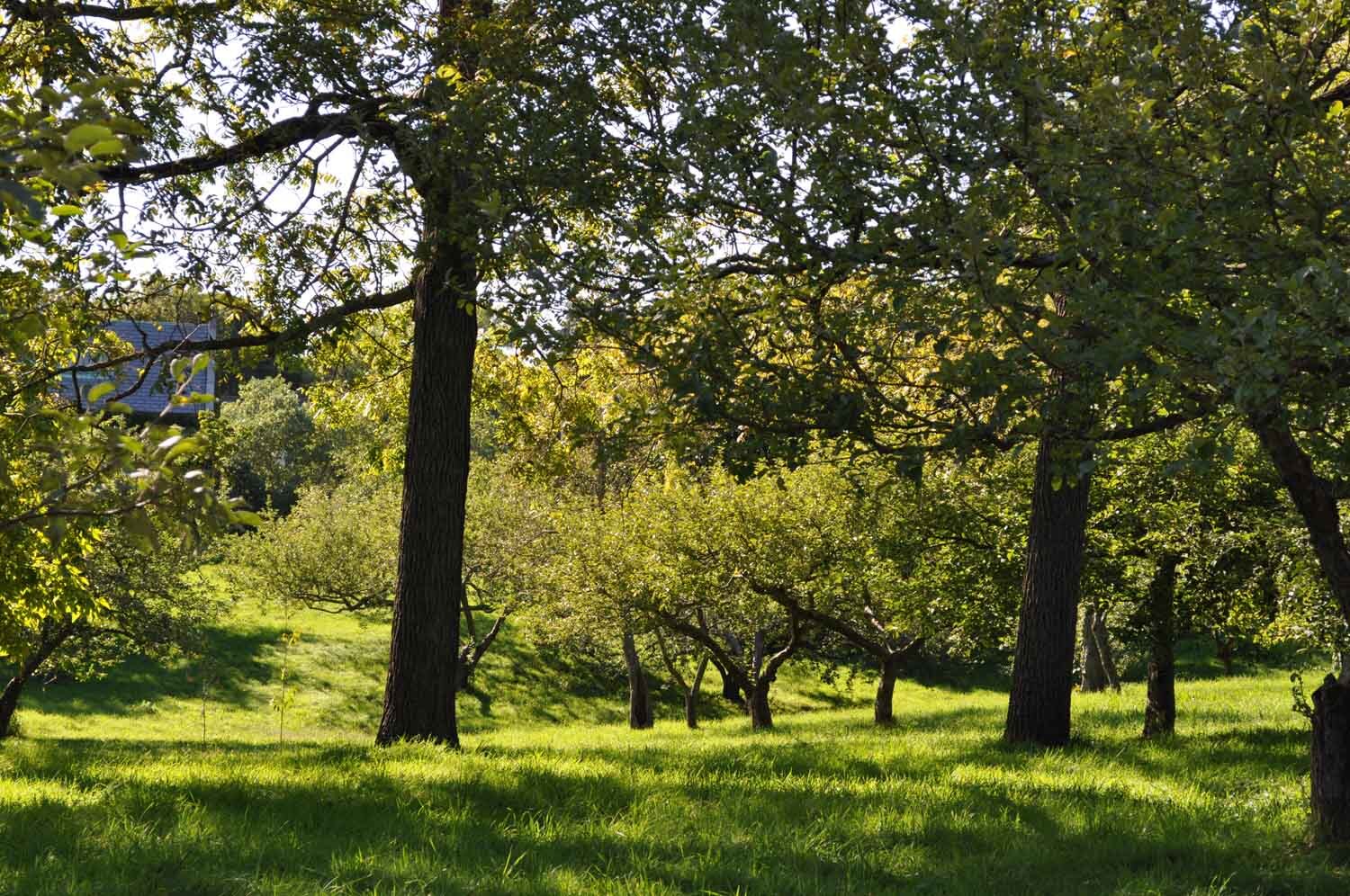
Six decades after the boll weevil began collapsing Montague County’s cotton economy, the county was leading Texas in apple production. The same soils that had produced mediocre cotton — the sandy loam uplands of the Cross Timbers, well-drained and fast-warming — turned out to be well-suited to orchards. The transition from cotton to fruit was not planned; it was a process of adaptation, failure, trial, and eventual success that played out across multiple farming generations and produced, by 1980, one of north Texas’s most distinctive agricultural identities.
The Orchard Belt
Fruitland: The Early Experiment
The orchard story in Montague County begins not in the post-cotton era but during it, in a community whose name still announces its founding purpose.
Fruitland — established in the early 1880s on State Highway 101 approximately six miles southeast of Bowie — was the creation of William H. Scarborough, who cleared marginal agricultural land and systematically replanted it with fruit trees in ten-acre lots. The community went through three names: Plano (the original), Woodswitch (1884, named for a wooden loading platform Scarborough built when the Fort Worth and Denver City Railway extended to the area), and finally Fruitland — a name chosen to directly announce what the settlement intended to be.
Postal service began under the Fruitland name in 1892. By the early twentieth century, Fruitland had established a regional reputation as a pioneer fruit-raising center in North Texas, cultivating apples, peaches, pears, and berries. The reputation became national when Frank Davis of Fruitland won first prize for apples at the 1904 St. Louis World’s Fair — placing a Montague County community at the apex of American horticultural competition.
Fruitland’s population peaked in the mid-1920s at approximately 150 residents — a substantial concentration for a rural MoCo community. The Great Depression and insect damage (distinct from the cotton-era boll weevil, though occurring in the same general era) began the decline. By the mid-1970s the population had fallen to around 20. Fruitland is a ghost town today, its principal commemoration a historic marker for the Fruitland School.
Belcherville: The Western Belt
Belcherville, on US-82 between Saint Jo and Nocona in northern Montague County, was a railroad-era community with orchard country in the surrounding hills. The Saint Jo–Belcherville corridor became the principal orchard zone for MoCo’s mid-to-late 20th-century fruit production — the area where the combination of Cross Timbers sandy loam soils, reasonable frost protection, and highway access for direct marketing aligned most favorably.
The specific orchard families of the Belcherville area are documented unevenly in available regional sources. Multi-generational farming families operated orchards through the 1950s–1990s; some operations persist today. A comprehensive family history of the Saint Jo–Belcherville orchard belt remains a primary-research project.
Why Sandy Soil and Why Fruit
The ecological case for fruit in MoCo is straightforward, though it took decades of trial for farmers to arrive at it fully.
Drainage is the decisive variable. Fruit trees, particularly peaches, are intolerant of waterlogged roots. A wet summer with clay-heavy soil can rot a peach orchard. The Cross Timbers sandy loam soils of MoCo’s uplands drain quickly — a liability for cotton in dry years, an asset for fruit in wet ones.
Chill hours favor most apple and peach varieties. Apples require 800–1,000 hours below 45°F annually for proper bud development; peaches require somewhat less. MoCo’s winter climate typically delivers 1,000–1,300 chill hours — adequate for most commercial apple and peach varieties without the risk of insufficient winter chill that limits fruit production in south Texas.
The growing season is long enough. Peaches need heat to develop — extended periods above 80°F — and MoCo provides more than 100 such days in a typical year. The fruit-development window from spring bloom through late-summer or fall harvest fits the county’s climate reliably in good years.
The risk is spring frost. Fruit trees bloom early in the Texas spring, and late freezes can destroy an entire year’s crop after bloom. The frost hazard is the defining risk of MoCo orchard farming — a single cold April night can eliminate a year’s income. Orchardists have managed this risk with smudge pots, wind machines, and sprinkler irrigation in some operations, but the risk never disappears entirely.
The 1980 Peak
By 1980, the combination of Fruitland’s early development, the Saint Jo–Belcherville belt’s mid-century expansion, and the diversification momentum from the post-cotton era produced a result that placed Montague County at the top of the Texas apple production rankings:
- #1 in Texas in apple production
- #6 in Texas in peach production
Texas is not a major apple state nationally — Washington, Michigan, and New York dominate American apple production at a scale that MoCo’s output could not approach. Being number one in Texas means being the leading producer in a relatively small-scale state apple industry, which is a meaningful regional distinction but should be understood in that context. In Texas terms, it represented genuine agricultural achievement and recognized MoCo as a fruit-growing county of note.
The peach ranking of sixth in Texas is more competitive: Texas produces meaningful quantities of peaches, particularly in the Hill Country and East Texas, and sixth in a real peach-producing state is a substantive position.
Specific bushel and acreage figures from the 1980 USDA Census of Agriculture would confirm the exact production numbers; those records require direct primary-source verification.
The Annual Orchard Cycle
MoCo orchard farming follows a rhythm that differs substantially from the row-crop calendar:
March–April: Bloom — the most beautiful and most anxious time. Orchards in full flower are MoCo’s brief spring spectacle. They are also the window of maximum frost vulnerability. A hard freeze after bloom means no fruit that year. Orchardists watch overnight temperature forecasts through April with the same attention cotton farmers once gave rain gauges.
April–June: Fruit set and thinning. Commercial orchards thin developing fruit — removing excess apples or peaches from clusters — to concentrate the tree’s resources into larger, better-quality fruit rather than many small ones. Thinning is manual work.
July–September: Peach harvest, varying by variety. Peaches are the earlier-maturing crop; different varieties ripen from July through September.
August–October: Apple harvest. Apple variety selection in MoCo ranges from early-ripening summer varieties through fall mainstays like Red Delicious, Golden Delicious, Gala, Granny Smith, and Fuji.
November–February: Pruning season. Annual pruning is essential for tree health and productive cropping; it is skilled work that shapes the following year’s harvest. Equipment maintenance and planning fill the winter.
Labor: Family labor is central to MoCo orchard operations. Harvest peaks require additional hands — historically including migrant workers, often Hispanic, during peak picking periods, as well as the pick-your-own customers who provide free harvest labor in exchange for the fruit.
Direct Marketing and Agritourism
MoCo’s fruit economy was always more direct-marketing than wholesale-industrial. The scale of production, the highway access (US-82), and the proximity to DFW and Wichita Falls day-trip markets made pick-your-own and roadside-stand operations viable in ways that wholesale distribution to major grocery chains was not.
By the 1970s–1980s, MoCo apple orchards had developed an agritourism dimension:
- Pick-your-own operations drawing fall weekend visitors from the Metroplex
- Roadside stands along US-82 through the Saint Jo–Belcherville corridor
- Apple cider production at some operations
- Fall festival events associated with the harvest season
- Informal “Apple Capital of Texas” identity circulating in regional promotion
The Forestburg Watermelon Festival (45+ years running as of 2025) is the more famous MoCo fruit festival, but it represents the same agritourism logic applied to a different crop in a different part of the county.
Decline from Peak and Current Presence
The pressures that pulled MoCo’s orchard industry back from its 1980 peak are multiple and partly structural:
Market consolidation through chain grocery buyers shifted purchasing power toward large, nationally branded operations. MoCo’s family orchards could not compete on volume or uniformity with industrial producers.
Aging orchards required replanting — capital investment that not all operations could make.
Generational succession challenges: orchard operations require deep site-specific knowledge and multi-year establishment investment. When the generation that built an orchard retired, successors were not always available or interested.
Late frost events periodically devastated multiple seasons in sequence, reducing profitability and operator confidence.
Land use competition: the Cross Timbers sandy upland that carries orchards also carries recreational and residential value as the DFW exurban zone has extended northward.
Some MoCo orchards persist into the 2020s — primarily in the Saint Jo and Belcherville areas, with a smaller presence elsewhere in the county. Seasonal direct-sale operations, some pick-your-own, and a smaller but continued commercial presence maintain the orchard tradition at reduced scale.
The Broader Agricultural Story
The apple and peach orchard era is one piece of the larger post-cotton agricultural diversification that defined MoCo’s 20th-century economy. Cattle (see Major Historic Ranches), watermelons (see Watermelons), and oil royalties (see The KMA Oilfield) round out the picture. None of these streams alone approached the economic density of the cotton peak. Together they produced a more resilient and more varied county economy than the cotton monoculture had provided.
The orchard story’s quiet distinctiveness is worth noting. The cattle drives have mythology; the oil boom has drama; the cotton collapse has scale. The apple orchards have the 1904 World’s Fair prize and the county’s number-one ranking in Texas and the roadside stands on US-82, which is its own kind of achievement — specific, local, and genuinely earned.
Related pages: Watermelons in Montague County · The Cotton Era in Montague County · Fruitland · Belcherville · Cattle-Cotton-Oil Era Index
Sources: TSHA Handbook of Texas; Fruitland data TSHA-verified (Scarborough founding, Plano→Woodswitch→Fruitland naming, Fort Worth and Denver City Railway 1884, Frank Davis 1904 World’s Fair prize, postal service 1892–1954, peak population ~150 mid-1920s); Belcherville regional sources. Texas A&M AgriLife Extension orchard publications. 1980 USDA Census of Agriculture ranking cited from regional themes documentation; exact bushel and acreage figures require direct primary-source confirmation.