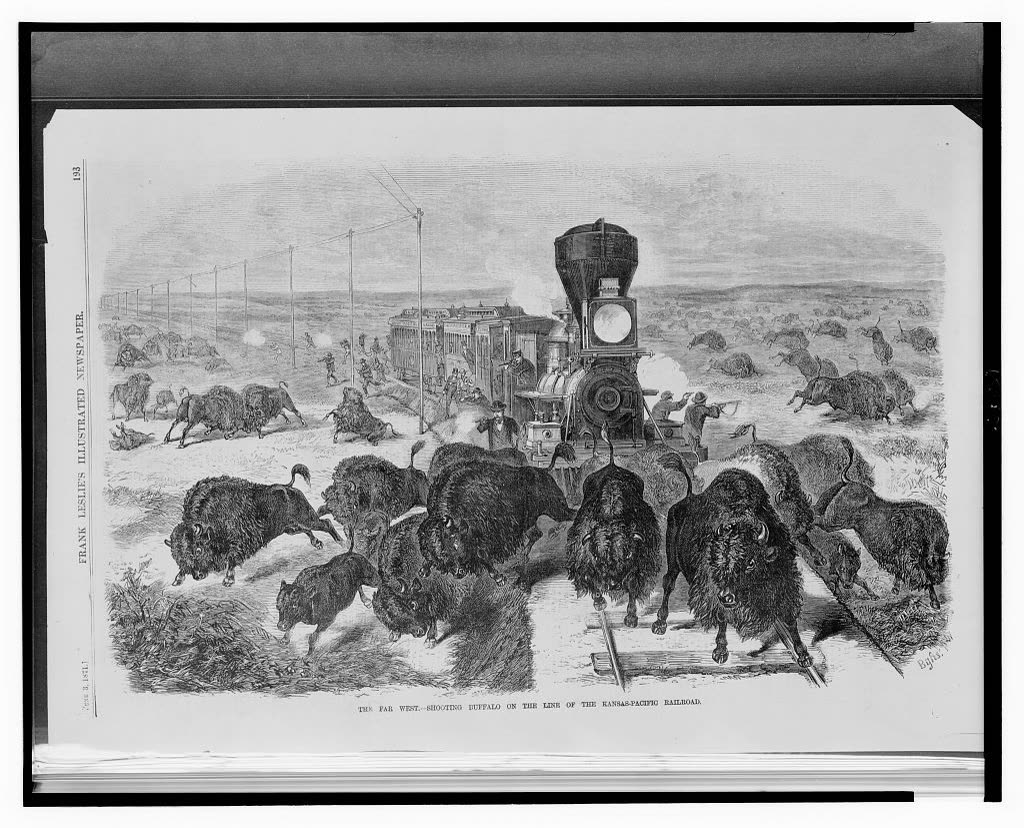
The killing was fast. In roughly six years — from 1872 to 1878 — commercial hide hunters reduced the southern bison herd from millions of animals to functional extinction as a wild population. They worked from railhead supply points in Dodge City, Kansas, and Fort Griffin, Texas, using heavy Sharps rifles to kill animals by the hundreds in a single afternoon’s work. The hides went east on freight cars. The carcasses rotted on the plains.
Montague County was not the center of this story. The hide hunters’ main operations ran through the Texas Panhandle and the high plains to the west, where the densest remaining buffalo concentrations made commercial hunting viable. MoCo sat at the eastern fringe of the southern herd’s range, a place where buffalo had grazed the western prairies but never in the numbers that drew large hunting outfits. Some peripheral hunting activity almost certainly occurred — small parties working local herds for hides — but the county’s connection to the buffalo era is less about the killing than about what the killing ended and what it made possible.
How Large Was the Southern Herd?
The American bison (Bison bison) is the largest land animal native to North America. By the early 1800s, the North American bison population was divided into a northern herd centered on the Yellowstone-Missouri country and a southern herd centered on the Texas-Oklahoma-New Mexico-Kansas Plains. The southern herd’s pre-contact population may have numbered 10 million or more animals at peak. Its range included the Texas Panhandle and Llano Estacado as core habitat, the western Oklahoma and Kansas grasslands, and the rolling plains of north-central Texas — including the western prairies of what is now Montague County.
The Cross Timbers timber itself is not classic buffalo habitat; bison prefer open grassland. But the prairie corridors running between and beside the Cross Timbers — MoCo’s western county especially — would have had grazing herds moving through on seasonal migrations. Buffalo had been a constant feature of this landscape for the same reason they were a constant feature of Comanche and Kiowa life: the grassland prairie supported them.
Why Did It Collapse in the 1870s?
The near-extermination of the southern herd was not an accident or an inevitable consequence of settlement. It was a convergence of specific economic and technological factors that made rapid commercial slaughter possible and profitable for a brief window:
Pennsylvania tannery technology. Tanneries developed methods for processing buffalo hides into commercial leather — specifically into the industrial belting that drove factory machinery. This created a market for buffalo hides that had not previously existed at commercial scale.
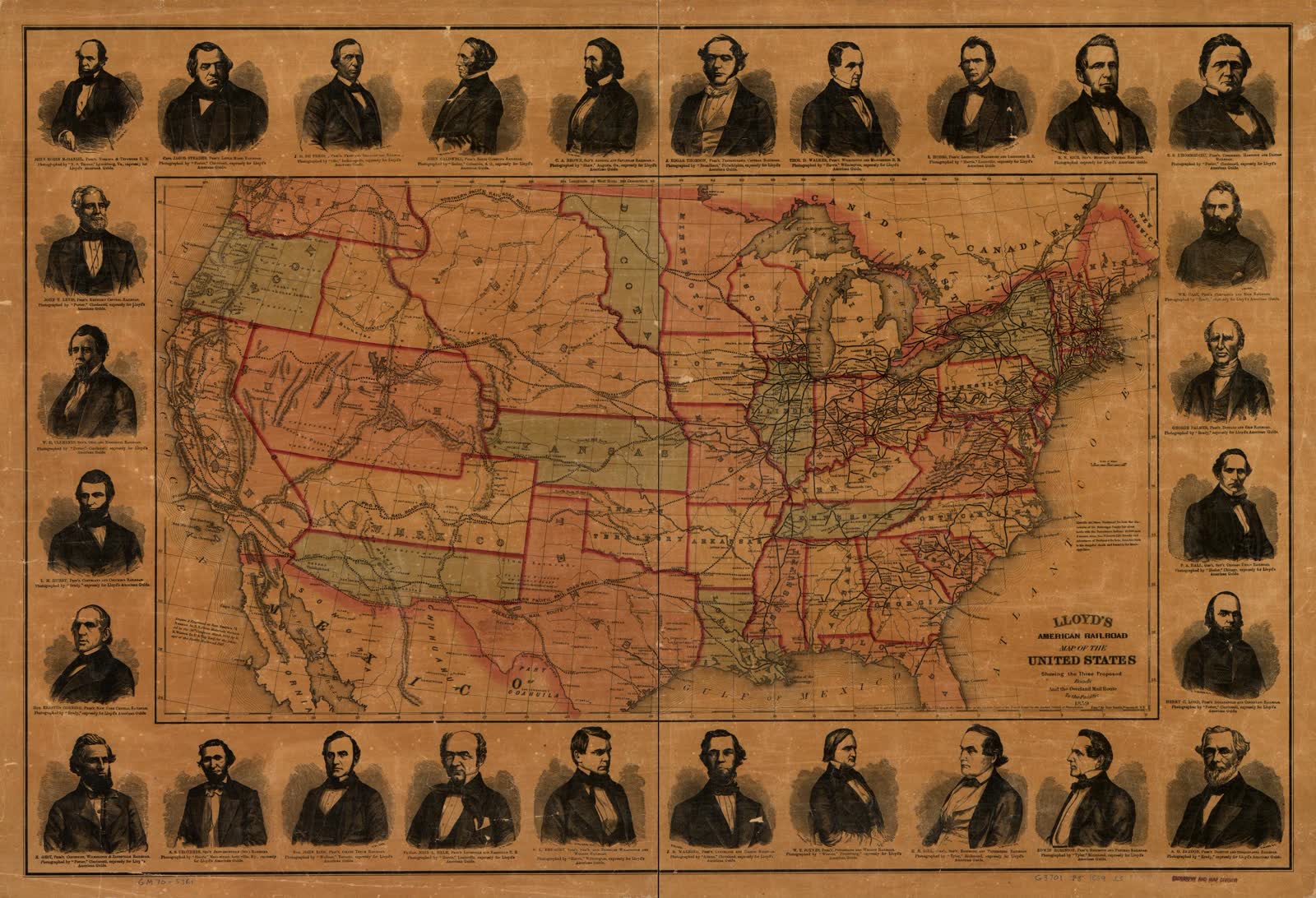
Railroad expansion. The railroads reached the southern Plains in the early 1870s, providing supply lines for hunters and shipping capacity for hides. Dodge City on the Santa Fe Railroad became the great hide railhead; Fort Griffin on the Clear Fork of the Brazos served as the primary Texas supply center.
Heavy rifles. The Sharps falling-block rifle in large-caliber configurations — including the .50-caliber “Big Fifty” — gave hunters effective long-range killing power with enough range that a skilled shooter could fire dozens of rounds without disturbing a herd.
Federal policy. Federal authorities did not simply permit the slaughter. They encouraged it. Destroying the southern herd meant destroying the subsistence base of the Comanche, Kiowa, and other Plains peoples, forcing them onto reservations and ending the armed resistance that had cost the Army considerable blood and money. “Destroy the herd, destroy the resistance” was the implicit and sometimes explicit logic of federal Indian policy in the early 1870s.
Peak hide prices. For a brief period in the early-to-mid 1870s, hide prices made the work profitable enough to attract men willing to spend weeks on the southern Plains in difficult conditions.
How Did the Hunters Work?
The dominant technique was called the “stand.” A hunter approached a herd quietly to within rifle range — often 200 yards or more with a heavy Sharps. He shot the lead cow first; she was typically the matriarchal animal whose loss disoriented the group. The herd, smelling blood but not locating a threat, milled in place. The hunter continued firing from a fixed position until the herd finally moved or his ammunition ran out. A skilled hunter could kill dozens of animals in a single stand; on exceptional days, the count reached into the hundreds.
Skinners followed the shooter to remove hides. Camp organization was efficient and brutal: one or two shooters, three to five skinners, a cook, and a wagon team. A typical outfit operated for three to six weeks before returning to the railhead with a load of cured hides. The carcasses were left. Only the hide had commercial value at the scale these operations required; the meat was almost entirely wasted. The southern Plains were soon covered with bones.
The bone trade
After the carcasses had bleached — some years after the hide-hunting peak — bone collectors gathered what remained and shipped it east for processing into bone meal fertilizer and bone char for industrial uses. The bone trade ran through the 1880s as a secondary economy across the same prairie ground where the killing had occurred.
What Did This Mean for Comanche and Kiowa Peoples?
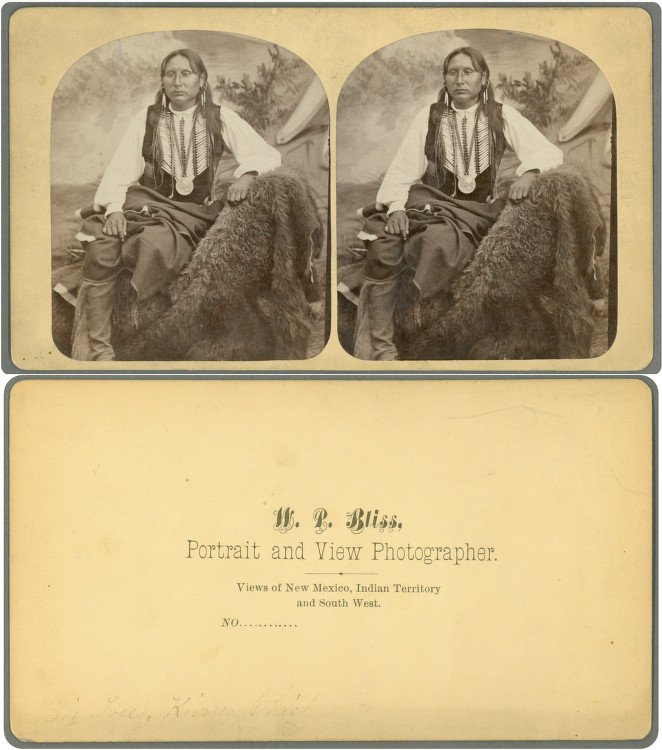
For the Comanche and Kiowa nations, the buffalo was not simply a food source. It was the foundation of the entire Plains economy: food, clothing, shelter material, tools, ceremonial objects, and the medium of trade. The annual cycle was organized around buffalo movement. The horse-mounted hunting culture that made the Comanche the dominant power on the southern Plains from roughly the early 1700s onward was built on the buffalo’s abundance.
The hide-hunting campaign eliminated that foundation within a single decade:
- 1872: Millions of bison estimated to remain on the southern Plains
- 1872–1878: 3–5 million killed across the region
- 1878: Southern herd essentially extinct as a wild population
With the buffalo gone, bands could not feed themselves through traditional means. The subsistence collapse was total and rapid. Families that had maintained their mobility and independence for generations were reduced to dependency on government rations at reservation agencies. The hide-hunting campaign was, in effect, deliberate ecological warfare — and federal authorities understood it as such.
For Montague County specifically, the end of the buffalo economy and the end of the Comanche-Kiowa raiding era were the same event viewed from different angles. The raids that had kept MoCo under pressure since the late 1840s depended on the same Plains military capacity that the buffalo supported. When the buffalo collapsed, the military capacity collapsed with it. The Red River War of 1874 and the forced reservation confinement of 1875 finished what the hide hunters had started.
What Replaced the Buffalo in Montague County?
The cattle drives. The same prairie corridors that had supported bison migrations became the routes for Texas cattle moving north to Kansas railheads along the Chisholm Trail and its branches. The same grassland that bison had grazed became rangeland for longhorn cattle. The ecological function — large grazing animals on open prairie — was transferred to a domesticated species, and the economy built on that grazing was now Anglo-Texan rather than Comanche-Kiowa.
MoCo’s cattle-drive era peaked in the early 1880s before the railroad arrived and reshaping began again. But the enabling condition for that era was the prior decade’s destruction of the southern herd and the removal of the Comanche-Kiowa nations from the southern Plains.
The buffalo and the world they supported are preserved in different ways in modern Montague County. The Tales ‘N’ Trails Museum in Nocona and the Stonewall Saloon Museum in Saint Jo hold Western heritage collections that reference the buffalo era. The bois d’arc trees in MoCo’s Red River bottoms — whose hard, flexible wood supplied bow staves traded across the southern Plains — are a living connection to the ecology that supported both buffalo herds and the hunters who depended on them. Buffalo wallows, the shallow depressions left by bison dust-bathing behavior, may still exist on undisturbed prairie ground in the county, though they grow harder to locate each generation.
The broad regional pattern of the hide-hunting era is well-documented from TSHA Handbook and supporting sources. Specific Montague County hunter activity — accounts of particular outfits working MoCo’s western prairies, local diaries or memoirs — has not been confirmed by primary sources. The Tales ‘N’ Trails Museum and county historian are the recommended sources for MoCo-specific buffalo-era documentation.
Related pages: Comanche Raiding Routes Through Montague County · The 1863 Illinois Bend Raid · Texas Rangers in Montague County · Frontier Era Index
Sources: TSHA Handbook of Texas (“Buffalo Hunting,” “Bison”); Comanche Nation, “History” (comanchenation.com); Kiowa Tribe of Oklahoma, “Our History” (kiowatribe.org). MoCo-specific hunter activity awaits primary-source verification.