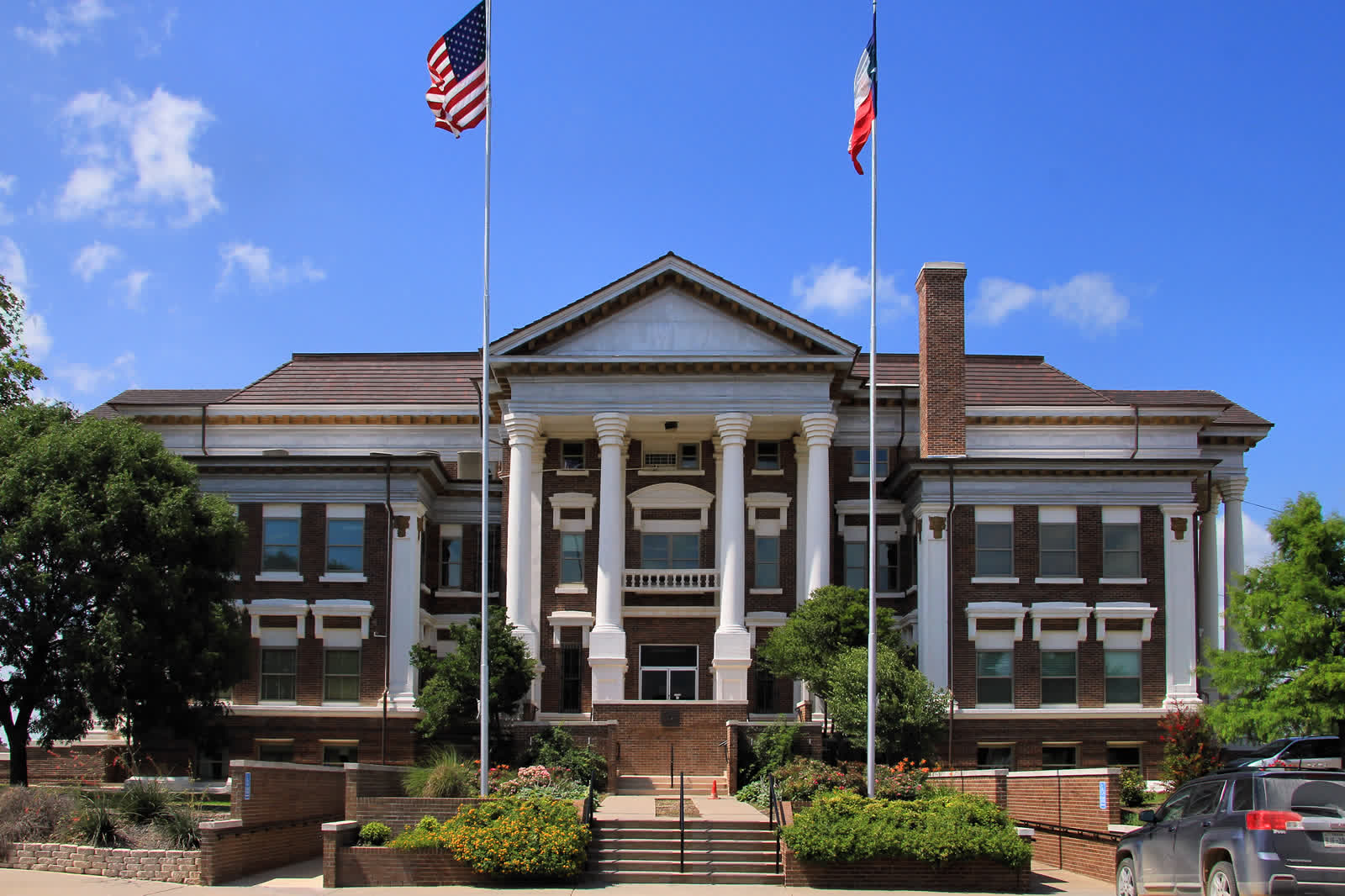
Montague County government works the way virtually all Texas county governments work: through a Commissioners Court composed of an elected County Judge and four elected Commissioners, one per precinct, plus a roster of independently elected officials — Sheriff, County Clerk, District Clerk, Tax Assessor-Collector, County Attorney, Justices of the Peace — who handle specific county functions. The whole apparatus operates from the 1913 Classical Revival courthouse in Montague, the small county seat town that has housed county government since the county’s organization in 1858.
For residents doing county business — filing a deed, searching property records, paying property taxes, appearing in county court — the courthouse in Montague is the destination.
The Structure of Texas County Government
Texas counties are creatures of state law. The Texas Constitution and the Local Government Code define what counties can and must do, which offices must exist, and how those officials are selected. Montague County has no unusual features in its basic structure; it operates according to the same framework as the other 253 Texas counties.
The County Judge is both the presiding officer of the Commissioners Court and the county’s general administrative head. The judge also has judicial functions: probate, mental health hearings, and a general jurisdiction civil/criminal court known as the County Court. In practice, most County Judges in rural Texas counties spend the majority of their time on administrative and Commissioners Court functions.
The four County Commissioners represent the county’s four precincts. Each Commissioner has specific road and infrastructure responsibilities within their precinct and participates equally in Commissioners Court decisions on budget, policy, and administration. Road maintenance — the physical upkeep of county roads and bridges — is the function most directly tied to precinct structure.
The Commissioners Court as a body sets the annual county budget, approves the property tax rate, hires some department heads, awards contracts, and makes the major policy decisions of county government. It meets regularly (typically twice monthly) in open session at the courthouse. Public comment is standard procedure. For a county of 20,000 residents, the Commissioners Court is the most accessible level of government most residents will ever encounter.
Elected Officials and What They Do
Texas counties elect a remarkable number of officials independently. This structure — traceable to Jacksonian-era distrust of appointed government — means each major county function has its own independently accountable officer.
Sheriff: Operates the county jail, provides law enforcement in unincorporated areas, provides courthouse security, and executes court orders. The Sheriff is the county’s principal law enforcement officer and one of its most publicly visible officials.
County Clerk: Records deeds, mortgages, plats, and other real property documents; issues marriage licenses; maintains probate court records; and administers county elections in some precincts. The County Clerk’s office is the primary destination for genealogical and property research.
District Clerk: Maintains records for the district courts (felony criminal cases and major civil cases). Works closely with the District Judge(s) who serve Montague County under the state judicial district structure.
Tax Assessor-Collector: Administers property tax collection, vehicle registration, and related functions. The tax rate itself is set by the Commissioners Court; the Tax Assessor-Collector administers collection and maintains records.
County Attorney: Handles civil legal matters for the county and prosecutes Class A and B misdemeanors in County Court. (Some functions overlap with the District Attorney for felony prosecutions.)
Justices of the Peace: Four JPs, one per precinct, handle small claims civil cases, minor criminal matters, traffic offenses, and the initial processing of arrest warrants. JPs also certify deaths in some circumstances. The JP court is often the first point of contact between residents and the county court system.
Services the County Provides
County government in Texas has a specific mandate: it provides the services that neither the state nor the cities have taken on, primarily for residents of unincorporated areas.
Law enforcement through the Sheriff’s Office covers the rural county — the roads, farms, and communities outside city limits. Bowie, Nocona, and Saint Jo have their own police departments for in-city law enforcement; county roads and rural areas are Sheriff’s territory.
Roads and bridges are the largest single budget item for most rural Texas counties. The Commissioner for each precinct oversees road maintenance within that precinct. County road crews maintain gravel and paved county roads; TxDOT handles state highways (US-287, US-82, state routes) and the county coordinates with TxDOT for shared responsibilities.
Courts at the county level — County Court and Justice of the Peace courts — handle the legal matters that don’t rise to district court level. The 1913 courthouse’s courtroom remains in active use for county court proceedings.
Property administration through the County Clerk and Tax Assessor-Collector touches every property owner in the county. Deed recording, tax billing, and the formal legal record of property ownership all run through courthouse offices.
Public health functions are limited at the county level; most public health services flow through state agencies and regional health districts rather than direct county delivery. Veterans services, library services, and most social services are delivered through cities, state agencies, or non-profit organizations rather than the county directly.
The Courthouse at the Center
The 1913 courthouse is more than an administrative building; it’s the organizing center of county civic life for a county whose population center has long since shifted elsewhere. Most of Montague County’s 20,000 residents live in Bowie (about 5,000 residents) or Nocona (about 3,000), not in the county seat town of Montague (a few hundred). The drive to the courthouse is a regular feature of civic participation for most residents.
The courthouse history — five previous buildings, two fires, tornado damage, and a contested 1984 election that came close to moving the seat to Bowie — is told in Courthouse History. For the town of Montague itself, see Montague.
Daily operations at the courthouse follow standard county government rhythms: office hours for public business, court sessions on scheduled dockets, Commissioners Court meetings twice monthly (open to the public), and the steady flow of deed filings, marriage license applications, vehicle registrations, and tax payments that constitute the ordinary business of county government.
Modern Challenges for a Rural County
Montague County’s government faces the challenges that characterize rural Texas county government in the 2020s:
Revenue pressure: The county’s property tax base is constrained by declining property values in depopulating communities and political pressure to hold tax rates low. State funding for mandated services does not always cover actual costs.
Workforce recruitment: Specialized positions — information technology, forensic accounting, skilled law enforcement — are difficult to fill when county salaries compete against urban employers who can pay more. Rural counties often lose trained employees to larger jurisdictions.
Aging infrastructure: Roads, bridges, courthouse systems, and county facilities require continuous maintenance investment. Deferred maintenance compounds over time.
Mandated services: State and federal governments impose service requirements on counties without always providing corresponding funding, creating structural budget tension.
Population shifts: The county’s overall population has been relatively stable in recent decades (approximately 20,000), but distribution has shifted — more concentration in Bowie, more thinly populated rural areas. Service delivery to dispersed populations is inherently expensive.
These pressures are not unique to MoCo; they characterize rural county government across Texas and the rural United States. Montague County manages them with the tools and structure that Texas law provides, operating from the courthouse that has anchored county government since the building opened in 1913.
Related pages: Courthouse History · Montague (Town) · Modern Era Index
Sources: Montague County official website (co.montague.tx.us); Texas State Directory Online; Texas Association of Counties. Government structure is well-documented in these sources. Current elected officials and budget specifics are subject to change and are not listed; consult co.montague.tx.us for current information.