Before the power lines came, rural Montague County ran on kerosene.
The farmhouses that dotted the Cross Timbers and the Red River bottomlands in the 1920s and early 1930s used the same technologies their grandparents had used: kerosene lamps for light, wood stoves for heat and cooking, windmills and hand pumps for water, and horse or human muscle for every task that required sustained power. The towns — Bowie, Nocona, Saint Jo — had electricity from private utility companies. The farms, which were most of the county, did not.
The gap between town life and rural life was not just a matter of inconvenience. It was a structural limit on what was possible: how well-lit a home could be, how cold food could be kept, how quickly information could arrive through radio, how efficient farm labor could become. Rural people in 1930 were living, in material terms, much as their great-grandparents had lived in 1870. The Rural Electrification Administration changed that, and it changed it within fifteen years.
The Pre-Electric Rural Reality
What Life Without Power Looked Like
Before the REA lines reached MoCo’s farms — roughly mid-1930s through the 1940s — daily life was organized around the absence of electricity:
Lighting: Kerosene lamps provided reading light after dark, but the quality was poor and the fire risk was real. Farm families went to bed early in the winter and rose with the sun. Evening tasks — mending, accounting, letter-writing — happened by lamplight that strained the eyes.
Cooking and heating: Wood stoves served both purposes. Cutting, hauling, and splitting wood was a constant labor requirement. In summer, a wood stove made the kitchen oppressively hot; there was no alternative.
Water: Hand pumps drew from wells; windmills pumped from deeper sources. Both required maintenance and failed in drought or freeze. Hauling water to the house from a pump or cistern was a daily task, often assigned to children.
Food preservation: Without refrigeration, food spoilage was a constant challenge. Root cellars provided some temperature regulation; ice was delivered to towns but rarely reached outlying farms in usable condition. Canning, smoking, and drying were the primary preservation methods.
Radio: Battery-powered radios existed but were expensive and the batteries depleted quickly. Rural families in the early 1930s were largely cut off from the radio culture — news, weather, music, Roosevelt’s Fireside Chats — that was reshaping American life.
The contrast with electrified town life, visible every time a rural family drove into Bowie or Nocona, was stark and felt. The towns had light, refrigeration, and radio. The farms had kerosene and silence.
The REA and How It Worked
Roosevelt’s Executive Order
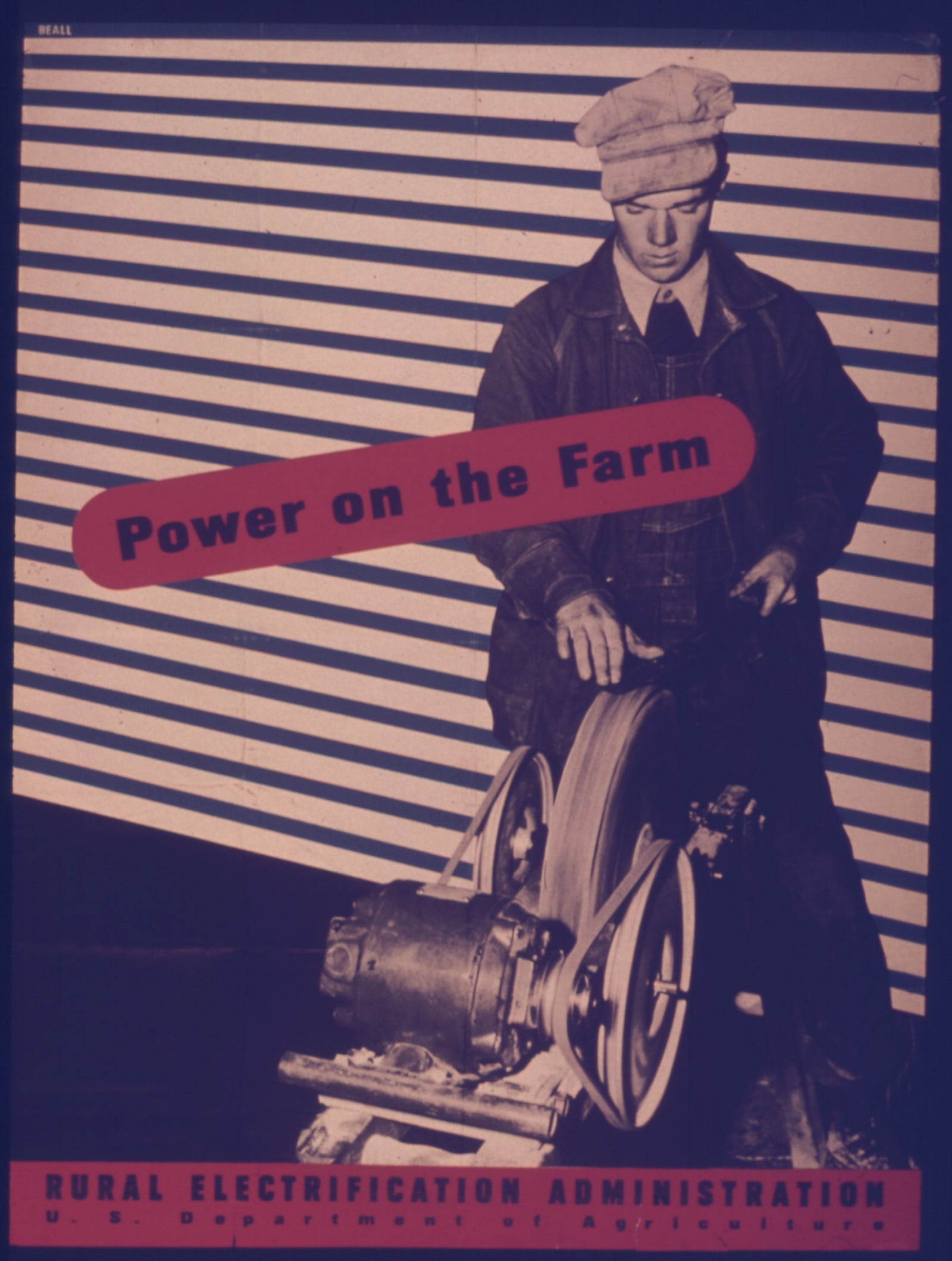
On May 11, 1935, President Franklin D. Roosevelt signed the executive order establishing the Rural Electrification Administration (Source: TSHA Handbook of Texas). The REA was codified in the Rural Electrification Act of 1936, creating a federal agency authorized to make low-interest loans to cooperatives building rural electric distribution lines.
Before REA, fewer than 2% of Texas farms had electric service — private utility companies had calculated, correctly by their own accounting, that the cost of stringing lines to widely scattered rural customers was too high to justify (Source: TSHA Handbook of Texas). The REA’s innovation was not to force private utilities to serve rural areas but to finance farmer-owned cooperatives that could absorb the infrastructure cost over decades, accepting lower rates of return than investor-owned utilities required.
Why Cooperatives, Not Private Utilities
The cooperative model was essential to the program’s success. A farmer-owned cooperative meant:
- Members shared the cost of line construction through their monthly bills and initial fees
- The cooperative’s mission was to serve its members, not to maximize returns for shareholders
- Federal financing at low interest rates made infrastructure investment viable over long amortization periods
- Engineering assistance from REA technical staff helped co-ops design efficient systems without reinventing the wheel in each county
Private utilities had the right to serve rural areas; they simply chose not to, because it wasn’t profitable enough. REA-financed cooperatives changed the equation by separating the infrastructure question from the profit question.
Electrification Comes to MoCo
The Cooperatives
The specific cooperative or cooperatives that served Montague County were organized in the late 1930s or early 1940s as part of the wave of Texas co-op formation between 1936 and 1945. The likely candidates based on regional geography are Cooke County Electric Cooperative — which serves multiple counties in north-central Texas and may include parts of MoCo — and potentially Wise Electric Cooperative to the south or another regional co-op. The specific cooperative-by-county distribution requires verification through primary research at REA records, the Texas Public Utility Commission, or the cooperatives themselves.
Building the Lines
Initial line construction in MoCo most likely began in the late 1930s and extended through the 1940s, with WWII creating some delays as materials and labor were redirected to the war effort. The post-war buildout completed rural service through the late 1940s.
The physical work of building rural electric lines was substantial: setting poles across miles of brush country, stringing wire across creeks and draws, running service drops to individual farmsteads. In some Texas co-ops, member-farmers assisted with the labor — digging post holes, clearing right-of-way on their own land — as part of the cooperative membership commitment.
When the Lights Came On
The moment of connection was remembered distinctly by those who experienced it — consistent with the documented regional pattern. The first time an electric light replaced a kerosene lamp; the first time a radio worked without batteries; the first electric pump drawing water without a hand on the handle — these were before-and-after moments that people remembered decades later.
The immediate changes on an electrified MoCo farm:
- Electric lighting in the farmhouse and outbuildings
- Radio — suddenly reliable, no batteries to manage
- Refrigeration — the ice box, over the following years, gave way to an electric refrigerator
- Water pumping — electric pumps replaced windmill and hand pump for many operations
- Power tools — in the barn and workshop
The changes that followed over the next decade:
- Washing machines, electric irons, and vacuum cleaners
- Electric stoves (replacing wood, gradually)
- Television in the 1950s
- Air conditioning in some homes by the 1960s
- Milking machines for dairy operations
- Egg incubators and brooders for poultry
What had been a multi-hour process of hauling water, heating it on a wood stove, and washing clothes by hand became a machine’s task. What had been a fire-and-smoke cooking process became a controlled-heat electric one. The labor released by each of these transitions went somewhere — into other farm work, into education, into the gradual expansion of what was possible in a rural household.
The Cultural and Political Impact
Roosevelt, the Democrats, and the REA
The Rural Electrification Administration was one of the New Deal’s most tangible gifts to rural America, and rural Texas knew it. Roosevelt and the Democratic Party were strongly associated with electrification in the minds of the farmers who received it (Source: TSHA Handbook of Texas). The Democratic loyalty of rural Texas through the 1950s and 1960s was partly rooted in precisely this kind of material benefit — programs that reached directly into farmsteads and changed what daily life was like.
The eventual Republican political realignment of rural Texas, which began in the 1980s, happened long after the electrification was complete. The cooperatives outlasted the political affiliation they had helped create, and most MoCo farmers who voted Republican after 1980 still received their electricity from a co-op that FDR had financed.
Co-op Pride and Member Identity
Member ownership of electric cooperatives created a distinct civic identity. Annual member meetings — with elections to the board of directors, scholarship programs for members’ children, and community recognition events — gave the co-op a presence in community life beyond the utility bill. Co-op directors were civic figures. The cooperative model was understood as something different from a private utility: it was ours.
This identity has persisted. MoCo’s electric cooperatives continue to hold annual meetings, offer community programs, and operate under the member-ownership structure that REA financed in the 1930s and 1940s.
Modern Cooperative Service
The REA’s descendant cooperatives still serve rural Montague County today. Modern challenges look different from 1940s challenges:
- Aging infrastructure requires continual capital investment
- Wildfire risk creates transmission-line maintenance concerns in drought years
- Renewable energy integration — wind and solar — is reshaping how co-ops source their power
- The 2021 winter storms stressed the Texas grid in ways that exposed infrastructure vulnerabilities for all providers
- Rural broadband is a 21st-century co-op frontier: some Texas electric cooperatives have leveraged their pole and right-of-way infrastructure to build broadband networks in areas that commercial internet providers have bypassed — exactly the same market logic that justified rural electrification in 1935
The parallel between rural electrification and rural broadband is not lost on the people who follow rural policy: the same structural argument (private markets won’t serve low-density areas; cooperative infrastructure can) is being made again, eighty years later, about a different utility.
The Big Picture
Rural electrification transformed Montague County farmstead life from kerosene-lamp pre-modernity to electric-powered modern living within roughly fifteen years. It didn’t happen all at once and it wasn’t painless — the transition required farmers to reorganize their equipment, their budgets, and their habits. But the before-and-after was real, and the people who lived through it remembered it as exactly that: a dividing line between two ways of life.
The cooperatives that delivered electrification are still delivering power. The member-ownership structure that seemed like a New Deal innovation in 1936 has outlasted almost everything else from that era. And somewhere in the cross-timbers draws of Montague County, there are poles that the co-op work crews set in the 1940s, still holding wire, still carrying current to farmhouses that might otherwise be dark.
Related pages: WPA and CCC in Montague County · Modern Era Index
Sources: TSHA Handbook of Texas, “Rural Electrification” (tshaonline.org/handbook/entries/rural-electrification). Specific MoCo cooperative name(s) and exact arrival dates have not been confirmed in available sources and require TX PUC records, co-op websites, and USDA Census of Agriculture historical data for verification.