The story of Indigenous peoples in Montague County’s region is not reducible to the Taovaya village and the Comanche frontier. Those are the most dramatically documented threads — but surrounding them, connected by language, trade, and contested geography, are peoples whose presence shaped what the region was before Anglo settlers arrived. The Caddo Confederacy and the Tonkawa peoples are two of those surrounding threads.
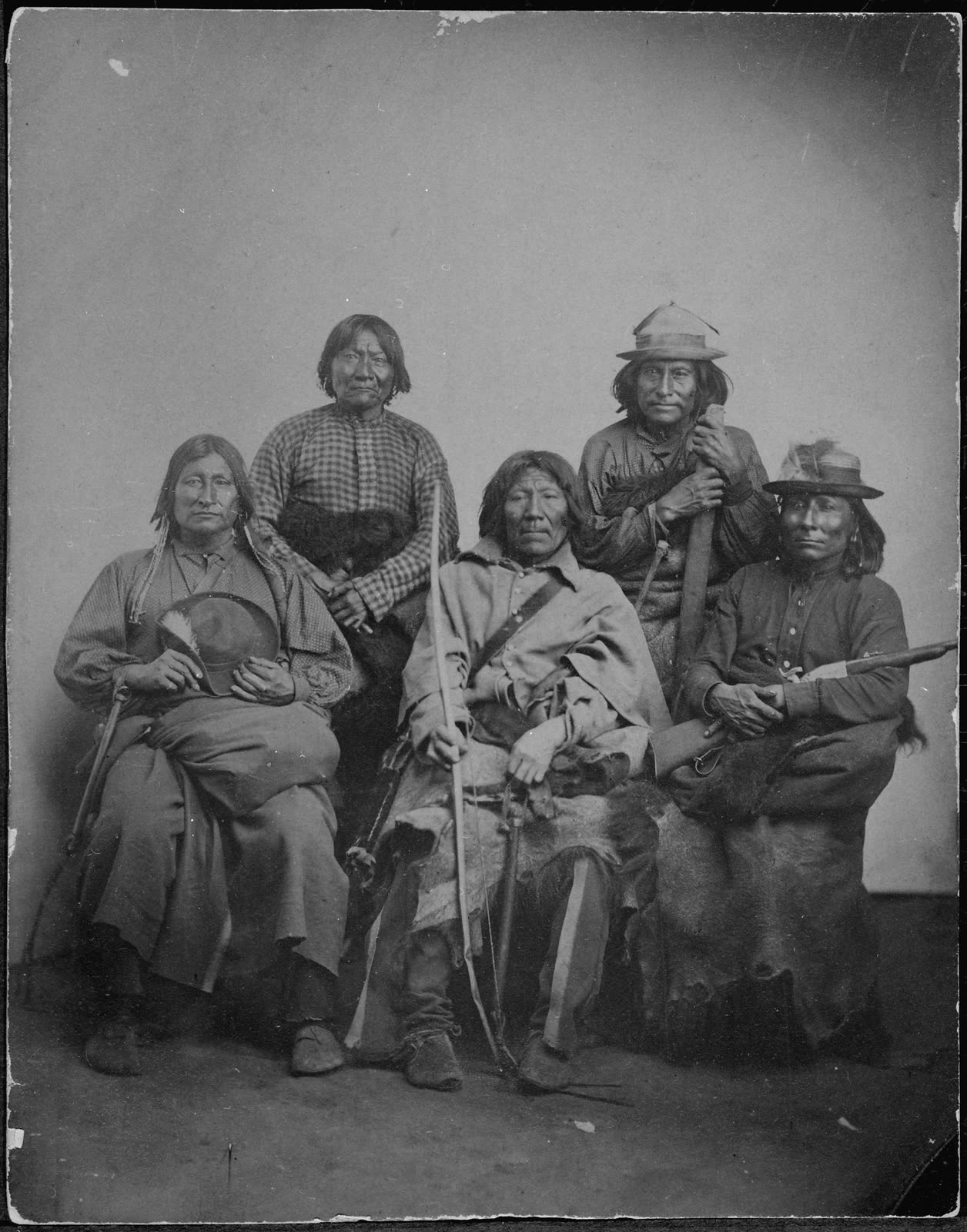
Neither was the principal occupant of what is now Montague County. But both left marks — the Caddo through cultural kinship with the Wichita peoples who were the county’s primary agricultural residents, and through trade networks that made the Red River corridor economically significant long before any European eye reached it. The Tonkawa through their role, complicated and often coerced, as scouts in the frontier conflict era. Both nations survive today as federally recognized sovereign nations in Oklahoma.
Caddo and Tonkawa peoples appear in Montague County’s documentary record primarily through Spanish colonial sources and later academic reconstruction. Tribal consultation pending — Caddo Nation and Tonkawa Tribe perspectives on trade routes, scouting, and movement through north Texas are not yet incorporated. Claims here reflect what colonial and secondary sources recorded.
1. The Caddo Confederacy
Who They Were
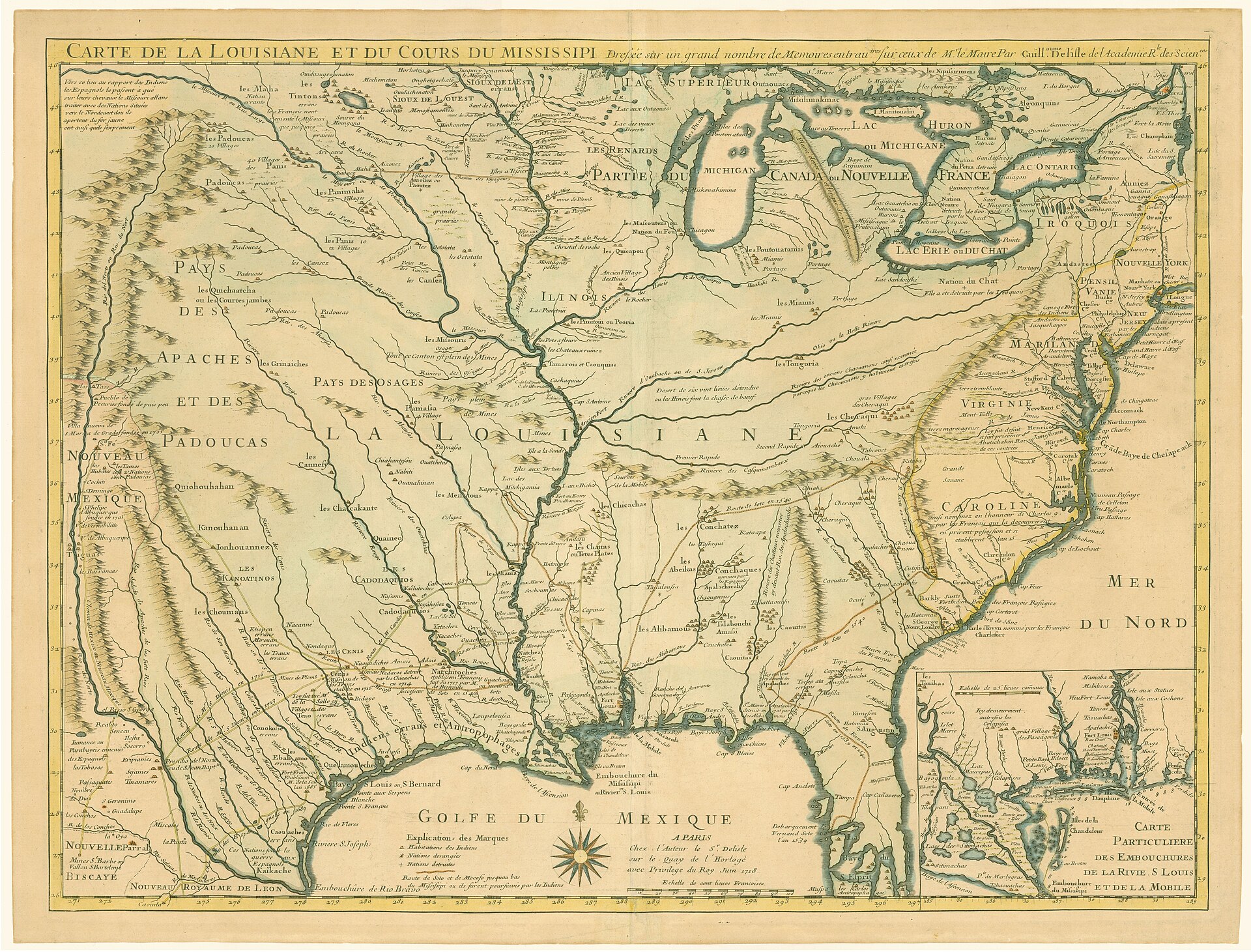
The Caddo were a confederation of related peoples — the Hasinai, the Kadohadacho, the Natchitoches, and others — speaking languages of the Caddoan family, which also includes the Wichita and Pawnee languages. Their core territory was the Pineywoods of east Texas, southwestern Arkansas, and northwestern Louisiana: a region of high rainfall, rich soils, and dense forests that supported one of the most populous Indigenous civilizations of pre-contact North America. Pre-contact population estimates run to 250,000 or more across all Caddo peoples.
Caddo civilization was agricultural, permanent, and architecturally ambitious:
- Mound-builders — Caddo communities built earthwork mounds for ceremonial and elite-residential purposes; major complexes include Caddo Mounds State Historic Site in east Texas, Mounds Plantation, and Spiro Mounds in Oklahoma
- Agricultural specialists — corn, beans, squash, sunflowers, tobacco, gourds; surplus production supported populations larger than mobile-hunting peoples in comparable territory
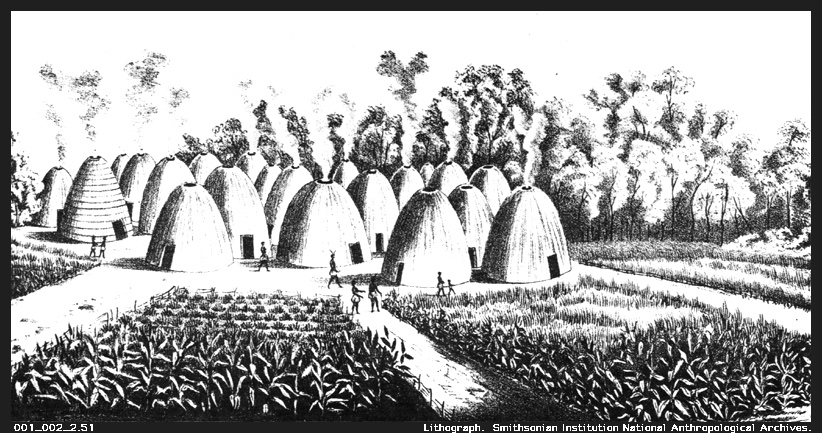
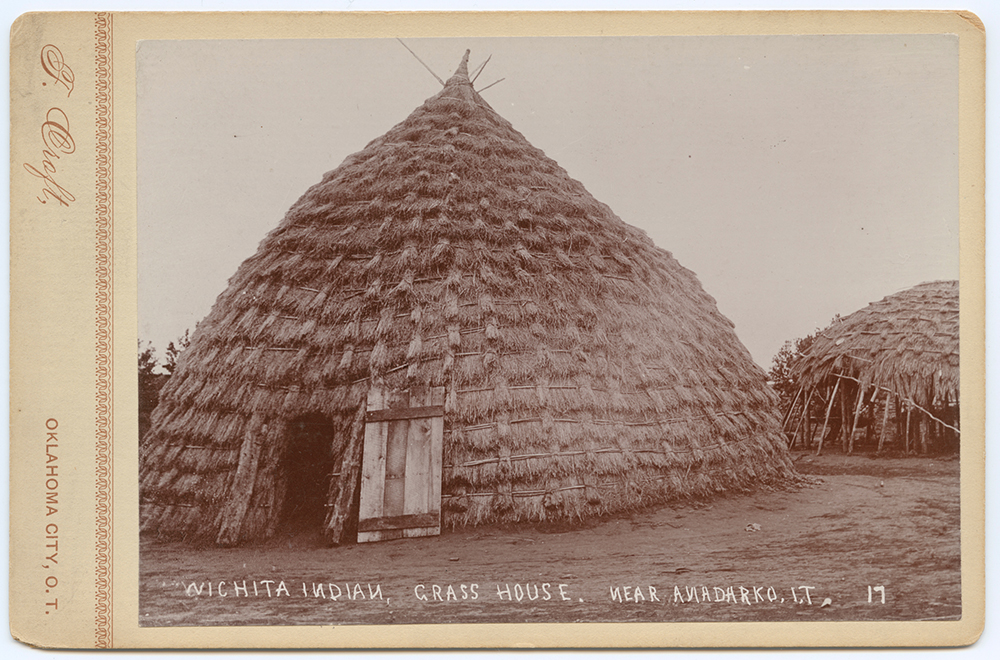
- Permanent towns with grass-thatched dome lodges similar to Wichita lodges — the architectural similarity reflects the linguistic relationship
- Pottery of exceptional quality; Caddo ceramics are among the finest in pre-contact North American traditions
- Trade networks — Caddo merchants connected the Mississippi Valley to the southern Plains; goods including bois d’arc bow staves moved through Caddo-organized networks reaching from east Texas to the central Plains
The MoCo Connection
The Caddo proper were not the principal Indigenous occupants of Montague County. That role in the documented period (1700s–early 1800s) belonged to Wichita-Caddoan peoples — specifically the Taovaya and related groups covered in Taovaya and Wichita Peoples. But the connection between Caddo and MoCo’s region runs through several threads:
Linguistic and cultural family. Wichita peoples spoke a Caddoan language. The Taovaya village at Spanish Fort was, in linguistic terms, a Caddoan-family settlement. The grass-thatched dome lodge architecture, the agricultural economy, the trade-network orientation, the pottery style — all reflect a shared cultural tradition spanning from east Texas’s deep Pineywoods to the Red River bluff in northern Montague County.
Bois d’arc trade. The bois d’arc tree (Maclura pomifera — Osage orange) has its native range concentrated in the Red River valley of north Texas, southern Oklahoma, and southwestern Arkansas. Montague County’s Red River corridor is in the heart of this range. The wood was the most prized bow-making material on the Plains: dense, flexible, rot-resistant, producing a bow superior in performance to any other available wood. Caddo and Wichita-Caddoan peoples were the principal sources of bois d’arc bow staves, which moved through trade networks reaching peoples whose territories did not include the tree’s native range. The Red River corridor was commercially significant in pre-contact North America partly because of this tree.
Colonial pressure parallel. Caddo peoples were caught between Spanish and French colonial powers in ways that paralleled the Wichita experience. The same French trade networks that armed the Taovaya with firearms by the mid-1700s also ran through Caddo territory. The same Spanish missionary agenda that produced San Sabá mission also produced earlier, less violent but equally unsuccessful, mission efforts among Caddo peoples in east Texas.
Decline and Removal
Caddo populations suffered catastrophic epidemic losses through the 18th and 19th centuries. Estimates of the mortality from successive smallpox waves and other introduced diseases run to 90 percent or more from pre-contact levels. The 1835 Treaty of Caddo was the first US-Caddo treaty. In 1859, Caddo peoples were forcibly removed from Texas to Indian Territory in Oklahoma alongside other Indigenous peoples. The modern Caddo Nation is headquartered at Binger, Oklahoma, with 6,000 or more enrolled members, and maintains active cultural programs, language revitalization efforts, and government services.
2. Tonkawa Peoples
Who They Were
The Tonkawa were a small Indigenous nation of central Texas, speaking a Tonkawan language with no confirmed close relatives — a linguistic isolate, or at most a distantly related outlier, in a region of otherwise well-characterized language families. Their territory centered roughly on the Brazos River south, shifting in response to pressure from all sides; their range did not centrally include Montague County but touched the southern fringes of Comanche territory.
Tonkawa lifeways differed fundamentally from the Caddo or Wichita model:
- Mobile hunters and gatherers — not village agriculturalists
- Seasonal bison hunting across central Texas ranges
- Wild plant gathering supplementing the hunting economy
- Smaller population — pre-contact estimates in the low thousands, substantially smaller than the agricultural Caddo or Wichita peoples
- Distinct language and culture that set them apart from all surrounding nations
Relations With Other Peoples
Tonkawa were persistently vulnerable. Their small population, mobile lifestyle, and lack of a fortified village base put them in a structurally weak position in a region contested by Comanche, Apache, Spanish, and Anglo-Texan power. They were often hostile to Comanche peoples — a hostility that had a long pre-contact history and reflected genuine competition for territory in central Texas.
This hostility to Comanche made the Tonkawa, paradoxically, sometimes useful to colonial and later Anglo-Texan forces. If the enemy of your enemy is your potential ally, the Tonkawa occupied that position in the frontier conflict era.
Tonkawa as Scouts
In the mid-19th century, Tonkawa peoples served as scouts for Texas Rangers, the US Army, and Anglo-Texan military operations against Comanche, Kiowa, and Apache peoples. This scouting role:
- Reflected genuine Tonkawa hostility to Comanche, not merely coercion
- Created lasting hostility from Comanche and Kiowa peoples who viewed Tonkawa cooperation with Anglo forces as betrayal
- Contributed to the Anadarko massacre of 1862 — Tonkawa peoples at the Wichita Agency in Indian Territory were attacked by other Indigenous peoples (including some Caddo, Wichita, and others), resulting in approximately 137 Tonkawa killed out of a population of roughly 300
- Was a factor in Tonkawa population collapse; the nation never fully recovered numerically
Tonkawa scouts may have participated in Texas Ranger expeditions through Montague County’s region during the frontier conflict era (1849–1875). Specific documentation of Tonkawa scouting activity in MoCo has not been found in available sources and requires further archival research to confirm.
Removal and Modern Status
Tonkawa peoples were removed from Texas to Indian Territory in 1859, a removal wave that affected multiple Indigenous nations. The 1862 Anadarko massacre devastated the population, and survivors were relocated multiple times through the late 19th century. The modern Tonkawa Tribe of Oklahoma is headquartered at Tonkawa, Oklahoma, with under 1,000 enrolled members. They maintain tribal government, cultural programs, and historical preservation efforts.
3. Other Peoples in the Broader Contact Zone
Montague County’s pre-Anglo Indigenous landscape included several other peoples with peripheral or temporary connections worth noting:
Apache peoples. Lipan Apache and Mescalero Apache peoples ranged across central and west Texas. In the period before Comanche dominance solidified (roughly before 1750), Apache groups were the stronger power in north Texas. They were pushed south and west by Comanche expansion and did not hold MoCo’s region in the documented period. Periodic Lipan Apache raiding into MoCo’s area during the frontier era (1849–1875) is documented.
Five Civilized Tribes. Cherokee, Choctaw, Chickasaw, Creek, and Seminole peoples were forcibly removed from the southeastern US to Indian Territory (present-day Oklahoma) through the 1830s. Their territories did not include Montague County, but their proximity immediately north of the Red River made that boundary politically and culturally significant through the frontier era and afterward.
Kickapoo peoples passed through Texas in multi-stage forced migration through the 19th century; some ended up in northern Mexico, others on Kansas and Oklahoma reservations.
4. The Interlocking Indigenous Layer
A useful summary of the pre-Anglo Indigenous occupation of MoCo’s region:
- Wichita peoples (Taovaya and related groups) — primary occupants of the Red River corridor in the documented period (1700s–early 1800s); agricultural village-dwellers; eventually displaced through epidemic, Comanche pressure, and colonial conflict. See Taovaya and Wichita Peoples.
- Comanche and Kiowa peoples — dominant from roughly 1800 through 1875; mobile horse-warriors whose territory (Comanchería) included MoCo’s region during the peak expansion period. See Comanche and Kiowa.
- Caddo peoples — eastern relatives and linguistic kin of the Wichita; displaced by Anglo-American pressure; cultural and trade connections reaching into the Red River corridor through the Wichita.
- Tonkawa peoples — small mobile group; sometimes scouting for Anglo-Texan forces against Comanche; population devastated by the 1862 Anadarko attack.
- Apache peoples — earlier dominance before 1750; periodic later raiding.
- Five Civilized Tribes — relocated to Indian Territory immediately north of the Red River; defining the boundary politically.
All of these peoples were effectively displaced from MoCo’s region by 1875, opening the way for Anglo-Texan settlement, the cattle drives, and the cotton and oil economy that followed.
5. Modern Nations
All principal nations mentioned here have federal recognition and active cultural programs today:
- Caddo Nation — Binger, OK; caddonation-nsn.gov
- Tonkawa Tribe of Oklahoma — Tonkawa, OK; tonkawatribe.com
- Wichita and Affiliated Tribes — Anadarko, OK; wichitatribe.com
- Comanche Nation — Lawton, OK; comanchenation.com
- Kiowa Tribe — Carnegie, OK; kiowatribe.org
Each nation maintains active cultural programs today. Tribal consultation pending — Caddo Nation and Tonkawa Tribe perspectives on oral history, trade routes, and presence in the Red River corridor are not yet incorporated here.
References
Texas State Historical Association. “Caddo Indians.” Handbook of Texas Online. Retrieved 2026-05-06. https://www.tshaonline.org/handbook/entries/caddo-indians
Texas State Historical Association. “Tonkawa Indians.” Handbook of Texas Online. Retrieved 2026-05-06. https://www.tshaonline.org/handbook/entries/tonkawa-indians
Texas State Historical Association. “Hasinai Indians.” Handbook of Texas Online. Retrieved 2026-05-06. https://www.tshaonline.org/handbook/entries/hasinai-indians
Smith, F. T. The Caddo Indians: Tribes at the Convergence of Empires. Texas A&M University Press, 2000.
Newcomb, W. W. The Indians of Texas: From Prehistoric to Modern Times. University of Texas Press, 1961.
Sjoberg, A. F. The Tonkawa Indians. Texas Memorial Museum, 1951.
DeMallie, R. J., ed. Handbook of North American Indians, Volume 13: Plains. Smithsonian Institution, 2001.
Caddo Nation. caddonation-nsn.gov. Retrieved 2026-05-06.
Tonkawa Tribe of Indians of Oklahoma. tonkawatribe.com. Retrieved 2026-05-06.
Texas Historical Commission. “Caddo Mounds State Historic Site.” thc.texas.gov. Retrieved 2026-05-06.
Related pages: Taovaya and Wichita Peoples | Comanche and Kiowa | Battle of the Twin Villages | Old Spanish Fort