The visual identity of Montague County’s interior uplands is set by two trees: post oak (Quercus stellata) and blackjack oak (Quercus marilandica). Gnarled, relatively small, with thick bark and leathery leaves, they grow on the sandy, acidic soils of the Western Cross Timbers in dense scrub patches and open savannah formations that give the county’s wooded terrain its characteristic look. Neither produces valuable timber. Both are exceptionally well-adapted to conditions that would stress or kill more commercially valuable tree species.
What Post Oak Is
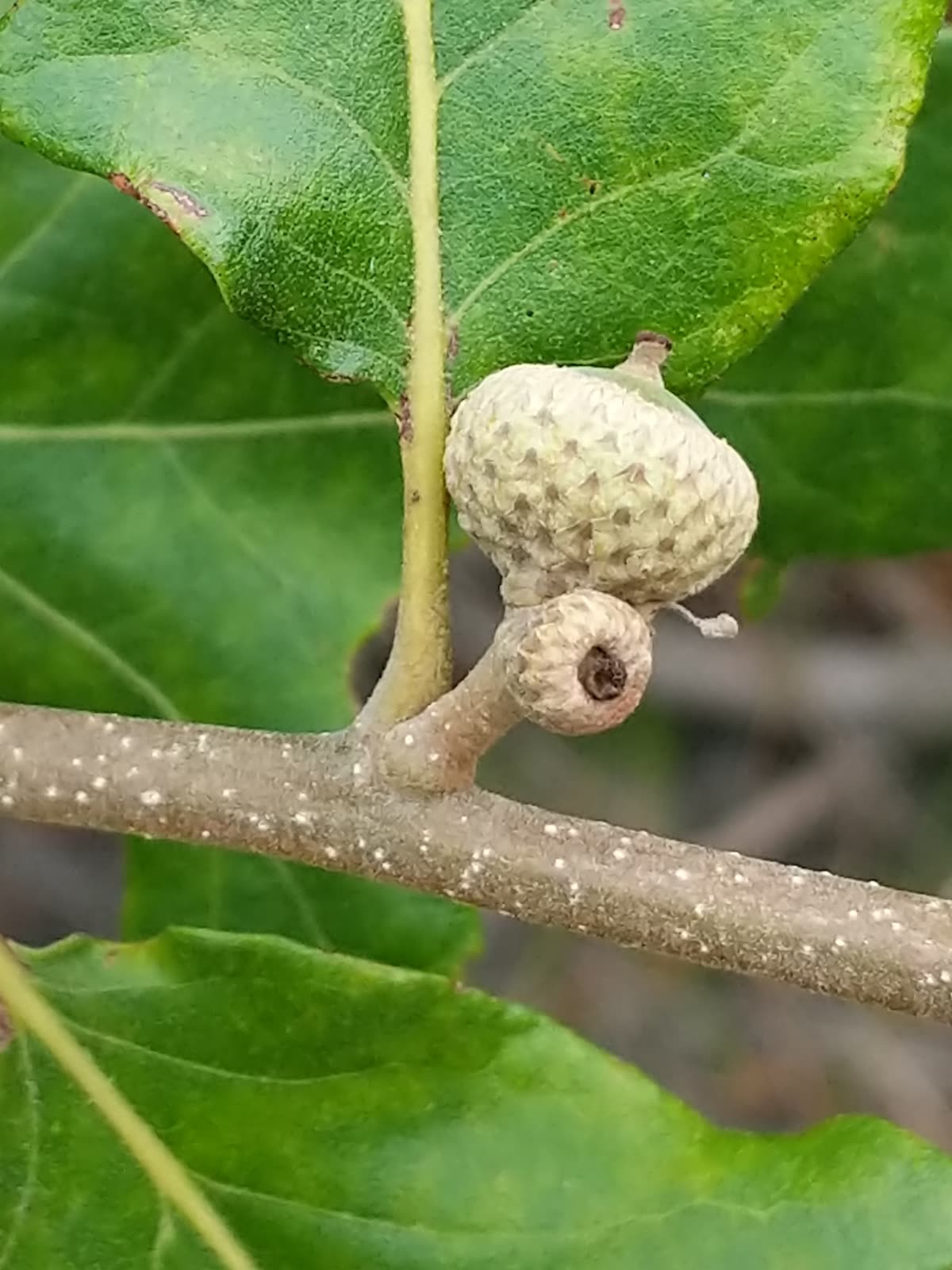
Post oak is a medium-sized oak — typically 40 to 70 feet at maturity in good sites, often shorter and more spreading on the droughty Cross Timbers soils where it most commonly grows in MoCo. The distinctive leaf has a cross-shaped or plus-sign silhouette that distinguishes it from other oaks. Bark is gray and plated; acorns are small with a deep cup. The common name “post” reflects historical use: the wood is hard, rot-resistant, and durable for fence posts even without treatment, making it valuable in a region where hardwood timber was scarce.
Blackjack oak is the companion species, often growing in the same patches. Its leaves are shaped like a duck’s foot — broad at the tip, narrowing to the base. Blackjack grows smaller than post oak, often shrubby, and tolerates even poorer soils. Where the Cross Timbers grades into its most degraded, sandiest upland sites, blackjack may be the only canopy tree standing.
Why These Trees Dominate Here
Three factors converge to create post oak and blackjack oak country:
Soils: The Windthorst, Konsil, and Konawa soil series that underlie much of MoCo’s Cross Timbers terrain are sandy, acidic, and moderately to poorly fertile. They drain quickly, dry out fast, and do not support the mesic hardwoods of East Texas. Post oak and blackjack evolved specifically for these conditions.
Rainfall: At roughly 28 to 34 inches of annual rainfall, MoCo is in the transitional zone between forest and prairie. Enough moisture to support trees; not enough for closed-canopy woodland. The result is savannah — scattered to clustered oaks with open, grassy understory — when fire and grazing maintain the balance.
Fire history: Periodic fire — both lightning-ignited and deliberately set by Indigenous peoples — historically kept the post oak savannah open, burning away brush and cedar seedlings and maintaining the mosaic of woodland and grassland that the system evolved with. Fire suppression through the 20th century has allowed eastern red cedar, mesquite, and greenbriar to fill former open areas, thickening what settlers described as more open timber into denser brush.
Ecological Role
Post oak and blackjack produce reliable acorn crops that are a critical mast resource for white-tailed deer, wild turkey, squirrels, and a range of smaller wildlife. The dense scrub formed by these oaks in their Cross Timbers growth habit provides cover that game birds — quail, turkey — depend on. The sandy-soil habitat beneath these oaks supports a distinctive suite of native wildflowers and grasses, including associations documented in the Cross Timbers ecoregion literature.
For the full ecoregion context, see Cross Timbers Ecoregion. For tree species in the riparian corridor, see Native Trees of Montague County.
Related: Cross Timbers Ecoregion | Native Trees | Native Wildflowers