Montague County is not bat country in the way Bracken Cave or the Congress Avenue Bridge in Austin are bat country — no multi-million-bat spectacular emergence, no famous cave system. What MoCo has is quieter and more diffuse: a representative cross-section of north Texas bat fauna spread across bridge roosts, old buildings, tree hollows, and rocky outcrops, performing around-the-clock insect control that is economically significant even when it goes mostly unseen.
Why MoCo Has Few Natural Caves
The famous Texas caves — Bracken Cave, Wonder Cave, the caverns of the Hill Country and Edwards Plateau — form in karst limestone: soluble bedrock that groundwater dissolves over millennia into chambers, passages, and sinkholes. Montague County’s geology runs differently.
Most of MoCo sits on Permian and Pennsylvanian sandstone, the substrate underlying the Cross Timbers ecoregion. Sandstone does not dissolve into caves the way limestone does. The western fringe of the county brushes against Cretaceous limestone at the Grand Prairie edge, but exposures there are minor and surface caves are not documented. The Red River corridor adds alluvial bottomland to the picture — equally inhospitable to natural cave formation.
The result is that MoCo’s bats have adapted to the same alternative roosts that support most of Texas’s urban and suburban bat fauna: the expansion joints of highway bridges, the attics and wall cavities of old buildings, hollow trees, and crevices in rocky bluff exposures.
Bat Species in Montague County
Mexican Free-Tailed Bat (Tadarida brasiliensis)
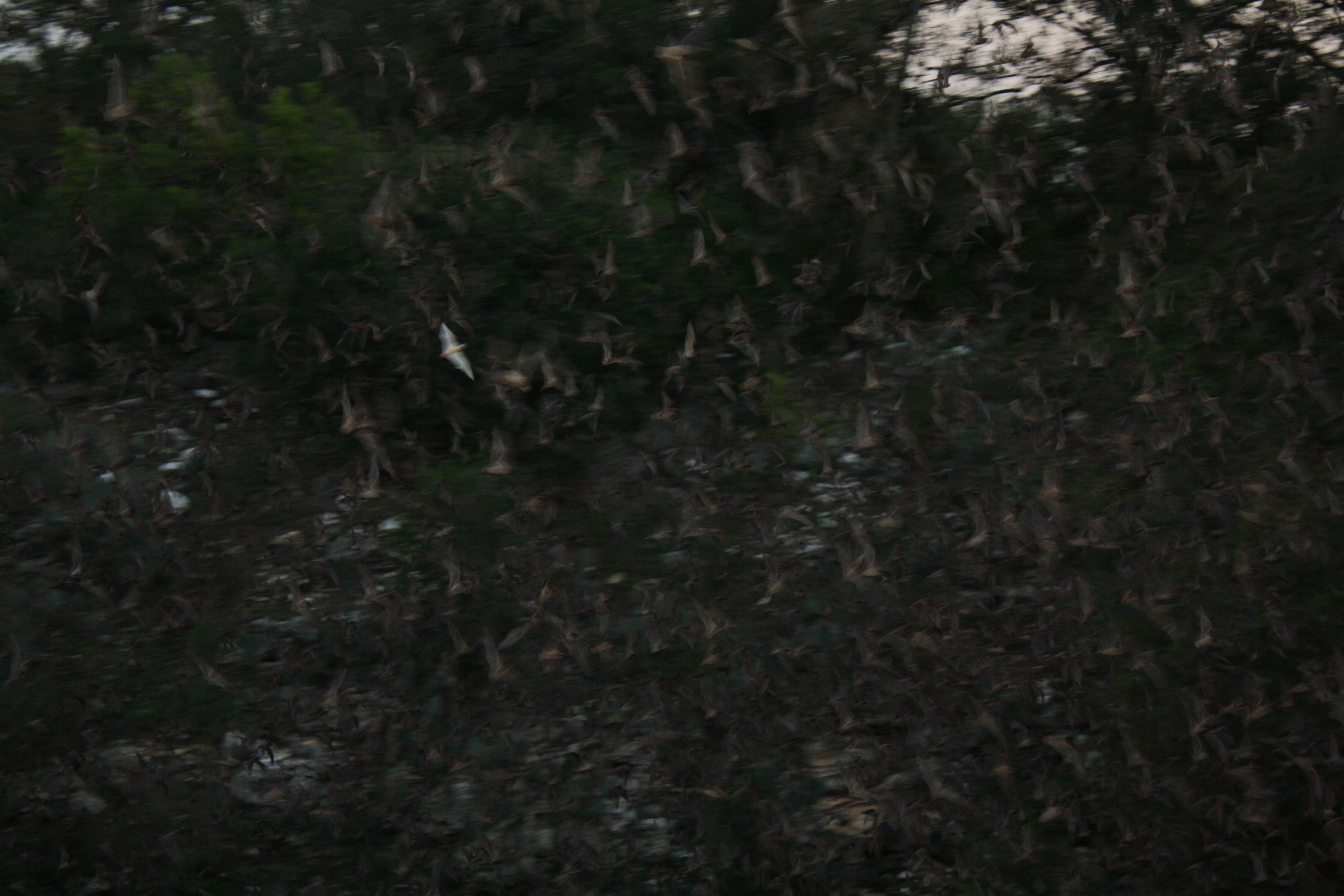
The most numerous bat in Texas and the likely dominant species in MoCo. Long, narrow wings; fast direct flight at heights of 30–1,000 feet; eats moths, beetles, and flying insects by the thousands per night. Migratory: spring and summer residents, wintering in Mexico. This is the species that forms spectacular bridge colonies across Texas, and MoCo’s larger highway bridges — US-287, US-81, and significant FM-road crossings — likely support free-tail colonies. Specific colony surveys have not been published in accessible records; this is a standing research gap.
Big Brown Bat (Eptesicus fuscus)
Year-round resident. Roosts in buildings, hollow trees, and occasionally caves. Larger than free-tails; tends to be a solitary or small-colony species. The bat most often found in attics and wall voids of rural homes.
Eastern Red Bat (Lasiurus borealis)
A tree-roosting solitary bat — the males are bright red-orange, females a more muted russet — that hangs from foliage or tucks under bark. Common in Cross Timbers woodland and bottomland forest. Migratory; summer breeder. Probably MoCo’s most-seen bat species at yard level, hunting around porch lights on summer evenings.
Hoary Bat (Lasiurus cinereus)
The largest bat in North America by wingspan. Silvery frosted fur; tree-roosting and migratory. Uncommon; occasional over MoCo.
Eastern Pipistrelle / Tri-Colored Bat (Perimyotis subflavus)
A small woodland bat that roosts in caves and buildings; one of the species most heavily affected by white-nose syndrome (see below).
Additional Species
Little brown bat (Myotis lucifugus), cave myotis (Myotis velifer), silver-haired bat (Lasionycteris noctivagans), and pallid bat (Antrozous pallidus) have ranges that include or approach MoCo, with varying certainty of local presence.
Where to Find Bat Roosts in MoCo
Bridge Roosts
Texas highway bridges are the most productive bat habitat in urbanizing and rural Texas alike. The expansion joints, rail channels, and underside textures of concrete highway bridges create ideal roost cavities that can shelter from dozens to tens of thousands of free-tailed bats. TxDOT has developed bat-friendly bridge design standards and consultation protocols for major construction projects.
In MoCo, the most likely bridge-colony sites are larger spans over water on US-287 and US-81. Dusk emergence flights from bridge roosts in summer — the column of bats exiting before dark — are viewable from a respectful distance without any special equipment.
Building Roosts
Old barns, abandoned farmhouses, historic courthouses, and similar structures shelter big brown bats, free-tails in small numbers, and occasionally other species. Guano accumulation under long-established roosts can build significantly; cleanup of large guano deposits should follow health-protective protocols (histoplasmosis risk from fungal spores is real, though modest for casual exposure).
Tree Roosts
Eastern red bats, hoary bats, and silver-haired bats are foliage-roosters. Cross Timbers woodland, bottomland pecan groves, and any mature tree habitat supports tree-roosting species. These bats are solitary and cryptic; spotting them requires luck.
Ecological Role
A single Mexican free-tailed bat can consume hundreds to thousands of insects per night. At colony scale, the cumulative suppression of corn earworm, cotton bollworm, mosquito, and other pest populations delivers economic value that researchers have estimated in the tens of millions of dollars annually for Texas agriculture.
MoCo’s agricultural character — rangeland, hay production, row crops in some areas — benefits directly from this around-the-clock insect control. The bats don’t need much credit; they do the work invisibly.
Threats
White-nose syndrome (WNS) is the most significant bat-conservation crisis in North American history. The fungal pathogen Pseudogymnoascus destructans invades hibernating bats, disrupting torpor and causing mass mortality. The disease was confirmed in Texas in 2017 and has been spreading. Species at highest risk include little brown bat, tri-colored bat, cave myotis, and big brown bat. The Mexican free-tailed bat’s migratory habit (rather than cold-cave hibernation) offers some protection. MoCo’s lack of major cave systems may limit the scale of WNS impact locally, but building- and bridge-roosting populations are not immune.
Habitat loss affects tree-roosters most directly: removal of mature trees with cavities, demolition of old barns, and bridge replacement (new designs sometimes less bat-friendly) all reduce roost availability. Wind energy development — a growing regional industry — creates bat mortality from blade strikes and barotrauma; MoCo’s wind footprint is currently limited but expanding.
Pesticide use reduces insect prey and can directly harm bats through secondary poisoning.
Disturbance of maternity roosts from May through July — when pups are flightless and dependent — can cause colony abandonment and pup mortality. This is the most direct human-caused disruption to local bat populations.
Bat Watching
MoCo doesn’t offer a famous emergence-flight spectacle, but bat watching is genuinely accessible:
- Bridge emergence at dusk — identify a likely highway bridge over water and watch from a distance at sunset in summer. Free-tailed bats exit in a column before full dark.
- Yard watching — any summer evening with porch lights attracts foraging bats. Eastern red bats hunting moths around a light are easy to observe.
- Bat houses — rural property owners can install bat houses to attract resident colonies. Properly sited bat houses (warm exposure, appropriate height) can become occupied within a season or two.
Related nature topics: Cross Timbers Ecoregion | Dark Skies | Native Mammals