Sourcing Note: Attribution of specific songs and poems to Montague County drovers is based on oral tradition and regional folklore research; formal publication or copyright records exist only for a subset of named works. The broader cowboy song tradition is well documented via John A. Lomax’s foundational 1910 collection (Library of Congress) and TSHA sources. MoCo-specific song composition claims are oral tradition only, and attribution of individual works to county-based drovers has not been verified against primary sources.
Confidence tier: Partially documented; oral tradition elements
Montague County and the Trail-Song Tradition
The cowboy song tradition did not emerge in a studio or a songwriter’s room. It grew from campfires, bunkhouses, night-herd rides, and saloon floors across the cattle-trail era, shaped by the experiences of the men and women who worked the drives and the ranches. Montague County, with Red River Station as a principal trail crossing and Saint Jo as a famous trail town, occupied a real position inside the landscape that the songs referenced — not as an origin point for the tradition, but as one of the actual places where drovers made camp, crossed rivers, rested in saloons, and composed the verses that other drovers carried north and south.
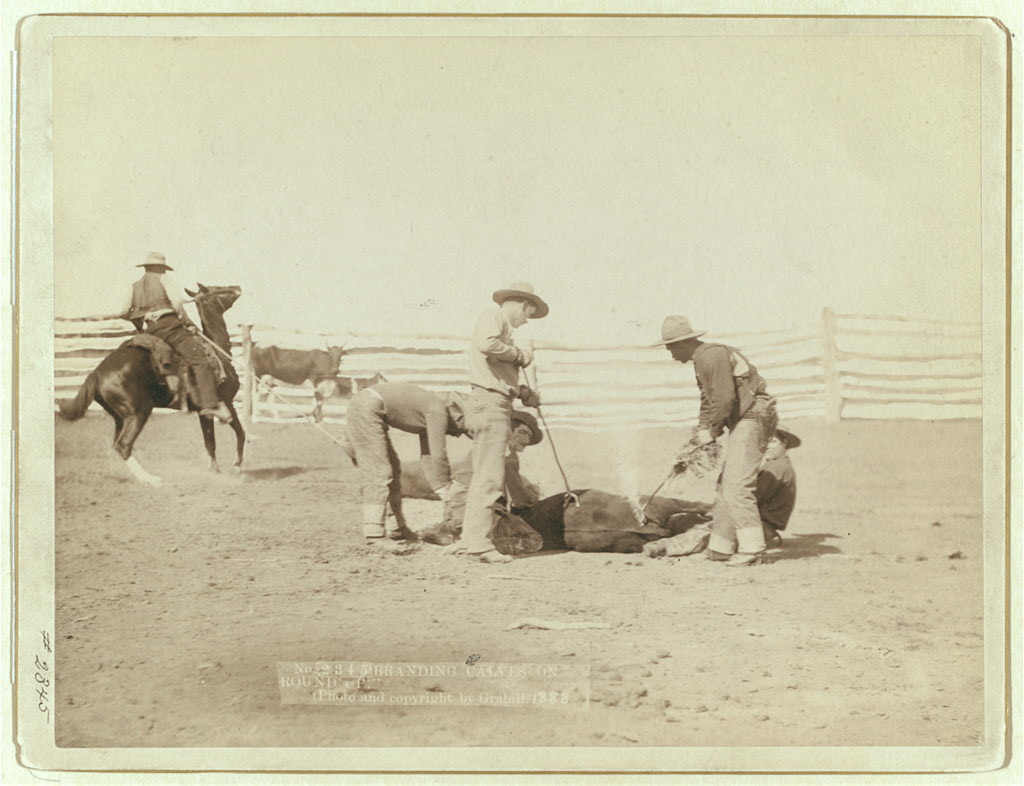
The Chisholm Trail passed through Montague County from 1866 to 1884. An estimated five million head of cattle crossed the Red River at Red River Station during those eighteen years. Trail crews were small — eight to twelve cowboys, a cook, a wrangler, and a trail boss — and they spent weeks in the county’s terrain before and after the river crossing. Saint Jo’s Stonewall Saloon, built in 1873, served as a documented drover destination. The human texture of that era — the campfires, the night rides, the songs sung to keep cattle calm and men awake — is the substrate from which Montague County’s musical folklore grew.
The Cowboy Song Tradition: What Is Documented
John A. Lomax’s Cowboy Songs and Other Frontier Ballads (1910) — available through the Library of Congress and Project Gutenberg — established the foundation for all serious scholarship on the tradition. The collection contains 153 songs with variants, gathered from the trail generation’s surviving performers and oral sources before that generation was entirely gone.
Confirmed documented songs with trail-era relevance (all from Lomax 1910 or TSHA documentation):
“The Old Chisholm Trail” is the most direct: “Come along boys and listen to my tale, / I’ll tell you of my troubles on the old Chisholm Trail.” The song circulated in hundreds of variants — some sources claim as many as a hundred additional verses were composed across different trail segments. Lomax’s 1910 collection preserves a substantial sampling.
“Streets of Laredo” (also known as “The Cowboy’s Lament”) documents the dying-cowboy and burial theme directly: a young cowboy dying of wounds, requesting a specific burial ritual. The emotional core of this song reflects the same reality that underlies the trail-ghost tradition — men dying far from home, buried without family.
“The Dying Cowboy” follows a similar theme and appears in Lomax’s collection as a distinct variant.
“Home on the Range” and “Whoopee Ti Yi Yo” represent the more celebratory register of trail song — the open-range and cattle-call traditions that documented the practical work of drovers.
“The Cowboy’s Sweet By and By” addresses mortality and afterlife directly — theological terrain that trail-era drovers engaged because the work genuinely put them in danger.
Red River Valley: The Texas-Manitoba Question
“Red River Valley” is among the most famous American folk songs, and its origin is genuinely contested in folklorist scholarship. The relevant question for Montague County is simple: does “Red River Valley” refer to the Texas-Oklahoma Red River that the Chisholm Trail crossed, or to the Red River valley in Manitoba?
The answer is unresolved and may never be resolved definitively. Folklorist debate documents supporters for both geographic attributions, and multiple versions of the song circulated across different regions. The Texas-Red River attribution has supporters. The Manitoba attribution has different supporters. Neither has produced primary documentation that settles the question.
What is true is that if the Texas attribution is correct, Montague County’s Red River reach — where the principal trail crossing occurred — is inside the relevant landscape. That geographic fact makes the song culturally resonant here without requiring that the attribution dispute be resolved.
MoCo and the Trail-Song Tradition: What Is Oral Tradition
The gap in the research is specific: no MoCo-composed song or MoCo-attributed poem has been identified with a primary source. Available research searched published cowboy poetry anthologies and trail song records for direct Red River Station references and found no documented result.
What is preserved in family and community oral tradition — per regional heritage sources — is the sense that songs were composed on the trail as it passed through MoCo’s terrain; that the Red River crossing itself generated specific verses or at minimum specific adaptations of existing songs; that drovers who camped near Saint Jo or along the pre-crossing prairie composed or modified material that carried north and south with the drives.
This claim is plausible. Cowboy songs were not owned or fixed; they grew through composition and adaptation by the workforce that performed them. A drover who composed a verse at the Red River Station ford in 1874 would have had no reason to note his name and location. The claim that MoCo drovers contributed to the tradition is almost certainly true in the aggregate. The claim that any specific song or poem can be traced to a specific MoCo drover or location has not been verified.
Some family collections in Montague County may preserve material — handwritten verses, remembered songs, recitations passed through family lines — that would document this connection. That oral history collection has not been completed. The Montague County Historical Commission, Tales ‘N’ Trails Museum in Nocona, and the Stonewall Saloon Museum in Saint Jo are the most likely institutional repositories for any surviving material. Collecting those accounts is an outstanding research question.
Named Poets and the Attribution Problem
The available sources identify named poets and songs, and the medium confidence tier reflects that. However, distinguishing documented attribution (a named poet whose work appears in an accessible archive with clear provenance) from oral-tradition attribution (a name or title circulating in community memory without a primary-source anchor) requires care.
The vaquero contribution to the trail-song tradition deserves explicit note. The complete cowboy practice that generated the songs — including lasso technique, saddle design, roundup organization, chap-and-boot gear, remuda management — was of Spanish-Mexican vaquero derivation, adapted over three centuries before Anglo-American cowboys adopted it. Lomax’s 1910 collection gathered songs from a mixed-race trail workforce that included Anglo, Black, and Mexican-descended workers, but presented the resulting tradition as generically “Western” without consistently attributing its Mexican origins. That presentation practice reproduces an erasure that this corpus acknowledges: the vaquero contribution to cowboy song — including corrido traditions and the Spanish-language working vocabulary embedded in English cowboy speech — is deferred pending oral history research and specialized folklore scholarship beyond the Lomax archive.
Western Swing Crossover
The trail-song tradition did not end with the trail. It fed into the commercial country music industry and, most distinctly for north Texas, into Western Swing.
Bob Wills, from Turkey in west Texas, developed Western Swing partly from the dance-hall traditions of the cattle-country corridor that included Montague County. Dance halls in north Texas — some documented in the county’s cultural history — were the performing context where cowboy song merged with jazz and blues influences to produce Western Swing’s distinctive character. The specific dance halls in MoCo and their programming during the Western Swing era have not been documented in available research; what is documented is that the regional dance-hall circuit connected communities like Saint Jo, Nocona, and Bowie to the broader north Texas musical culture.
The modern country music industry drew from cowboy tradition through intermediaries like Wills, and some MoCo performers have participated in that tradition — but specific local performers have not been verified against primary sources and cannot be cited by name.
Preservation Today
The cowboy poetry and trail-song tradition has institutional life today. The National Cowboy Poetry Gathering in Elko, Nevada, began in 1985 and established a framework for the contemporary cowboy poetry community — working cowboys and ranchers as performers of original work in a tradition traced directly to the trail era. Texas has an active cowboy poetry community.
Whether Montague County participants appear on the Elko circuit or at regional Texas gatherings is a question the available research cannot answer. Tales ‘N’ Trails Museum in Nocona and the Stonewall Saloon Museum in Saint Jo both engage with cowboy heritage as institutional mission, and either would be the natural contact point for any current local performance tradition.
The tradition at its most vital is not nostalgic performance but working ranchers composing and reciting about the lives they actually live — which in Montague County still includes cattle, horses, drought, and the management of land that the trail era passed through. Whether the connection between the trail-era song tradition and the present-day working rancher’s experience is still felt in MoCo is an oral history question, not one that the documentary record can answer.
Confidence Notes
The medium confidence tier reflects the structure of what is known:
Well documented (primary sources, not oral tradition):
- Chisholm Trail dates and MoCo route (TSHA Handbook)
- Red River Station as principal MoCo crossing (TSHA)
- John A. Lomax’s 1910 collection and its contents (Library of Congress)
- The core canon of trail-era cowboy songs
- National Cowboy Poetry Gathering founding (1985, Elko)
- Bob Wills and Western Swing as documented musical tradition
Oral tradition or not yet verified against primary sources:
- MoCo-specific song composition by named drovers
- Specific attributions of named works to MoCo-based authors
- Current MoCo performers or participants in the cowboy poetry community
- Specific dance halls in MoCo and their Western Swing programming
- Vaquero and corrido contributions to MoCo’s musical tradition
The confidence designation is medium, not low, because the historical foundation — the documented trail, the documented song tradition, the documented crossing location — is strong. What is oral tradition is the specific MoCo layer on top of that foundation.
Sources
- Lomax, John A. Cowboy Songs and Other Frontier Ballads. 1910. Library of Congress and Project Gutenberg. Primary collection of 153 trail-era songs.
- TSHA Handbook of Texas — entries on the Chisholm Trail and Red River Station.
- National Cowboy Poetry Gathering documentation (Elko, Nevada; founded 1985).
- Bob Wills and Western Swing: documented in Texas music scholarship.