Sourcing Note: Trail ghost stories are oral-tradition accounts collected from drover descendants and regional heritage sources; no contemporaneous written account of any supernatural event exists for the Chisholm Trail’s Montague County segment. The historical facts about the trail, its route, and the documented hazards that killed drovers are anchored in primary sources including J. Marvin Hunter’s Trail Drivers of Texas (1925) and the TSHA Handbook. The supernatural interpretations layered over those facts are folklore.
Confidence tier: Partially documented; oral tradition elements
The Trail Through Montague County
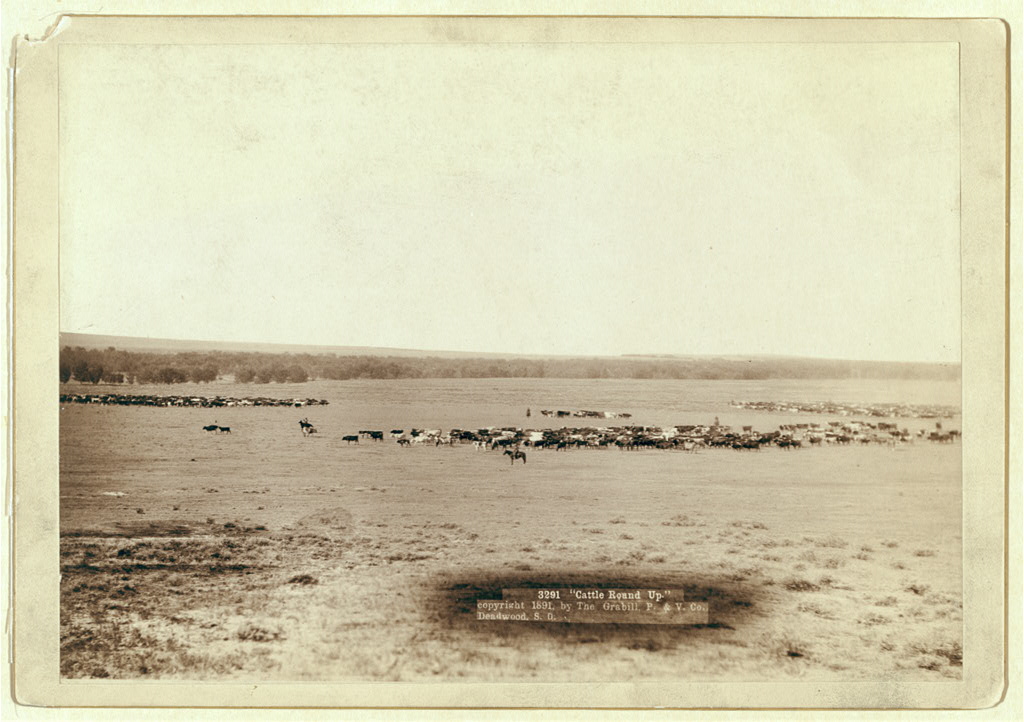
The Chisholm Trail passed through Montague County for eighteen years, from 1866 to 1884. It was not a romantic journey for the men who made it. An estimated five million head of cattle moved north through the county’s prairie corridors during those years, crossing the Red River at Red River Station in northwestern Montague County — a town that at its peak held 250 to 300 residents and served as the principal chokepoint for the entire drive.
The trail experience was genuinely dangerous. River crossings at Red River Station exposed men and cattle to currents that could shift without warning over unstable sandy bottoms. Cattle herds of three thousand head required hours to cross. Men were swept from horses. Horses lost footing. Cattle turned back midstream, creating churning masses that dragged swimming men under. J. Marvin Hunter’s The Trail Drivers of Texas (1925) — the most comprehensive primary collection of drover memoirs assembled in the trail generation — documents specific drowning deaths at Red River crossings, though individual accounts vary in geographic precision as to which crossing point is referenced.
Beyond the river, lightning struck cattle and cowboys on open prairie. Stampedes scattered herds across miles of rough country and occasionally crushed men attempting to turn them. Trail crews were small — a trail boss, eight to twelve cowboys, a cook, and a wrangler — and they moved through country far from any settlement capable of organized burial or memorial. When a man died on the trail, he was buried where he fell, marked by a wooden cross or rock cairn that weather and cattle traffic erased within years.
This combination — mass mortality, unmarked graves, violent deaths in isolated country, and the rapid disappearance of the trail town itself within a generation of the trail’s closure — created the precise conditions that folklore consistently uses to explain haunted landscapes. The ghost stories grew from the documented history. Understanding that history is required to understand why the stories took the shape they did.
For the full historical account of the Chisholm Trail’s passage through Montague County, see Chisholm Trail and Red River Station.
Drowned Cowboys of the Red River Crossing
Longtime residents of northwestern Montague County and the Nocona area have circulated accounts — through family storytelling chains rather than documented interviews — of a figure seen near the river bank during the spring months, when water is highest and the Red River’s characteristic red-brown color runs deepest. The figure is described variously as a cowboy in trail dress, sometimes on horseback, sometimes on foot near the water’s edge, who does not respond to hailing and who is gone when approached.
The oral tradition explicitly frames this apparition as a drowned drover from the trail era. The spring-season timing is not incidental: drive season ran March through August, and high-water crossings were spring events. The figure appears where the documented deaths occurred — at the ford itself, not at the town site or the cemetery.
No documented paranormal investigation report has been produced for the Red River Station crossing site specifically, and this account rests entirely on oral tradition circulating through family storytelling rather than documented witness statements with named sources.
The historical foundation is solid: people did drown at this crossing, the crossings were as dangerous as the oral tradition implies, and Hunter’s Trail Drivers of Texas preserves enough first-person testimony to establish that drowning was a recurring event, not a rare exception. The apparition that grew from that documented reality is, however, folklore — oral tradition only, without primary-source corroboration.
Ghost Cattle and the Phantom Herd
Among the most widespread archetypes in American drover ghost lore is the phantom cattle herd — a stampede or moving herd heard or glimpsed but found absent when sought. J. Frank Dobie, in Tales of Old-Time Texas (1955), documented multiple variants of this legend type across the cattle-country of south and central Texas, noting that the pattern recurs wherever stampede deaths were common. The ground remembers the animals and the men who died in the churning run.
The Montague County version of this tradition locates the phantom herd on the open prairie southeast of Red River Station, along the approximate route the trail followed approaching the river crossing from the south. Oral accounts circulating in the Saint Jo and Nocona areas through at least the mid-twentieth century — per regional heritage sources — describe the sound of cattle on a night when no cattle are present: hooves on hard ground, the low bawling of a large herd moving in darkness, and occasionally what sounds like a drover’s whip or the shout of a cowhand working the trail edges. The sounds are reported as most common on nights preceding a thunderstorm, which is precisely the atmospheric condition most likely to have caused trail-era stampedes.
The convergence of archetype and specific location is characteristic of how trail-era lore developed across cattle country: a documented hazard generates a regional folklore pattern, and the pattern attaches to the specific landscape where the hazard was experienced. The Dobie archetype is documented; the specific MoCo application is oral tradition only.
The Wandering Drovers of Saint Jo
Trail crews that lost a man on the trail buried him quickly and moved on. The drive could not wait; the trail boss had a delivery contract. This practical reality produced a landscape of unnamed graves distributed across the MoCo trail corridor. Hunter’s Trail Drivers of Texas includes first-person accounts from drovers who returned years later to search for graves of men they had buried and found nothing. The grief in those accounts — the impossibility of recovering the burial site — fed directly into the ghost-story tradition.
In the area around Saint Jo, which served as a famous trail-town stop for drovers moving north (the Stonewall Saloon, built 1873, was a documented destination), oral tradition preserves accounts of a figure in the town’s older residential areas — not the commercial district — described as wearing trail-era clothing and moving purposefully before vanishing. The Saint Jo version of the wandering-drover tradition is sometimes interpreted locally as a man who died in the town itself, perhaps from illness acquired on the drive. The accounts are neither internally consistent nor documentable — oral tradition only.
The wandering-drover archetype is not unique to Saint Jo; it recurs across trail-country communities from south Texas to Kansas. The shared foundation is the same: transient workforce, isolated deaths, impermanent burial, and the rapid disappearance of the trail.
The Night-Guard Ghost
Every large herd required a night guard — cowboys riding slow circles around the sleeping cattle in two-hour shifts, singing or talking softly to keep the animals calm. Lightning was the primary terror of the night guard’s hours. Cowboys on night guard were exposed to lightning strike themselves, riding elevated on horseback in open country during electrical storms. Trail records document multiple lightning fatalities among night-guard riders.
The north Montague County prairie between Saint Jo and the Red River — the last full day’s drive before the crossing — carries a localized oral tradition of a single rider moving slowly in a wide arc around a fixed point on nights with electrical storm activity, seen by people traveling the county roads that cross the historic trail route. The figure is interpreted in the tradition as a night-guard rider struck by lightning during a storm, killed before the crew found him at dawn. No specific name attaches to the figure in any version. The tradition is entirely oral — without primary-source corroboration.
The historical plausibility of the underlying event — a night-guard death by lightning strike in the MoCo corridor — is within the documented hazard profile of the trail era. The apparition tradition layers that plausible death onto the landscape where it could have occurred.
How the Stories Spread
The ghost-story tradition did not emerge immediately after the trail era ended. It developed across generations, shaped by the same forces Dobie identified in his fieldwork across Texas cattle country.
A trail that carried five million cattle and an unknown number of human deaths over eighteen years, through country with no capacity for systematic burial or memorial, left a charged landscape. The Red River Station cemetery preserves some period burials, but the majority of men who died along the MoCo stretch of the trail were interred in the surrounding grassland without record. A cemetery with weathered markers whose inscriptions are no longer readable gives physical weight to the ghost-story tradition: it confirms that people died at the crossing and were buried nearby, even when names and circumstances are now unrecoverable.
Communities along former trail routes — Saint Jo, Nocona, the former site of Red River Station — preserved memory of the trail era through family storytelling chains. Descendants of drovers who passed through MoCo sometimes carried accounts of deaths at the crossing. Heritage institutions including the Tales ‘N’ Trails Museum in Nocona and the Stonewall Saloon Museum in Saint Jo have preserved some of this oral material, though specific trail-ghost accounts from those collections have not yet been examined.
What Dobie established — and what holds for Montague County — is that the emotional truth of trail-era death exceeded what the documentary record could contain. The ghost stories are the overflow: oral tradition preserving the grief and danger of an era that ended before anyone thought to write it down systematically.
Confidence Notes
The medium confidence tier for this article reflects a specific structure: the historical foundation is well-documented, and the folklore tradition it generated is genuine oral tradition — but the supernatural claims themselves have no primary-source corroboration.
Confirmed historical anchors (supported by TSHA Handbook, Hunter 1925, Dobie 1955):
- Chisholm Trail passage through MoCo, 1866–1884
- Red River Station as primary crossing site, with documented drowning deaths
- Trail-era hazards: lightning, stampede, river crossing, disease
- Unmarked graves scattered across the trail corridor
- Dobie’s documentation of phantom-herd and wandering-drover archetypes across Texas cattle country
Oral tradition only (no primary-source corroboration):
- The drowned-cowboy apparition near the Red River Station ford
- The phantom-herd sounds on the north-county prairie
- The wandering-drover figure in Saint Jo’s older residential areas
- The night-guard ghost on the Saint Jo–to–Red River stretch
The distinction matters: what is documented is real history about a dangerous occupation and an era that left bodies in unmarked graves. What is oral tradition is the supernatural interpretation that accumulated on top of that real history. Both are worth knowing.
Sources
- Hunter, J. Marvin. The Trail Drivers of Texas. 1925. Primary collection of drover memoirs.
- Dobie, J. Frank. Tales of Old-Time Texas. 1955. Documents phantom-herd and wandering-drover archetypes across Texas cattle country.
- TSHA Handbook of Texas — entries on the Chisholm Trail and Red River Station.