Sourcing Note: Specific still locations and named-bootlegger stories in this article are oral-tradition accounts; the broader context of Prohibition-era bootlegging in North Texas is documented in county records and newspaper archives via the TSHA Handbook of Texas. No named MoCo moonshiner has been identified in the available primary sources at this research date. See the companion history article on prohibition and moonshine for the documented factual record. This folklore article covers the oral-tradition elaboration layer only.
Confidence tier: Partially documented; oral tradition elements
The Dry County Context
Before the folklore: the documented facts.
Montague County operated as a dry county under Texas law for much of the twentieth century, a status rooted in the same Methodist and Baptist church influence that shaped the broader North Texas cultural landscape. Texas state Prohibition began in 1918, two years before the federal 18th Amendment took effect in January 1920, and the 21st Amendment’s repeal in December 1933 did not automatically wet Montague County — local dry elections and Texas’s complex local-option law meant that individual counties and precincts could remain dry long after national Prohibition ended.
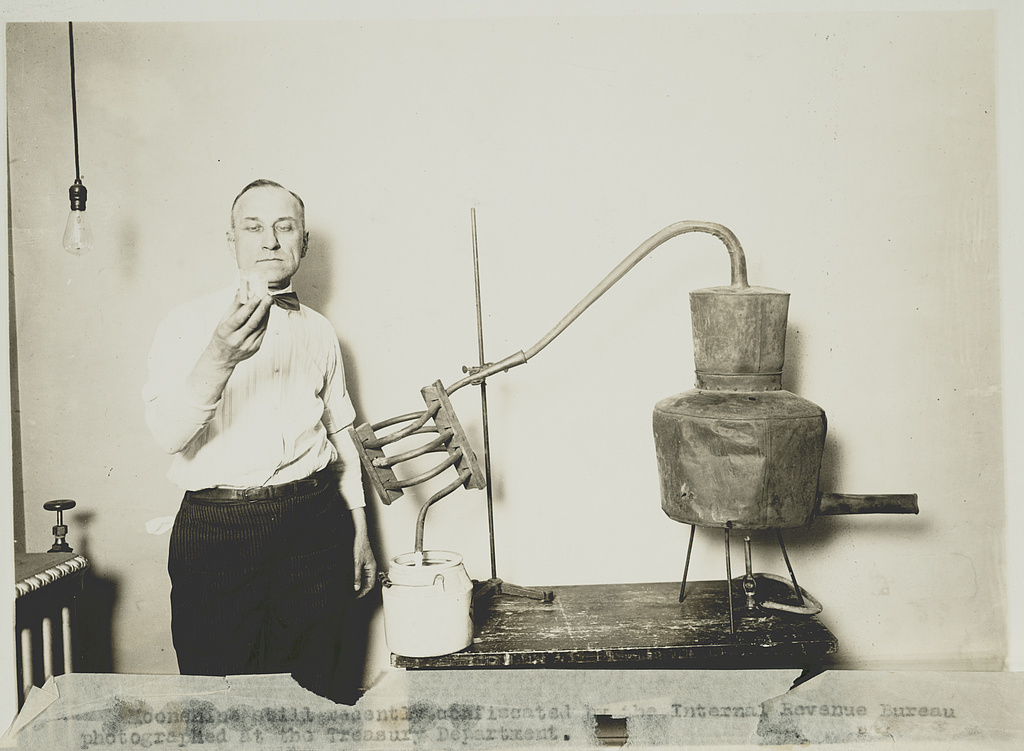
The practical consequence of dry-county status in an era of imperfect enforcement is that someone supplied the demand. Distilling and distributing was common across rural Texas during and after the Prohibition era. The TSHA Handbook of Texas documents the broader moonshining pattern in “Prohibition” and “Moonshining” entries, and that regional pattern unambiguously applies to Montague County. The facts documented in the companion history article — that the Cross Timbers terrain was suited to hidden stills, that enforcement was selective, that the practice continued after national Prohibition ended because federal excise tax kept illicit production economically attractive — are the documented ground on which the oral tradition rests.
This article is not the history article. It is the oral-tradition layer: the rumored geography, the character types, the stories that circulate in community memory without primary-source documentation. The companion history article carries the documented record; this entry carries what people say, what families remember, and what has not yet been captured in any archive.
Where the Stills Were Said to Be
The creek bottoms were the universal answer when older Montague County residents were asked where the stills operated. The logic is still persuasive in folk memory: a still needs water, concealment from the road, and firewood. The limestone-banked draws of Denton Creek below Forestburg and the heavily timbered sections along Farmers Creek west of Bowie satisfied all three requirements. Some accounts specify a “second bend” or a named tributary; specific locations are oral tradition and have not been verified against county records or news accounts.
The area around Illinois Bend — the dramatic oxbow of the Red River in northeastern Montague County — appears in at least one regional account as a site of moonshine operations because its geographic isolation made approaching lawmen visible from a distance. The oxbow geography created a natural lookout, and oral accounts describe a “signal system” of smoke or lanterns to warn operators of approaching law enforcement. Whether such signals were actually used or whether this is narrative embellishment common to moonshine lore across the rural South cannot be determined without primary documentation.
The Forestburg community in southeastern Montague County is consistent with what older community histories imply about the area’s relative isolation in the 1920s and 1930s. The scattered rural population of the cedar-brush terrain in that section of the county — the same geography that made the WPA’s 1937 school building a community milestone — is exactly the social landscape that supported moonshine operations without attracting the enforcement attention that a more concentrated settlement would have. Specific still locations in this area remain oral tradition without primary-source corroboration.
No specific still location in Montague County has been confirmed by county records, ATF case files, newspaper accounts, or identified oral history interview. The geographic logic is sound; the specific claims are oral tradition.
The Moonshiners in Folk Memory
Montague County oral tradition preserves a recognizable character type for the local moonshiner: an independent-minded farmer, usually older, with a tacit agreement with his neighbors — he wasn’t bothering anybody, he was providing something people wanted, and the law was an outside imposition on communities that had their own moral arrangements.
This character portrait appears consistently when older MoCo residents describe what their grandparents told them about Prohibition-era community life. The moonshiner in this telling is always a good neighbor: the man who helped someone through a hard winter, who never cheated his customers, who had been operating on the same land for thirty or forty years. Whether the specific MoCo figures behind these stories were that generous or that principled is unknowable from the available record. The telling shapes the memory.
No specifically named MoCo moonshiner has been documented in available sources at this research date. That gap is an honest one — not evidence that no individual existed in community memory, but evidence that memory has not been captured in any accessible archive. The most likely repositories for named accounts are the Bowie Public Library Local History Room, the Nocona Chronicles Project at Tales ‘N’ Trails Museum, and the Montague County Area Newspaper Collection digitized at the UNT Portal to Texas History.
Family operations with multi-generational continuity are described in the TSHA’s regional documentation as a documented phenomenon in rural Texas moonshining broadly. Some MoCo family oral histories reportedly preserve knowledge of which family lines had still-keeping traditions, though this knowledge circulates informally and has not entered any identified archive.
Law Enforcement Folklore: The Sheriff Who Looked the Other Way
Prohibition-era law enforcement generated its own body of folk narrative, and Montague County participates in this tradition. The central trope is the locally elected sheriff or constable who knew exactly where the stills were but found reasons not to raid them: political caution, personal sympathy with the operator’s view of the law, or occasionally a quiet commercial arrangement.
This is not a claim about any specific named Montague County sheriff. The county sheriff list documents the sequence of office-holders, and no surviving record in the available sources links any of them to documented non-enforcement. The folk narrative of the lenient sheriff is a regional oral-tradition type documented broadly in rural Texas Prohibition history (TSHA Handbook, “Prohibition”), not a specific MoCo allegation.
The structural reality does support the folk memory. A MoCo sheriff was a locally elected official navigating genuine community division: significant religious anti-alcohol sentiment alongside a substantial population that drank regardless of dry-county status. That structural divide gave every sheriff incentive to be selective in enforcement, and the folk memory of selective enforcement is likely grounded in something real even when the specific cases are lost. Specific enforcement decisions are oral tradition without primary-source documentation.
The opposite character type also circulates in oral tradition: the zealous federal Prohibition agent who arrived from outside the community, raided without warning, and was regarded with hostility that persisted for decades in family memory. Some accounts position local law enforcement as a buffer between federal agents and community operators — sometimes warning operators before a federal raid. This federal-versus-local tension is consistent with documented Texas patterns (TSHA, “Prohibition”) and is plausible as a MoCo phenomenon.
What Persisted After Repeal
Oral tradition in some MoCo communities suggests that still operations continued well into the 1950s and possibly the 1960s — not at commercial scale, but as a cottage operation for personal use and sale to trusted neighbors. The BATF conducted periodic still raids in rural Texas through this era, and the regional pattern would be consistent with MoCo cases. Specific documented BATF cases in Montague County have not yet been examined in newspaper archives and remain an outstanding archival research question.
Some hunters and rural property owners report occasionally finding old copper pipe, broken crockery, and stone-ringed fire circles in remote creek-bottom draws that they interpret as the remnants of old stills. These finds circulate as informal discovery stories. They are consistent with the documented pattern of hidden creek-bottom operations but cannot be verified as Prohibition-era sites without physical investigation.
The mason jar survives in oral memory as the signature container: stories of grandparents or great-grandparents hiding mason jars in root cellars, hollow tree trunks, or buried beneath outbuildings circulate across MoCo family lines in a way that doesn’t always distinguish between canned tomatoes and illicit whiskey — which may itself be a form of folk coding. The deliberate ambiguity of the mason jar story is a cultural artifact of Prohibition-era discretion that survived into later generations as family lore.
Where Fact Meets Folklore
The documented facts in Montague County’s Prohibition history are:
- Texas state Prohibition 1918; federal Prohibition 1920; national repeal 1933
- MoCo’s dry-county status continued past national repeal
- Cross Timbers terrain was suited to hidden still operations by geography
- Selective law enforcement was a documented regional pattern (TSHA)
- Moonshining continued nationally after repeal for economic reasons (federal excise tax)
The oral-tradition layer builds on those facts:
- Specific creek-bottom locations where stills operated
- The Illinois Bend lookout-system tradition
- The character of the local moonshiner (good neighbor, practical man, law as outside imposition)
- The lenient sheriff who knew but didn’t raid
- The federal-agent arrival as community antagonist
- The mason jar as family lore container
The facts explain why the folklore is plausible. The folklore cannot be verified against the facts. What makes the MoCo moonshine tradition culturally interesting is that the coexistence of documented religious temperance sentiment and documented alcohol consumption in the same county — sometimes in the same family — makes the oral tradition internally coherent in a way that more binary moral geographies wouldn’t produce.
For the documented record, see the companion history article on prohibition and moonshine. For other MoCo oral traditions involving hidden activity and discovery, see buried treasure and lost gold and cowboy poetry and trail songs.
Confidence Notes
Medium confidence reflects the structure of what is known: the historical context is documented; the oral-tradition content built on it is not.
Confirmed (TSHA Handbook and documented history):
- Texas Prohibition 1918 and 18th Amendment 1920; 21st Amendment 1933 repeal
- Dry-county status in MoCo extended past national repeal
- Cross Timbers and creek-bottom terrain suited to still concealment
- Regional moonshining pattern documented in TSHA
- Post-repeal continuation due to federal excise tax documented
Oral tradition — no primary-source corroboration:
- Specific creek-bottom still locations (Denton Creek, Farmers Creek, Illinois Bend)
- Named-operator accounts
- Illinois Bend signal-system tradition
- Sheriff leniency in specific MoCo cases
- Family mason-jar lore distinguishable from standard canning practice
Sources
- TSHA Handbook of Texas — entries on “Prohibition” and “Moonshining.”
- Companion history article: Prohibition and Moonshine.
- Bowie Public Library Local History Room and UNT Portal to Texas History (Montague County Newspaper Collection) — identified as outstanding archival sources; not yet consulted.