The Jacksboro courthouse in Jack County, Texas, is not in Montague County. It is roughly sixty miles south of the Red River crossings at Spanish Fort and Red River Station that defined MoCo’s frontier geography. But what happened in that courthouse in July 1871 is part of Montague County’s frontier record in a way that few events in adjacent counties are.
The trial of Satanta and Big Tree — Kiowa chiefs arrested after the Warren Wagon Train Raid of May 1871 — was the first time in American history that Native American leaders were tried in a civil court under Texas state law for acts committed during warfare. That specific historical first is confirmed by the TSHA Handbook of Texas and is the foundational reason the Jacksboro trial is studied today in legal history, in the history of federal Indian policy, and in the history of the Texas frontier.
The connection to Montague County is through Big Tree himself. Anglo-settler sources — including Mrs. W.R. Potter’s 1913 History of Montague County — attribute the devastating December 1863 Illinois Bend raid on Montague County to a Kiowa leader called Big Tree. Whether the Jacksboro defendant Adoeette was specifically the 1863 raid leader requires tribal consultation and cannot be stated as settled without it. What is documented: MoCo settler memory, the raiding corridor linking MoCo to Jack County, and the fact that the man tried at Jacksboro was the same figure whose name appears in the county’s most traumatic frontier event.
What Led to the Jacksboro Trial?
The immediate cause was the Warren Wagon Train Raid of May 18, 1871 — a Kiowa and Comanche attack on a government supply wagon train crossing Salt Creek Prairie in Young County, Texas, that killed seven teamsters. The full account of that raid is covered in the Warren Wagon Train Raid spoke.
The political catalyst was the presence of General William T. Sherman at Fort Richardson when the survivor’s report arrived. Sherman — the commanding general of the US Army — had himself passed through the Salt Creek area just hours before the attack. He ordered the arrest of the raid’s named leaders.
The arrests happened at Fort Sill in Indian Territory, during a council meeting. Satanta openly acknowledged his role in the raid. The three principal leaders — Satanta (White Bear), Satank (Sitting Bear), and Big Tree (Adoeette) — were placed under guard.
Satank was killed during the transfer to Texas. He sang his Kiowa death song — a warrior’s acknowledgment that he would not survive — and attacked his guards. He was shot and killed before reaching Jacksboro. Satanta and Big Tree arrived in Texas as prisoners and were placed on trial for murder.
Who Were the Defendants?
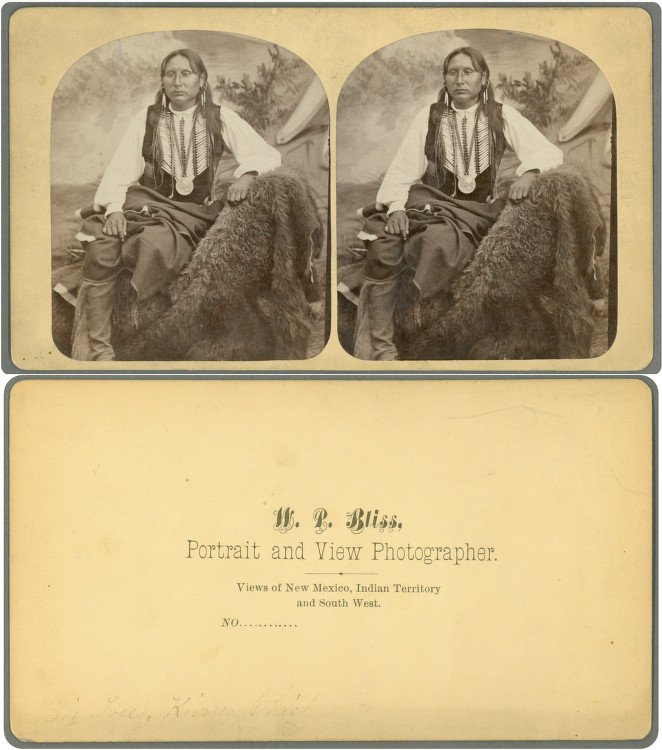
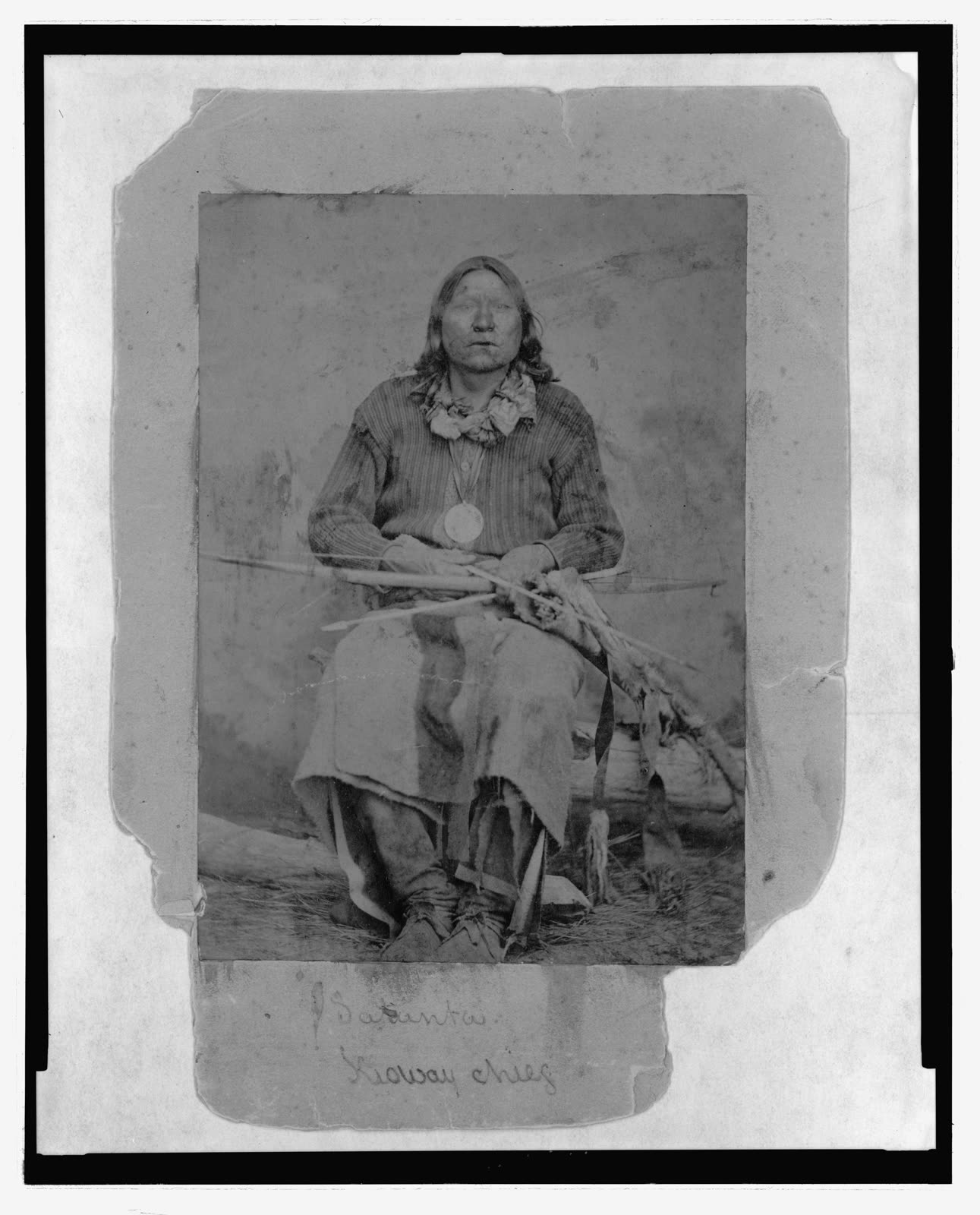
Satanta (White Bear) was the most politically prominent of the three leaders. A senior Kiowa chief known for his oratorical skill — he had spoken at the Medicine Lodge council in 1867 and was sufficiently well known in Anglo-American political culture to have been called “the Orator of the Plains” by contemporary observers — Satanta represented the most confrontational strand of Kiowa resistance to reservation confinement. His openness in acknowledging his role at the Fort Sill council, rather than denying involvement, reflects both his political strategy and his understanding of what the arrests meant.
Big Tree (Adoeette) was the youngest of the three principals. He was Kiowa, not Comanche — a distinction that contemporary Anglo-Texan records sometimes blurred because Kiowa and Comanche warriors operated together on joint raids and Anglo interpreters sometimes applied the same English nickname “Big Tree” to different individuals. The Kiowa tribal identification is confirmed by TSHA’s Handbook of Texas and the Encyclopedia of Oklahoma History. He was regarded as the most physically formidable warrior of the three, described in contemporary accounts as exceptionally gifted in the arts of horse-mounted combat.
Both men were, by birth and culture, warrior leaders whose actions at Salt Creek Prairie were understood — within the Kiowa context — as a military operation in defense of contested territory, not as criminal violence. That is not a framing that softens the seven deaths on Salt Creek Prairie; it is the context that made the trial genuinely contested as a matter of law and sovereignty, not just a routine criminal prosecution.
What Happened at the Trial?
The trial took place at the Jacksboro courthouse, Jack County, with Fort Richardson — the nearest US Army post — as the military backdrop. Judge Charles Soward presided.
The proceedings drew national attention. Federal Indian rights advocates argued that prosecuting Kiowa war leaders in a Texas civil court violated the treaty rights recognized in the Medicine Lodge Treaty (1867), which had promised Kiowa sovereignty over a reservation in Indian Territory. Texas frontier communities — whose inhabitants had lived for three decades under Comanche and Kiowa raid pressure — demanded the maximum penalty for what they viewed as straightforward murder.
The defense raised the sovereignty question: could a Texas civil court try Kiowa leaders for acts that were, from the Kiowa perspective, legitimate defensive warfare by recognized tribal leaders operating within their understood territory? The prosecution maintained that the Warren teamsters were civilian workers on US government contract and that their deaths were murder under Texas law regardless of the defendants’ status.
Both men were convicted of murder. Judge Soward sentenced both to death. The sentences were widely reported across the country.
What Happened After the Verdict?
Texas Governor Edmund Davis — a Republican Reconstruction-era governor who held office from 1870 to 1874 — faced an impossible political position. Texas frontier communities were unanimous in wanting the executions carried out. The federal Indian Bureau warned that executing Kiowa war chiefs under Texas state law would be understood across the southern Plains as an act of war against the Kiowa nation, potentially triggering widespread retaliatory raids. The Quaker peace advocates who had been working to manage the reservation transition as part of President Grant’s “peace policy” urged clemency.
Davis commuted both death sentences to life imprisonment. Satanta and Big Tree were transferred to the Huntsville State Prison in Walker County, Texas.
In 1873, after sustained lobbying by Quaker peace advocates and federal Indian Bureau officials — and over the vigorous objection of Texas frontier communities — Davis agreed to parole both men. They returned to Indian Territory.
The parole proved politically explosive when Kiowa and Comanche raiding resumed in 1874. The Red River War of 1874 — the US Army’s coordinated campaign culminating in Col. Mackenzie’s destruction of the Comanche horse herds at Palo Duro Canyon in September 1874 — ended organized Plains resistance. Satanta was accused of returning to raiding, was re-imprisoned at Huntsville, and died there in 1878 — reportedly leaping from an upper-floor window after learning he would never be released.
Big Tree did not return to Huntsville. His trajectory diverged entirely. He converted to Christianity, affiliated with the Rainy Mountain Baptist Church near Anadarko, Oklahoma, and eventually served as a deacon. He died on November 13, 1929 — a date confirmed by TSHA and the Encyclopedia of Oklahoma History — at Anadarko, Oklahoma, and was buried near Rainy Mountain Cemetery. He was among the last living witnesses to the Warren Wagon Train Raid and the Jacksboro trial.
Why Does the Jacksboro Trial Matter for Montague County History?
The connection runs through both geography and biography.
The geographic connection: Jack County’s courthouse is adjacent to MoCo’s southern frontier zone. The raiding corridor that produced the Warren Wagon Train attack — using the Red River crossings near Spanish Fort, Red River Station, and Illinois Bend in Montague County as its entry points into Texas — is the same corridor system that carried raiders to Young County and beyond. The trial at Jacksboro was in the legal and geographic heart of the region whose settlers had been absorbing Kiowa and Comanche raid pressure for thirty years. MoCo was part of that region.
The biographical connection: The most prominent named figure in Montague County’s frontier-era records is Big Tree. Anglo settler accounts, preserved in Mrs. W.R. Potter’s 1913 History of Montague County, attribute the December 1863 Illinois Bend raid — the most catastrophic single Indigenous military action in the county’s documented history — to Kiowa forces under Big Tree’s leadership. Whether the defendant at Jacksboro was specifically the 1863 raid leader requires Kiowa THPO consultation and cannot be stated as settled fact. What is established is that MoCo settler memory, the raiding corridor, and the available historical record all connect through the same figure tried in 1871.
The legal precedent: The Jacksboro trial established — or attempted to establish — that Texas state civil courts could prosecute Indigenous military leaders for acts committed in warfare. That precedent shaped how Texas and federal authorities approached subsequent frontier violence prosecutions, and it remains a case studied in American legal history for the unresolved tensions it exposed between state criminal jurisdiction, federal treaty obligations, and the laws of war as applied to non-state actors.
What Is the Jacksboro Trial’s Historical Significance Today?
The trial stands as one of the most-studied episodes in the legal history of the American West — a case that placed federal Indian policy, Texas state sovereignty, and the laws of war into direct conflict in a courtroom that was not equipped, legally or institutionally, to resolve those tensions cleanly. The fact that it ended in life sentences commuted from death, followed by parole, followed by one defendant dying in prison and one living another fifty-six years as a Baptist church deacon, suggests that the trial resolved nothing definitively — which may be why it remains so persistently studied.
For Montague County’s historical record, the Jacksboro trial is the capstone of the Kiowa-frontier cluster: the legal endpoint of the same three-decade resistance pattern that had made the county one of the most dangerous places in North America for Anglo settlers from the 1840s through the 1870s. That it happened in Jack County rather than in Montague County is a geographic accident. The forces it set in legal motion belonged to the entire north Texas frontier zone — including the Red River crossings, the raiding corridors, and the scarred community of settlers who had lived through everything that preceded it.
Related Pages
- The Warren Wagon Train Raid (1871) — the raid that precipitated the trial
- The 1863 Illinois Bend Raid — the MoCo raid attributed to Big Tree’s forces
- Reconstruction-Era Violence in Montague County — the broader post-war disorder context in which the trial occurred