Of all the stories that make Montague County unusual in the landscape of rural American history, few are as quietly remarkable as this one: a baseball glove company launched in a small north Texas town in 1926 is still making gloves there today — by hand, with American workers, in the same county that built it.
That company is Nokona, and its story is inseparable from Nocona’s identity as a leather-crafts town, from the Second World War’s demands on American manufacturing, and from the economics of staying put when every competitive pressure argued for leaving.
Nocona’s Leather Ecosystem
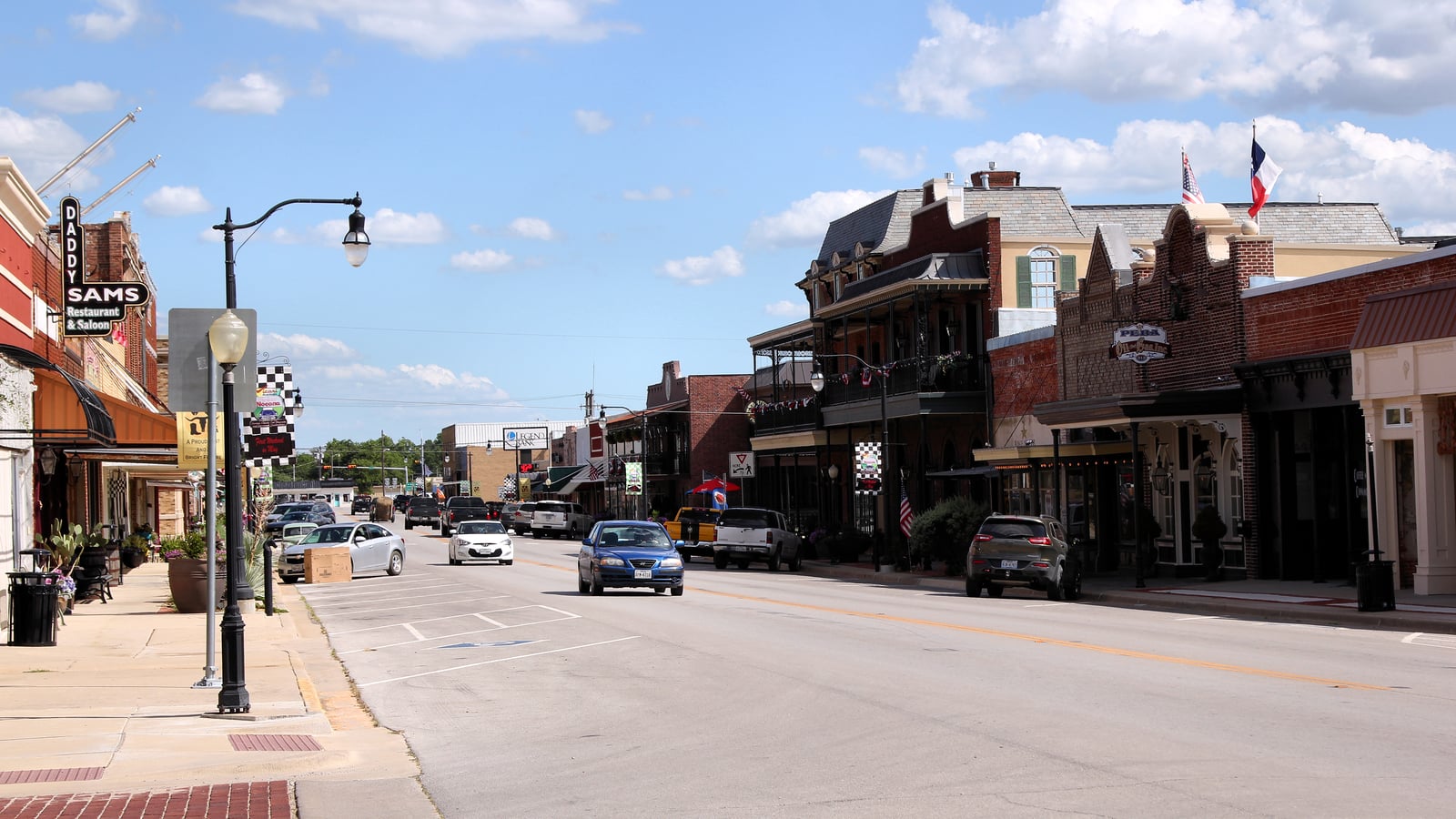
To understand Nokona, you have to understand what Nocona had become by the 1920s. The town was barely forty years old — platted in 1887 along the Gainesville, Henrietta and Western Railway on land donated by rancher D.C. Jordan — but in that span it had developed one of the most concentrated leather-manufacturing ecosystems in the American Southwest.
The catalyst was H.J. “Daddy Joe” Justin, who relocated his Spanish Fort boot shop to Nocona in 1889 when the railroad arrived. By 1915, his operation was selling boots in thirty-six states and five countries. When his sons moved the company to Fort Worth in 1925, his daughter Enid stayed behind and founded the Nocona Boot Company — a deliberate act of local loyalty that preserved the town’s bootmaking identity.
By 1926, Nocona had something rare: skilled leather craftspeople, tannery access, railroad infrastructure, and a commercial culture built around specialty leather goods. It was precisely the environment in which another leather enterprise could take root.
The Founding: From Leather Goods to Baseball Gloves
The enterprise began in 1926 as the Nocona Leather Goods Company, founded by Cadmus “Cad” McCall and T.B. Wilkes. The original products were wallets, purses, and belts — commodity items suited to the existing manufacturing base.
The pivot toward baseball gloves came from Bob Storey, a family member who had played baseball at Rice University and the University of Texas. His insight was simple and craft-logical: a baseball glove is a precision leather article requiring exactly the skills Nocona’s workers already possessed — pattern cutting, hand stitching, shaping to form. The product demanded leather quality that mass manufacturers would struggle to match at low cost, which meant a defensible position for a craftsman producer.
One obstacle produced the brand’s most recognizable feature. When the company sought to trademark “Nocona” for its baseball gloves, the U.S. Patent and Trademark Office declined — federal trademark law did not permit a town’s name as a product mark. The solution was to substitute the “c” for a “k.” “Nokona” was trademarked in 1934. The homophone was obvious to anyone who looked at the return address, which was the point: the brand traded on its place of origin while meeting the legal requirement.
The WWII Contract: From Craft Shop to War Production
The chapter that most directly connects Nokona to Montague County’s broader history came with World War II. In 1942, the company received a U.S. government contract to produce baseball gloves for American servicemen stationed worldwide.
The scale was unlike anything the small Nocona shop had faced before. Before the contract, production ran at approximately 50 to 100 gloves per day — a craft-shop pace. Under the wartime contract, output scaled to 1,000 gloves per day, a tenfold expansion that required significant workforce growth, floor-space reorganization, and supply-chain acceleration.
This is the signature MoCo home-front industrial story of the Second World War: a local leather company converting its operations to serve the military mobilization, demonstrating that the county’s manufacturing base could respond to national need. While Montague County men served in the European and Pacific theaters, Nokona’s workers in Nocona were producing equipment that connected those servicemen to the national pastime.
The broader context belongs to the home-front account — see WWII Service and Home Front in Montague County — but Nokona’s specific contribution stands as the county’s clearest documented case of local manufacturing converted directly to wartime production.
Innovation and Staying American
After the war, Nokona returned to baseball and entered the sport’s great expansion era — Little League growing across suburban America, youth sports markets multiplying, postwar prosperity funding new equipment purchases.
The company’s landmark postwar innovation came in 1957: Nokona introduced the first baseball glove manufactured with kangaroo leather, pioneering the use of kangaroo hide in glove production. The technical case was strong — kangaroo hide is lighter than cowhide at equivalent thickness, has superior tensile strength per unit of weight, and resists moisture absorption. Players recognized the quality immediately.
But the deeper story of the postwar decades was a choice. As Rawlings, Wilson, Spalding, and MacGregor shifted production offshore in the 1970s and 1980s — following economic logic that was genuinely hard to argue with — Nokona stayed in Nocona. The cost was a price premium that constrained mass-market share. The return was a brand identity that no offshore manufacturer could claim: Made in Nocona, Texas, with American workers and craft knowledge accumulated across generations.
Third-Generation Leadership and the 2006 Fire
In 1992, Rob Storey — third-generation of the founding family — assumed leadership of Nokona. The transition formalized what had been an inherited practice into an explicit strategic identity. The company’s marketing began communicating the story behind the glove: the Nocona factory, the American workers, the same Texas town that had been making leather goods since 1889.
On July 18, 2006, the Nokona factory burned to the ground. The fire destroyed the production facility, with losses exceeding $5,000,000. In a company of Nokona’s scale, this was potentially existential.
The response defined the company’s character: Nokona resumed production within ten days. No employee lost wages. The company relocated temporarily to the Old Nocona Boot Factory — Enid Justin’s former facility, vacant since the 1981 acquisition by Justin Industries — before moving to a new location off Clay Street.
That the infrastructure of one Nocona leather enterprise could temporarily sustain another is its own kind of Montague County story: an industrial heritage so woven into a town’s built environment that it can serve as a lifeline in crisis.
What Nokona Means to Montague County
Nokona’s significance to the county operates on several levels simultaneously.
Economic: In a town of three thousand, a manufacturer that stays rather than leaves represents purchasing power circulating in the local economy across decades. Every year Nokona continues production in Nocona is a year the town retains an employer that could, economically, have moved offshore long ago.
Heritage: The Tales ‘N’ Trails Museum in Nocona — opened 2010 after fifteen years of community fundraising — includes exhibits on the leather-manufacturing heritage covering both the boot industry and the glove company. The museum frames Nokona as part of the leather strand of the town’s story.
Baseball: The Nokona brand connects Nocona to the national pastime in a way that extends beyond manufacturing. Charlie Robertson, who grew up in Nocona, pitched one of the seventeen perfect games in major league history on April 30, 1922. That Nokona gloves and Robertson’s perfect game both trace to the same small north Texas town reflects the particular convergence of identity that gives a community a story worth telling.
Identity: Most fundamentally, Nokona functions as a working demonstration of what Nocona — and Montague County — can still make. The leather ecosystem that H.J. Justin built starting in 1889, the railroad infrastructure that made Nocona viable, the skilled workforce that developed across generations of boot and glove making: all of it contributed to creating Nokona, and keeping it going. The company is one of the most complete expressions of what Montague County’s industrial heritage actually means — not just a record of what was made here, but evidence that it is still possible to make something here, with American hands, in the twenty-first century.
Related pages: WWII Service and Home Front · Modern Era Index · Nocona Town Hub
Sources: Nokona Manufacturing Company, “Our Story” (nokona.com); TSHA Handbook of Texas, “Nocona, Texas” and “Nocona Boot Company” (tshaonline.org); NARA RG 241 trademark records confirming Nocona Athletic Goods Company trademark filings 2005–2006 (extracted 2026-05-12). WWII contract production figures await primary-source verification via NARA RG 179.