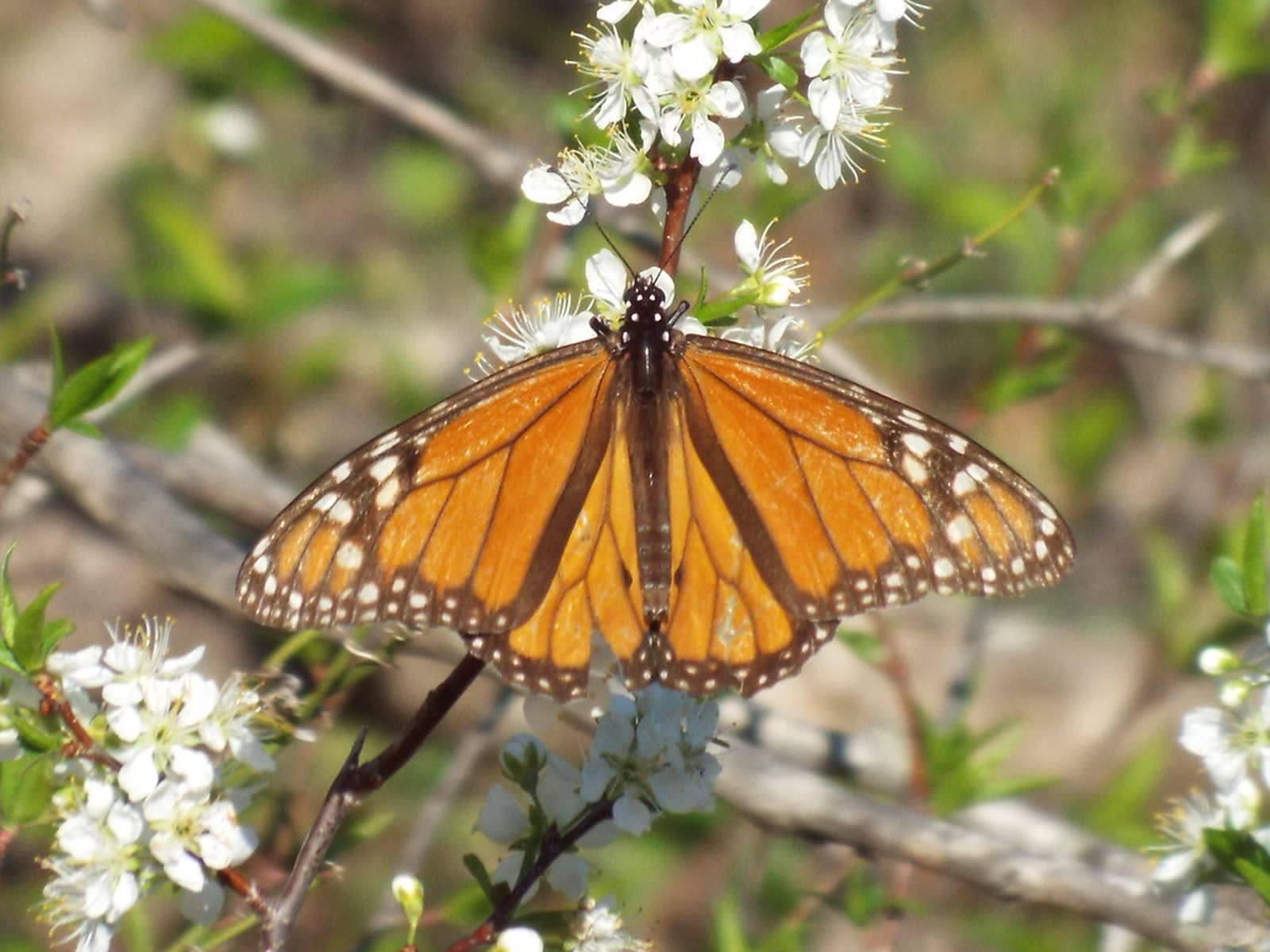
On a clear October day in Montague County, you can watch monarchs nectaring on roadside flowers in ones and twos, and then realize you’re watching one thread of a continent-wide movement that has been repeating for thousands of years. A single butterfly at a Maximilian sunflower head was probably in Michigan three weeks ago and will be in Michoacán, Mexico, in three more weeks. It has never made this trip before. Nothing in its experience tells it where to go. It goes anyway.
The Migration: Four Generations and One Extraordinary Flight
The eastern monarch population breeds across eastern and central North America — from Texas north through the Midwest and into southern Canada — and overwinters in the oyamel fir forests of Mexico’s Sierra Madre Occidental, at elevations above 10,000 feet. The round trip covers up to 3,000 miles. No single individual completes it.
The migration plays out across roughly four generations per year:
Generation 1 (March–April): Overwintering monarchs leave Mexico in early spring and fly north into Texas. They are the “Methuselah generation” that survived winter — old, worn, making their last flight. They lay eggs on emerging milkweed in Texas and the southern states and die. Their offspring emerge in spring.
Generations 2 and 3 (May–August): Each of these generations lives only a few weeks, moving progressively further north, breeding, and dying. By midsummer, monarchs are breeding across the Midwest and into Canada.
Generation 4 (September–November): The “super-generation.” These fall monarchs are physiologically different — instead of reproducing immediately, they enter a state of reproductive diapause, accumulating fat reserves and preparing for a long migration. They fly south thousands of miles to Mexico, overwinter for five months in mountain forests, and then begin the northward flight that will produce next year’s Generation 1. A fall monarch can live eight to nine months — four to five times longer than the summer generations.
It is Generation 4 — the super-generation — that creates the fall migration through Montague County.
The Central Texas Funnel
The monarch’s southward migration narrows as it crosses North America. The broad breeding range in the north funnels through a progressively narrower corridor as birds and insects move toward Mexico. The geography of Texas accelerates this concentration: the Gulf Coast to the east and the Trans-Pecos mountains to the west channel the migration into a central Texas corridor roughly aligned with the I-35 corridor and running west of it.
Montague County sits on the eastern edge of this central funnel — east of the heaviest concentration that moves through the Hill Country, but still within the high-density migration zone. The county’s position along the Red River, at the confluence of Central Flyway migration routes and the central Texas landscape funnel, means that fall migration here is real and consistent.
Peak fall passage through MoCo is typically late September through late October, with the greatest numbers in the first two weeks of October. On a warm, clear October morning with light south winds, monarchs can be abundant — dozens visible at a glance on Maximilian sunflower and fall aster patches along roadsides and fence lines.
Spring Migration and Breeding
Spring monarchs returning from Mexico move through Texas in March and April. They are smaller in number than the fall migrants — the population’s most vulnerable moment, before the three breeding generations rebuild it — and they are actively searching for the first emerging milkweed to lay eggs on.
The first spring monarchs in MoCo typically arrive in late March. Eggs laid in April on MoCo milkweed produce Generation 2 adults that emerge in May and continue north. MoCo’s spring milkweed is not just a waypoint — it is reproductive habitat, and what happens to it directly affects how many monarchs eventually make it to the breeding grounds.
Milkweed in Montague County
Monarch caterpillars feed exclusively on milkweed (Asclepias species). Adults nectar on a wide variety of flowers, but reproduction depends entirely on milkweed availability. The collapse of native milkweed habitat is the central driver of monarch population decline over the past three decades.
Native milkweed species in MoCo include:
Antelope-horn milkweed (Asclepias asperula) — the primary MoCo host plant. Common in Cross Timbers uplands and prairie remnants; distinctive greenish-white flower clusters appearing April through June.
Green milkweed (Asclepias viridis) — prairies and roadsides; broader leaves than antelope-horn.
Butterfly weed (Asclepias tuberosa) — the orange-flowered milkweed of sandy soils; cultivated in gardens as well as occurring wild.
Whorled milkweed (Asclepias verticillata) — narrow, thread-like leaves; common on prairie remnants and disturbed roadsides.
The main threats to MoCo’s milkweed base are agricultural herbicide use (especially glyphosate in row-crop margins where milkweed once persisted), roadside mowing schedules that kill milkweed before it sets seed, and brush-clearing operations that remove native forb communities. These are county-scale, landowner-by-landowner decisions that aggregate to a major habitat outcome.
Population Status and Conservation
The eastern monarch population is tracked by the area of Mexican forest occupied by overwintering colonies. The trend is stark: from roughly 21 hectares at the late-1990s peak to a low of 0.67 hectares in 2013–2014, with a highly variable mid-recovery that has not returned to anything approaching historical levels. The monarch is now listed as Endangered by the IUCN (2022, eastern migratory population). The U.S. Fish and Wildlife Service has been evaluating ESA listing; status updates are ongoing.
Conservation efforts relevant to MoCo include:
TxDOT roadside mowing schedules — the Texas Department of Transportation participates in the multi-state Monarch Joint Venture; modified mowing schedules on Texas highways aim to allow milkweed and nectar plants to bloom and set seed before cutting. MoCo’s portions of US-287, US-81, and major FM roads are subject to these schedules.
Monarch Waystations — registered habitat gardens through the University of Kansas Monarch Watch program; combination of milkweed and nectar plants in any sunny location.
Citizen science — Monarch Watch tagging (capturing and tagging fall migrants to track population movement and recovery), Journey North sighting reports, and iNaturalist observations all feed into the continental monitoring picture. MoCo participation in these programs is undocumented in public records but represents an accessible entry point for county residents.
How to Watch the Migration in MoCo
The fall migration in MoCo does not announce itself. It shows up as a butterfly at a flower, then another, then a dozen. The watching requires attention more than specialized equipment.
A reliable strategy: plant Maximilian sunflower, antelope-horn milkweed, frostweed (Verbesina virginica), fall asters, and lemon mint (Monarda citriodora) in any sunny location. Check flowers from late September through mid-October. Frostweed, which blooms in October, is particularly important as a late-season nectar source during the peak migration window.
On days with light southerly or calm winds, monarchs move actively and nectar at flowers for extended periods. On days with strong north winds, they shelter and wait. The pattern is readable once you know to look for it.
Spring: Late March through April, look for monarchs nectaring on early wildflowers and laying eggs on emerging milkweed. The eggs are tiny, white, and laid singly on milkweed leaves — visible to anyone who checks.
Related pages: Migratory Birds and the Central Flyway · Native Wildflowers of Montague County · Cross Timbers Ecoregion
Sources: USFWS Monarch Butterfly Status and Conservation; Monarch Watch / University of Kansas; Monarch Joint Venture; TPWD Monarch Butterfly Program. Monarch biology and migration are well-documented in these sources. MoCo-specific Monarch Watch tagging records and monarch waystation registry count remain outstanding research questions.