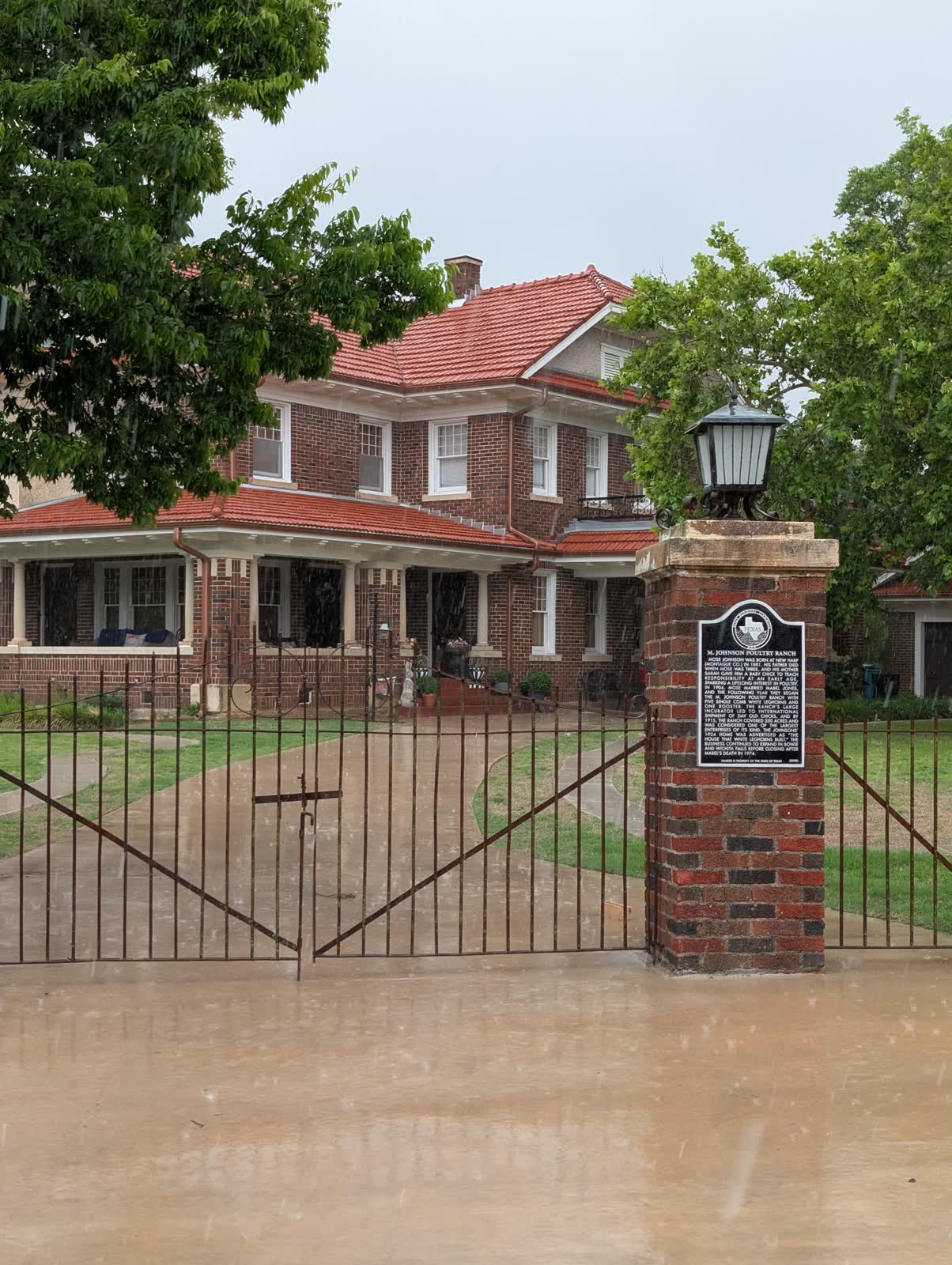
The M. Johnson Poultry Ranch is the enterprise that put Bowie on the map — nationally, and by some contemporaneous accounts internationally. The operation defined South Mills Street for nearly seven decades. Part of the ranch’s footprint is now the North Central Texas College Bowie Campus; the 1924 ranch house — “the house that white leghorns built” — still stands at the Mills / Mayor intersection, where a Texas Historical Commission marker holds the public memory.
What was the M. Johnson Poultry Ranch?
The M. Johnson Poultry Ranch was a 350-acre Bowie hatchery and breeding operation that ran from 1905 to 1974, producing more than one million day-old White Leghorn chicks annually at peak and shipping them by rail and parcel post across the United States and to Mexico, Central and South America, Canada, and China. Booster-era accounts called it the largest poultry farm in the world.
The ranch installed the first Mammoth Incubator in Texas, ran an incubator complex cycling 250,000 eggs every three weeks, held 15,000 pedigreed breeding hens at peak, and drew over 20,000 visitors annually to a complex that promoters branded “the City of the White Leghorns.” It was incorporated in 1957 as M. Johnson Poultry Ranch, Inc. (Texas #0013897200).
Who founded the M. Johnson Poultry Ranch?
Moses “Mose” Johnson and Mabel (Jones) Johnson co-founded the ranch in 1905 with five single-comb White Leghorn hens, one rooster, and a fifteen-dollar stake. Mose was born at New Harp in Montague County in 1881; his father died when he was three, and his mother Sarah gave him a baby chick — the founding image preserved verbatim in the THC marker inscription.
Mose and Mabel married in 1904. The first chicken coop was fashioned from an old piano crate. Mabel ran the enterprise through her own death in 1974, sustaining it across two world wars, the Great Depression, and the consolidation of industrial poultry production — a stewardship that boosters’ founder-narratives have historically underrecognized.
How large did the ranch grow?
By 1915 the operation covered 350 acres and was described as one of the largest enterprises of its kind in the world. Hen houses ran along both sides of the road for approximately one mile. Several brooding houses each held about 5,000 chicks.
Peak figures, as recorded in secondary sources and reproduced here pending primary-archive confirmation: 15,000 pedigreed breeding hens; 50,000 brooder chicks in annual production; an incubator capacity of 250,000 eggs every three weeks; more than one million day-old chicks shipped annually; over 20,000 annual visitors. The Johnsons’ 1924 home was advertised under the tagline “the house that white leghorns built.” The ranch shipped to every state in the Union and to four countries on three continents.
What stands on the ranch site today?
The North Central Texas College Bowie Campus occupies a 19.11-acre parcel — roughly 19 of the ranch’s original 350 acres — at 810 South Mills Street, near the U.S. Highway 287 end of the corridor; the 1924 ranch house still stands at the marker corner, with residential subdivision filling the stretch between them. The campus opened in January 2000 after Bowie voters approved a half-cent sales-tax increase to fund construction. The main building is 16,000 square feet, cost $2.196 million, and was joined in 2018 by an 8,700-square-foot Industrial Technology Center funded through Bowie’s 4B economic development corporation.
The Texas Historical Commission marker (#14790, erected 2008) stands at 511 Mayor Street at the intersection of Mayor and South Mills, coordinates 33°33.113′ N, 97°50.965′ W. The Johnsons’ 1924 home — “the house that white leghorns built” — still stands on the same corner, addressed today as 511 South Mills Street; it is the only confirmed surviving ranch-era structure on the original property. Whether any other original ranch structures survive on adjacent parcels is not confirmed in publicly accessible sources.
Who were the Chicken and Bread Boys?
The “Chicken and Bread Boys” were the circle of Bowie teenagers, including Mose Johnson and the future Fort Worth newspaper magnate Amon G. Carter, who sold chicken-and-bread sandwiches to passengers on the Fort Worth and Denver Railroad at the Bowie depot in the early 1900s. The practice ended in 1908 when a city ordinance banned peddling around the depot.
Named members included Amon Carter, Mose Johnson, John Black, Shorty Ryan, Perry Stallings, John White, and the Turner boys. Carter is credited with structuring the operation: buying chickens at roughly a quarter each, paying a boarding-house operator known as Widow Brodie to fry them, and selling sandwiches to depot passengers. When chicken was unavailable or unprofitable, the boys substituted rabbit. The story is the narrative foundation of Bowie’s annual Chicken and Bread Days Heritage Festival, held on the first Saturday of October on the brick streets of downtown.
What does the historical marker say?
Texas Historical Commission marker #14790 was erected in 2008 at the intersection of Mayor and South Mills Streets, with the official Bowie address of 511 Mayor Street. The marker is the authoritative public record of the ranch’s founding date, scale, founders’ biographies, and closure.
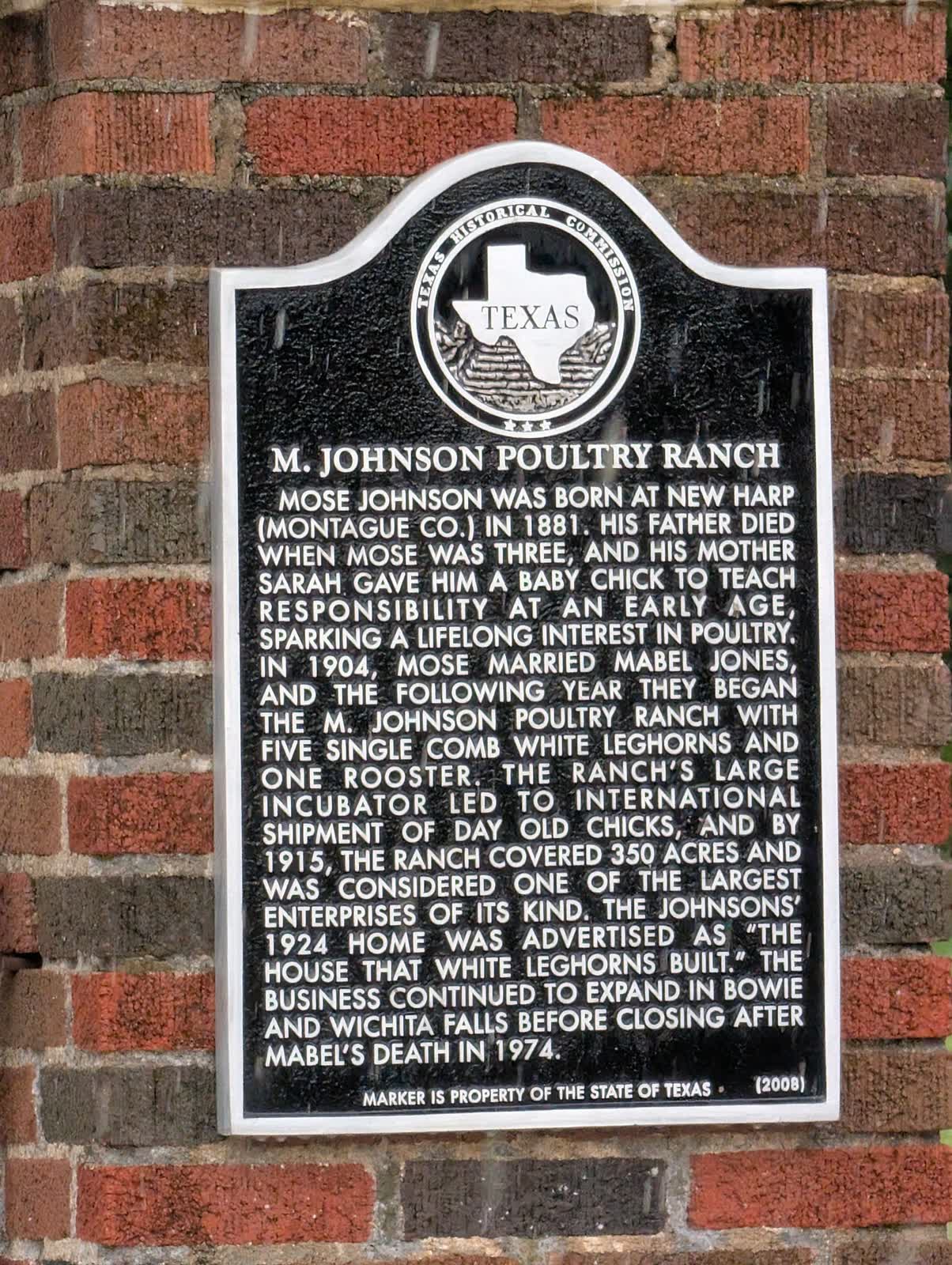
Full inscription:
Mose Johnson was born at New Harp (Montague Co.) in 1881. His father died when Mose was three, and his mother Sarah gave him a baby chick to teach responsibility at an early age, sparking a lifelong interest in poultry. In 1904, Mose married Mabel Jones, and the following year they began the M. Johnson Poultry Ranch with five single comb white leghorns and one rooster. The ranch’s large incubator led to international shipment of day old chicks, and by 1915, the ranch covered 350 acres and was considered one of the largest enterprises of its kind. The Johnsons’ 1924 home was advertised as “the house that white leghorns built.” The business continued to expand in Bowie and Wichita Falls before closing after Mabel’s death in 1974.
The marker is also catalogued at HMdb.org marker #14790 with photographs by Morgan Petermann (August 2024).
Why does it still matter to Bowie?
The M. Johnson Poultry Ranch was the single most economically significant non-commodity agricultural enterprise in Montague County’s history during its 69-year run, and it gave Bowie an international shipping reach unusual for a small Texas county. Its memory survives in four forms: the 1924 ranch house, still standing at the Mills/Mayor corner; the THC marker beside it; the NCTC campus on part of the former ranch land; and the Chicken and Bread Days festival that connects Mose Johnson’s depot years to the Amon Carter legend.
The “Old Chicken” name for the Mills Street corridor is not formally documented in public records but persists in local speech — the kind of place-identity that outlasts the physical plant of an operation that has otherwise largely disappeared.
Worker history — a named research gap
Every public account of the ranch consulted for this entry narrates the operation exclusively through Mose and Mabel Johnson. An enterprise of this scale — one million chicks annually, 250,000-egg incubator cycles, 20,000 visitors per year, a mile of hen houses — required a substantial permanent and seasonal workforce for egg candling, incubator management, chick sexing, packing, rail shipping, and building maintenance.
Whether that workforce included Black workers (Montague County was a confirmed sundown county during the ranch’s operating decades), Hispanic workers, or white day-laborers is absent from the documentary record. This is a named gap requiring oral-history and family-records remediation before the living-memory window for mid-20th-century ranch operations closes.
Related
- Bowie — the town the ranch helped define
- Elmwood Cemetery — likely first-check location for Mose and Mabel Johnson burial records
- Historic Markers of Montague County — the bowie-08 marker entry
Sources
- HMdb.org — M. Johnson Poultry Ranch Historical Marker #14790 (erected 2008 by Texas Historical Commission) — primary source for founding dates, scale, founders’ biographies, and location.
- City of Bowie — Embracing Our History — Mammoth Incubator detail; “Chicken and Bread Boys” period photographs.
- City of Bowie — History of Bowie
- Bowie TX Chamber of Commerce — Bowie History
- City of Bowie — Chicken & Bread Days Heritage Festival
- North Central Texas College — Bowie Campus — campus opened January 2000; 810 S. Mills St.; 16,000 sq ft / $2.196M main building; 8,700 sq ft Industrial Technology Center 2018.
- Montague County Appraisal District — property records confirming the NCTC campus parcel (19.11 acres, Hill survey Abstract 319) and the surviving 1924 ranch house at 511 S. Mills St.
- Red River Station Inn — “The Mose Johnson Room” — most detailed secondary narrative of operational scale and the piano-crate / 1909 storm details (treat operational figures as pending primary-archive corroboration).
- OpenCorporates — M. Johnson Poultry Ranch, Inc. (Texas #0013897200) — incorporated April 4, 1957.
- TSHA Handbook of Texas — Poultry Production — Texas-wide industry context.