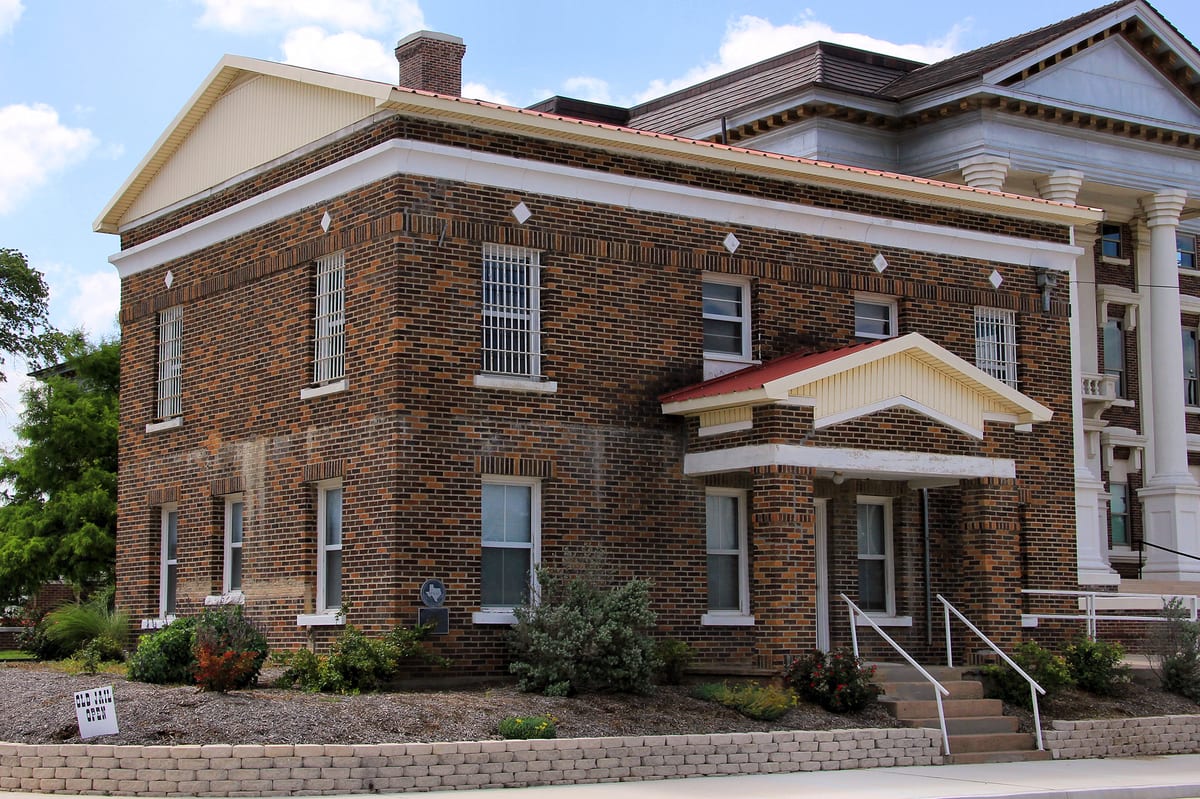
The Old Montague County Jail sits on the southeast corner of the courthouse square in Montague — forty yards from the 1913 Classical Revival courthouse it served for more than half a century. It is a plain brick building by comparison. That plainness is part of what it documents: the courthouse was built to project civic authority; the jail was built to exercise it.
What is the Old Jail Museum?
The Old Montague County Jail Museum is a 1927 brick building that served as Montague County’s official detention facility for 53 years, housing inmates charged with crimes from drunkenness and bootlegging to murder, until a new county jail opened in 1980. The Montague County Historical Commission assumed stewardship in 1996 and has operated it as a museum since.
The building is designated a Recorded Texas Historic Landmark by the Texas Historical Commission (RTHL #5337000033, 1991), recognizing both its architectural integrity as a surviving Texas county jail of the 1920s and its historical significance to Montague County’s law enforcement record.
How was the Old Jail designed?
The Old Jail placed jail cells on the upper floor and the sheriff’s family living quarters on the lower floor — a design that required the county’s chief law enforcement officer to live on-site, adjacent to the inmates he was responsible for. This arrangement was standard for Texas county jails of the 1920s and reflected both practical security concerns and a legal expectation that the sheriff maintained continuous custody of inmates.
The domestic and carceral spaces were separated by one floor, not by distance. The sheriff’s family — spouse, children, household — occupied the ground level while, directly above, inmates charged with murder, arson, theft, bootlegging, forgery, and insanity claims were held in cells. The arrangement produces, in the museum’s current form, an unusual layering: a building that was simultaneously a family home and a jail, interpretable in both registers.
The canning factory that occupied the courthouse basement during the Depression, the county jail cells on the courthouse’s fourth floor until 1927, and the Old Jail itself are three sequential expressions of how Montague County made do with the civic infrastructure it had. The Old Jail was the permanent solution — built to replace the improvised fourth-floor cells in the courthouse.
Who was held here?
Inmates at the Old Jail were charged with crimes that tracked Montague County’s social history across more than 50 years: drunkenness and bootlegging in the Prohibition era, theft and forgery through the Depression, murder cases during the frontier-to-modern-law transition period, and insanity claims throughout. The Montague County Historical Commission records document this range without a comprehensive inmate registry in publicly accessible sources.
The jail’s operating period — 1927 to 1980 — spans Prohibition repeal, the Depression, World War II, and the postwar eras that transformed a rural frontier county into a modern administrative unit. The building held that history in its cells for 53 years.
Who were the sheriffs?
The Montague County Historical Commission’s record of the Old Jail lists the following sheriffs who served during the building’s life: John W. Wales, R. T. Anderson, Lee A. Husband, Herman Chandler, Kate Chandler, Dick Lawrence, Bedford Henley, Helen Henley, J. L. Jameson, J. T. Lindsey, Howard Middleton, and W. F. Conway.
2 of those names require particular note.
Kate Chandler served as Sheriff of Montague County by completing her husband Herman Chandler’s term after his death in office. Helen Henley served as Sheriff by completing her husband Bedford Henley’s term after his death in office. Both women inherited the position under the Texas legal framework that allowed widows to complete their deceased husbands’ unexpired terms — a provision that, in practice, meant 2 women held the county’s chief law enforcement office at different points in the 20th century.
Their service challenges the conventional narrative of Texas frontier law enforcement as exclusively masculine. Administrative and civic continuity in rural counties sometimes transcended gender norms by way of succession provisions that the formal system had established for entirely practical reasons.
Visiting the Old Jail Museum
The Old Jail Museum is operated by the Montague County Historical Commission at the southeast corner of the courthouse square in Montague, Texas. Hours and admission should be confirmed directly with the Montague County Historical Commission (montaguecountyhistory.org).
The museum is located 40 yards from the 1913 Montague County Courthouse, which is itself architecturally significant — described by critics as “one of the state’s strongest examples of Classical Revival” and “one of the most surprising and outstanding examples stylistically found in North Central Texas.” A visit to both buildings in sequence provides the complete picture of Montague County’s civic infrastructure: the public face and the enforcement apparatus, built on the same square.
For the full history of Montague County’s courthouse sequence — 5 buildings from 1858 through the 1913 structure, including the 1884 arson by cattle thieves trying to destroy evidence — see Courthouse History. For the county’s current governmental structure, see County Government Today.
Sources
- Montague County Historical Commission — “The Old Jail” (montaguecountyhistory.org/the-old-jail.html) — primary source for all jail facts: 1927 construction, 53-year service, 1980 new jail, 1996 MCHC stewardship, cells upstairs / sheriff quarters downstairs, crimes listed, sheriff list including Kate Chandler and Helen Henley.
- Montague town hub — courthouse history and the jail’s place in Montague County’s civic infrastructure sequence.