Note: This page is a companion to the 1907 Hargrove Brothers Shooting entry. It covers 3 threads — the street geography of Smoky Row, the Hutchinson Hotel, and Porter Brodie’s aftermath — that extend or predate the main 1907 narrative. Confidence ratings vary by question and are labeled inline.
What was “Smoky Row” and where was it?
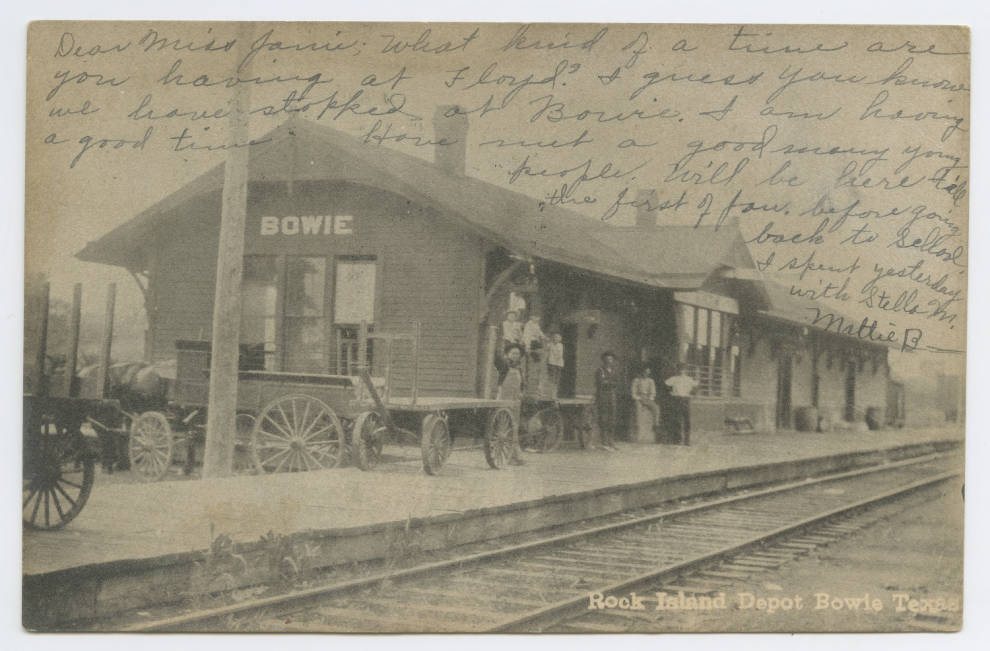
“Smoky Row” was the popular nickname for Smythe Street’s saloon-and-gambling district in downtown Bowie — active from the 1882 railroad arrival through the days following the March 27, 1907 Hargrove brothers shooting, a span of approximately 25 years. The Montague County Times (April 20, 1953) documented both the name and its origin, quoting Bowie pioneer Frank Cecil: “Frequency of shootings back in saloon days induced nicknaming this street ‘Smoky Row,’ a name by which it has been commonly known through the years to the present.”
Confidence: CONFIRMED. The 1953 retrospective is a secondary source — not a 1907 primary document — but it carries local authority as the county newspaper of record, and Frank Cecil is named as the oral-history source.
The 4 confirmed facts from this record:
- The name is “Smoky Row” (one e; “Smokey Row” is a variant spelling).
- The Hargroves saloon was at 205 Smythe Street.
- The origin of the name is gun smoke from frequent shootings — not forge smoke or locomotive smoke.
- The name remained in local use from the saloon era through at least 1953.
The City of Bowie’s official history confirms the active period: “During the period from 1882 until March 27, 1907, the saloons on Smythe Street and the brothels operated continually, but not without various kinds of trouble, including fighting and killing.” The official history also claims all saloons and brothels were expelled “within 48 hours” of the March 27, 1907 shooting. That specific claim has not been independently corroborated in any 1907 newspaper in the available sources.
What remains open: The Sanborn Fire Insurance Map for Bowie, 1908 edition (LOC item sanborn08437_005), would confirm the exact location of the Hargroves saloon, the butcher shop where the March 27 shooting began, and the street layout of the Smoky Row block. The 1908 map images have not been directly examined.
What was the Hutchinson Hotel?
The Hutchinson Hotel was a frame-built hotel on Montague Street in Block 11 of the 1885 Bowie townsite, approximately 185 feet from the Fort Worth and Denver depot — a typical position for railroad-era hotels serving traveling salesmen and passengers. It appears in the February 1885 Sanborn Fire Insurance Map, labeled “HUTCHINSON HOTEL,” and is absent from every subsequent Sanborn edition (1891, 1896, 1902, 1908, 1922).
Confidence: HIGH for location and active period; LOW for proprietor identity and closure reason.
The 1885 Sanborn shows the hotel’s floor plan: kitchen, dining room, hotel office, and a saloon — standard configuration for a Texas railroad-town hotel of the period. The structure was wood frame, approximately 50–60 feet of Montague Street frontage.
By February 1891, the Hutchinson Hotel is gone. The Block 11 area in 1891 shows different commercial uses but no Hutchinson label. Bowie had 3 hotels in 1885, per the City of Bowie’s official history; the Hutchinson was among them. By 1891, one of those 3 was gone — or renamed.
Operating window: Present by February 1885; absent by February 1891. Estimated active period: 1882–1890, approximately 8 years.
Why it disappeared: 3 plausible causes — proprietor change with rename (common in 1880s Texas), fire (the 1885 Sanborn notes “No steam & no hand engine” — very limited firefighting capacity in Bowie), or business failure. The cause is not documented in any accessible source.
The Hutchinson Hotel and the Hargrove era do not overlap. The hotel was gone by 1891; Walker Hargroves’s documented run of violence concentrated in 1905–1908. Approximately 17 years separate the Hutchinson Hotel’s disappearance and the March 27, 1907 shooting. The hotel belongs to the first generation of Bowie’s commercial history; Smoky Row belongs to the second.
A “Hutchison Street” (usually spelled with one n) appears on later Sanborn editions in the residential area southeast of downtown, suggesting the Hutchinson family name persisted geographically — but a direct documentary link between the hotel and a specific individual would require Montague County deed records (1882–1892) and pre-1891 Bowie Blade microfilm at the Bowie Public Library.
Who was Porter Brodie?
Porter Brodie was a Bowie barber who, on September 6, 1907 — six months after the marshals shooting — confronted the outlaw Walker Hargroves on Smythe Street outside the livery stable, pistol-whipped him to his knees, and opened fire on him in a publicly witnessed gunfight. Hargroves was shot in the right arm and in the temple, the bullet “ranging around the skull and emerging back of his head,” but survived. A bystander named Arthur Stoner, age 21, was fatally shot in the back while trying to enter a restaurant to escape the crossfire.
Confidence: HIGH for the September 6, 1907 incident, confirmed by 2 contemporaneous newspaper accounts. UNKNOWN for all events after Brodie’s escort to the train.
Brodie was NOT one of the 2 officers shot on March 27, 1907. The March 27 victims were Constable John Wales (mortally wounded) and City Marshal John Adams (grazed over the eye, survived). Brodie was a private citizen — a tradesman — who acted six months later.
After the September 6 gunfight, Brodie was placed under $500 bond, his weapons were confiscated, and officers escorted him to the train under the watch of 150–200 armed men who did not interfere. Walker Hargroves was also given bond and escorted out. The city’s tolerance for both men was exhausted.
The act is best understood as private justice against an outlaw the formal system had failed to constrain. Hargroves had survived the March 27 shooting without being wounded, had been out on bond for months, and had returned to Bowie for a court date when Brodie confronted him.
Porter Brodie after September 6, 1907: the documentary trail goes cold. No subsequent census record, death certificate, obituary, or Find a Grave entry has been located for Porter Brodie. No manslaughter charge in the September 6 Stoner killing has been found in digitized court records. It is possible he left Bowie permanently; it is possible he died under a name not yet indexed. The trail ends at the station.
Is Brodie Street named for the barber?
A street named “Brodie Street” exists in modern Bowie (zip 76230). No documentary source names Porter Brodie as the namesake, but given the rarity of the Brodie surname in Bowie’s documentary record and the public significance of his 1907 act, the street is plausibly named for the barber who took on Walker Hargroves. Confirmation would require Montague County deed records and Bowie city council minutes from the period the street was platted — a one-session archive visit would likely resolve it.
What the archive still needs
3 priority research tasks that would close these questions:
- Sanborn Fire Insurance Maps, Bowie, 1908 edition (LOC item sanborn08437_005) — visual inspection would confirm: the exact location of the Hargroves saloon at 205 Smythe, the layout of the Smoky Row block, and the site of Porter Brodie’s barbershop.
- Montague County Deed Records, 1882–1892 — would identify the Hutchinson Hotel proprietor, their family, and the disposition of the property between 1885 and 1891.
- Montague County District Court criminal docket, September 1907 — would confirm whether Brodie was charged with the manslaughter of Arthur Stoner, and if so, what the verdict was.
Sources
- Montague County Times, April 20, 1953, p. 6 (metapth644866) — Smoky Row name and origin; Frank Cecil testimony; 205 Smythe address.
- Fort Worth Record and Register, September 7, 1907, p. 4 (metapth1498874) — Porter Brodie gunfight; Arthur Stoner killed; Hargroves’s wounds.
- Goldthwaite Eagle, September 14, 1907, p. 4 (metapth1098781) — corroboration of September 6 gunfight.
- Sanborn Fire Insurance Map, Bowie, February 1885 (LOC item sanborn08437_001) — Hutchinson Hotel labeled, Block 11, Montague Street.
- Library of Congress Sanborn Map Index (1885–1932 Bowie editions): items sanborn08437_001 through sanborn08437_006.
- City of Bowie — Our History: cityofbowietx.com/207/Our-History — active period of Smoky Row; “within 48 hours” expulsion claim.
folklore/bowie-three-questions-dossier.md— full research file with all source citations.
For the full account of the March 27, 1907 shooting itself, see the 1907 Hargrove Brothers Shooting. For the “Sarah” ghost legend on adjacent N. Mason Street, see The “Sarah” Ghost of Bowie.