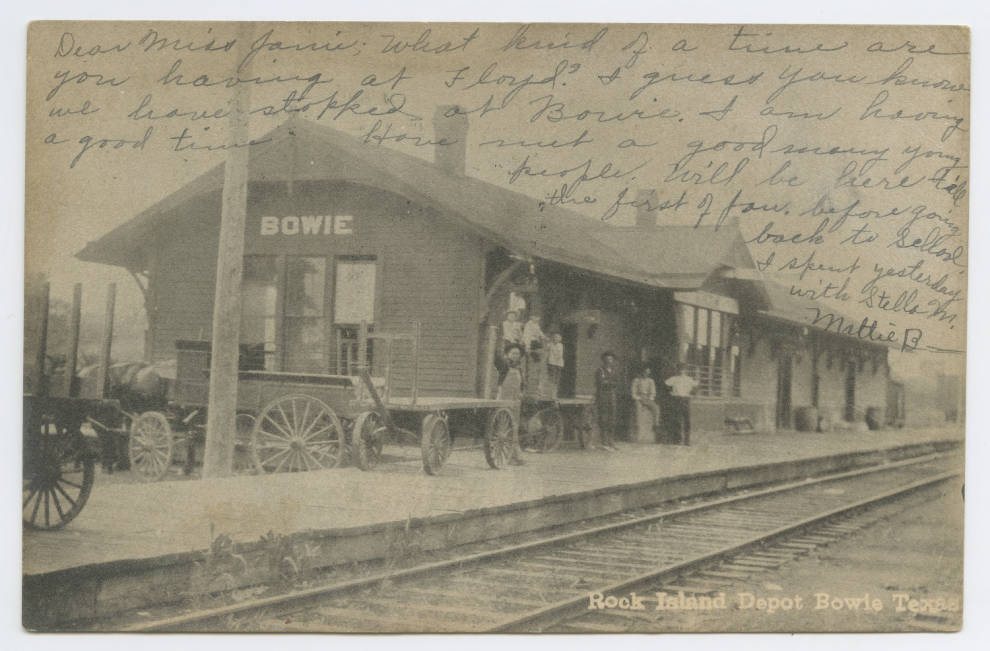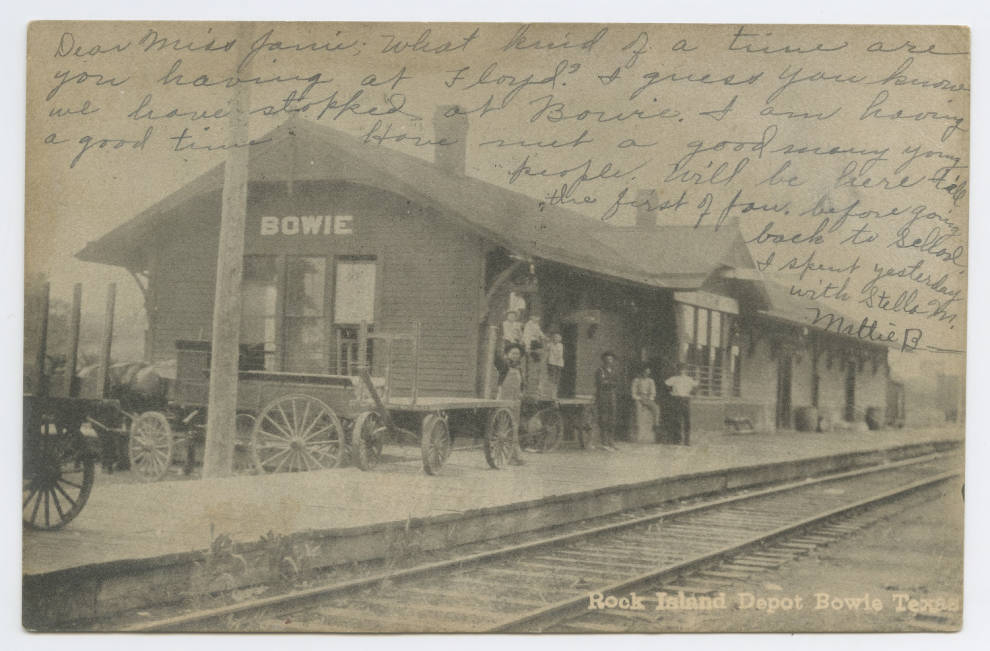
Sourcing note: The shooting of March 27, 1907 is confirmed from multiple contemporaneous primary newspaper sources. The critical factual question — who fired first — is answered differently by the City of Bowie’s official history and by the Fort Worth Record and Register’s corrected overnight dispatch. Both accounts are presented with their sourcing labeled. Court records from the subsequent criminal case have not been located in any digitized archive.
Confidence tier: High for the incident facts; contested for the official narrative’s framing
What happened on Smythe Street on March 27, 1907?
On the night of March 27, 1907, Walker and Robert (“Bob”) Hargroves exchanged gunfire with Constable John Wales and City Marshal John Adams on Smythe Street in front of a butcher shop — or barber shop, sources differ — leaving Wales mortally wounded, Adams grazed, and 2 bystanders lightly wounded. Neither Hargrove brother was hit in the exchange of 12 to 15 shots.
Bowie was in carnival season. The time was approximately 8 p.m. (Fort Worth Record and Register) or 7:15 p.m. (Waxahachie Daily Light). Robert Hargroves, described as a Fort Worth visitor about 25 years old, was accompanying his brother Walker on Smythe Street.
Who fired first?
This is the central contested question of the 1907 incident.
The primary newspaper account (Fort Worth Record and Register, March 28, 1907, corrected 1 a.m. dispatch):
“Now it appears that Walker and Bob Hargroves walked past the two officers who were seated in front of the butcher shop on Smyth street and as soon as they had passed the officers wheeled and began firing on them.”
The FWRR explicitly noted this was a correction: “It seems that the earlier reports of tonight’s tragedy varied a little from the facts in the case.” The newspaper corrected its initial account by the second edition. The corrected account attributes the first shots to the officers, not the brothers.
The official civic account (City of Bowie, cityofbowietx.com/207/Our-History):
“Shot down without warning two of Bowie’s marshals.”
This phrasing inverts the agency of the first shot and describes the officers as victims of an unprovoked attack — consistent with a moral narrative in which the Hargroves are unambiguous villains. It is not consistent with the FWRR’s corrected dispatch.
Summary of the contradiction:
| Element | City of Bowie official history | Fort Worth Record (corrected dispatch) |
|---|---|---|
| Who fired first | The Hargroves | The officers, after the brothers passed |
| Officers described | ”Two of Bowie’s marshals” | Constable John Wales and City Marshal John Adams |
| Narrative frame | Unprovoked attack by bad men | Contested, longstanding feud; officers fired first |
The FWRR is the contemporaneous authority. The City of Bowie’s account is a civic retelling compiled at an unspecified later date.
Who was Constable John Wales?
Constable John Wales was the Bowie peace officer mortally wounded on March 27, 1907. He was shot through the chest (per the FWRR) or in the right hand with a second wound to the shoulder (per the Waxahachie Daily Light). At 1 a.m. on March 28, Wales was resting easily but death was considered imminent. Wales is presumed to have died from his wounds, though no digitized obituary, death certificate, or coroner’s inquest has been located.
City Marshal John Adams was struck by “a glancing blow over the eye with a bullet” (FWRR) or “a bullet over the left eye, which glanced off, leaving only a flesh wound” (Waxahachie Daily Light). Adams survived.
2 bystanders received light wounds: a cattleman named Simpson from Newport (shot in the arm) and Dick Lund (a glancing bullet to the face). Both were characterized as non-serious.
Who were the Hargrove brothers?
Walker Hargroves was 38 years old at the time of his death in 1908 and had a documented criminal history in Bowie extending back to at least 1905: seven cases listed in the Bowie Blade’s September 15, 1905 county court docket, including liquor law violations, carrying a pistol, assault, and running a “blind tiger.” At least 2 additional cases from Montague County were already before the Texas Court of Criminal Appeals as of February 14, 1907 — six weeks before the March 27 shooting.
Walker owned a whiskey saloon and gambling hall at 205 Smythe Street, the documented epicenter of the block locals called “Smoky Row.” On November 7, 1906 — four months before the shooting — an unknown assailant fired 2 loads of buckshot at Walker in front of his cold-storage establishment on Smythe Street; he was hit in both arms. He refused to name the shooter.
A few days before the March 27 shooting, City Marshal Adams had been at Hargroves’s place. The FWRR reported: “The lie was passed and Adams knocked Hargroves down and there came near being a tragedy then. That is believed to have led up to the tragedy tonight.” The March 27 shooting was not an isolated event — it was the climax of a longstanding feud.
Robert (“Bob”) Hargroves was Walker’s younger brother, described as a Fort Worth visitor approximately 25 years old at the time of the shooting.
Walker’s mother was in his home at the time of the overnight standoff, “lying at the point of death from cancer.” [FWRR, March 28, 1907]
What happened overnight?
After the shooting, Walker Hargroves passed through the carnival tent and barricaded himself at his home, accompanied by several friends. Several hundred armed Bowie citizens surrounded the house. The FWRR reported “a large posse of citizens” and “free talk of violence.”
Walker telephoned the Fort Worth police at 2 a.m. and spoke with Sergeant John Connelley, asking for a squad of officers to be sent. Connelley told him it “could only be done at the request of the Bowie officers.” Walker then telephoned Tarrant County Sheriff Tom Wood at his residence, offering to pay for a special train if Wood would come receive the brothers’ surrender. Wood refused, saying it was “a matter to be settled by the officers there.”
At 2:30 a.m., Sheriff U. F. Watson and Mayor Bedeker negotiated the surrender. The brothers were guaranteed protection. A special posse of 16 men escorted them to Montague County jail. The journey went without mob interference.
What ended Smoky Row?
“Smoky Row” was the popular nickname for Smythe Street’s vice district — the saloon-and-gambling corridor that operated from Bowie’s 1882 railroad founding through the days following the March 27, 1907 shooting. The Montague County Times (April 20, 1953) documented the name and its origin, quoting Bowie pioneer Frank Cecil: “Frequency of shootings back in saloon days induced nicknaming this street ‘Smoky Row.’”
The Hargroves saloon at 205 Smythe Street was the documented epicenter. Frank Cecil “can’t recall Hargroves having killed anyone inside the saloon but does recall the shooting of several men, some of them fatally, by Hargroves within close range of the saloon.” The violence was not one incident — it was a 25-year pattern.
The City of Bowie’s official history states that all saloons and brothels on Smythe Street were expelled “within 48 hours” of the March 27, 1907 shooting. This claim is from a single official source; it has not been independently corroborated in any 1907 newspaper found in the available sources.
The vice district ended. The violence on Smythe Street did not.
What happened after the shooting?
The March 27, 1907 shooting did not end the violence connected to Walker Hargroves and Smythe Street. On September 6, 1907 — six months after the marshals shooting and with Walker out on bond for a court date — Bowie barber Porter Brodie intercepted Walker on Smythe Street outside the livery stable. Brodie pistol-whipped Hargroves to his knees and opened fire.
Walker was shot in the right arm and in the temple — the bullet “ranging around the skull and emerging back of his head” — but survived. A bystander named Arthur Stoner, age 21, was fatally shot in the back while trying to enter a restaurant to escape the crossfire. Brodie was placed under $500 bond, his weapons were confiscated, and officers escorted him to the train as a 150–200-man armed mob watched without interfering.
Brodie’s act is best understood as private justice against an outlaw the formal system had failed to constrain. Whether Brodie acted alone or expressed broader community sentiment is not documented. His subsequent biography is unknown — the documentary trail ends at the Bowie train station on September 6, 1907.
Walker Hargroves was killed approximately May 20, 1908 in Fort Worth, at the Board of Trade saloon at Main and Third Streets, by bartender Walter James. The dispute was over broken glasses. James shot Hargroves 3 times; the fatal bullet entered his forehead just above the left eye. Death was instantaneous. Walker was 38 years old, survived by a widow and 2 infant children, with an estate valued at $50,000.
What does the court record show?
The criminal case from the March 27, 1907 shooting produced no digitized court record. Eight distinct digital sources were systematically queried — the Montague County District Clerk’s online portal, TSLAC finding aids, the Texas Court of Criminal Appeals, Google Scholar, Casetext, FamilySearch, the Southwestern Reporter, and the Handbook of Texas — and no case record was found.
The Wichita Daily Times (October 5, 1907) confirms that a pistol-toting case against Walker Hargroves was continued at the October 1907 Montague County District Court term, suggesting ongoing prosecution. The disposition of the March 27 shooting case is unknown without physical archive access.
Physical archives required for the full legal record:
- Montague County District Court records, 1907–1912 (criminal docket books, minutes, indictments) — Montague County District Clerk’s Office, 101 E. Franklin Street, Montague, TX 76251
- TSLAC Reel 1255967 (District Court Minutes, 1898–1910) — may hold relevant record
- Southwestern Reporter, vols. 100–130 (Sw.) — would capture any appeal to the Texas Court of Criminal Appeals
Sources
- Fort Worth Record and Register, March 28, 1907, p. 1 (metapth1501076) — breaking dispatch; corrected “officers wheeled and fired” account.
- Fort Worth Record and Register, March 29, 1907, p. 4 (metapth1501080) — Walker’s telephone calls to Fort Worth police and Tarrant County sheriff.
- Waxahachie Daily Light, March 28, 1907, p. 1 (metapth1071338) — 7:15 p.m. time; “barber shop” variant; Robert described as Fort Worth visitor.
- Fort Worth Record and Register, September 7, 1907, p. 4 (metapth1498874) — Porter Brodie gunfight; Arthur Stoner killed.
- Goldthwaite Eagle, September 14, 1907, p. 4 (metapth1098781) — corroboration of September 6 gunfight; brother Tom mentioned.
- Waxahachie Daily Light, November 8, 1906, p. 1 (metapth1071918) — buckshot ambush at cold storage.
- Bowie Blade, September 15, 1905, p. 3 (metapth646021) — 7 prior cases against Walker Hargroves.
- Austin Statesman, February 14, 1907, p. 1 (metapth1434757) — Walker’s cases before Texas Court of Criminal Appeals.
- Montague County Times, April 20, 1953, p. 6 (metapth644866) — Smoky Row retrospective; 205 Smythe address; Frank Cecil testimony.
- Wise County Messenger, May 22, 1908, p. 4 (metapth1581479) — Walker Hargroves death; estate $50,000; widow and 2 children.
- City of Bowie, Our History — cityofbowietx.com/207/Our-History — official account (“shot down without warning”).
- TSHA Handbook of Texas Online — “Bowie, TX” (David Minor) — railroad founding 1882; population context.
For the Hutchinson Hotel, Smoky Row street geography, and the Porter Brodie aftermath in full detail, see Bowie Three Historical Questions. For the adjacent downtown ghost legend with a different evidentiary profile, see The “Sarah” Ghost of Bowie.